
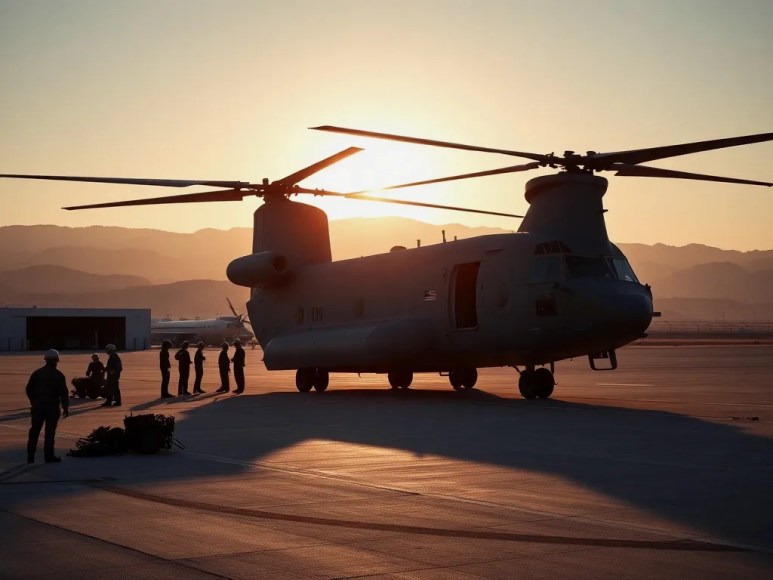
The United States continues to strengthen its special operations aviation capacity by expanding orders for the MH-47G Chinook. Boeing received a $197.3 million contract modification to supply additional MH-47G helicopters to US Special Operations Command (USSOCOM). The Department of Defense posted the award on 24 November 2026, setting the contract’s total value at $197,279,932. The announcement did not disclose how many airframes will be supplied or whether they will come as new production aircraft or remanufactured airframes.
How this procurement is funded and scheduled
Funding for the contract comes from the fiscal 2027 defense budget and US Army aircraft procurement accounts, with the full contract amount obligated at the time of award. Boeing will perform production and modification work at its Ridley Park, Pennsylvania facilities. Program officials expect all contract tasks to be completed by September 2031, allowing a multi-year integration window for aircraft deliveries, test flights, avionics upgrades and crew qualification.
What the MH-47G Block II modernization includes
The MH-47G is the special-operations version of the CH-47 Chinook: a heavy-lift, twin-rotor helicopter used for long-range personnel movement, medevac, and logistics support. Boeing’s Block II modernization program focuses on:
Key upgrades included in Block II:
• Modernized avionics suite: Integrated digital flight controls, improved sensors, and navigation systems that expand all-weather, night and contested-environment capability.
• Structural and mission systems refurbishment: Airframe life-extension work, corrosion control, and updated cargo-handling systems to maintain operational tempo in austere environments.
• Communications and defensive systems: Hardened datalinks, secure voice and data comms and countermeasures integration to improve survivability against pulse and infrared threats.
Boeing is conducting remanufacture work that returns legacy MH-47Gs to a near-new baseline while also inserting Block II capabilities into new-build helicopters where requested. This mixed approach shortens lead times and reduces lifecycle cost versus full new-production fleets.
Program scale, recent contract history, and fleet posture
In March 2025 Boeing announced a $240 million contract to remanufacture five MH-47G helicopters, bringing the total number of MH-47G Block II aircraft under contract to 51 at that time. Earlier in 2026, USSOCOM added approximately $19.4 million in supplemental funding for the same program. The newly announced $197.3 million modification continues that multi-year investment trend and further enlarges the SOCOM Chinook inventory—both in quantity and capability—through a combination of new-builds and remanufactures across multiple award actions.
Why SOCOM relies on MH-47G Chinooks
SOCOM requires heavy, long-range rotary platforms to move operators, equipment and to support austere forward bases. The MH-47G’s twin-rotor architecture delivers high payload and long-range fuel efficiency compared with single-rotor heavy-lift helicopters, while its specialized mission systems allow low-level, night and denied-area operations. Examples of mission sets where the MH-47G adds unique value include:
• Long-range infiltration/exfiltration: Flights beyond unrefueled range of standard assault helicopters, often using aerial refueling or auxiliary tanks.
• Large-scale logistics pushes: Delivering bulk supplies and rotary-wing re-supply to remote forward operating bases in a single sortie.
• Mass casualty evacuation: Rapid consolidation and movement of large numbers of casualties from dispersed locations under contested conditions.
How the procurement affects readiness and industrial base
Allocating the full amount at contract award preserves program momentum and stabilizes Boeing’s production and Remanufacture timelines at Ridley Park. That funding certainty supports supplier retention, workforce planning and the specialized tooling needed for Block II upgrades. Completing the work through 2031 staggers deliveries so units can integrate upgrades, conduct aircrew training, and adapt tactics without an abrupt fleet-wide transition.
Numbers and timeline: what to watch next
Key near-term indicators to monitor for analysts and procurement observers:
• Delivery rate announcements: Watch for milestone releases that specify how many airframes will be delivered each year toward the September 2031 completion date.
• Mix of new-build etc. remanufacture: Explicit counts will clarify whether the program is accelerating capability through remanufacture or expanding fleet size with new production aircraft.
• Integrated capabilities demonstrations: Early Block II flight tests and instrumented demonstrations will show how avionics, defensive systems and communications perform in representative mission profiles.
Context: recent USDOD contracting adjustments
The Department of Defense previously published an initial contract value for late-2025 MH-47G work near $877 million but subsequently adjusted the figure downward to $271 million for a specific award tranche. Contract announcements from both the DoD and Boeing have indicated that, across multiple actions and fiscal years, a total of 56 MH-47G helicopters had been placed under contract through mid-2026. The $197.3 million modification announced in November 2026 adds to that ongoing multi-year procurement and modernization campaign for SOCOM’s heavy-lift rotary capability.
Bottom line for operators and planners
USSOCOM’s continuing investments in the MH-47G Block II program balance faster fielding through remanufacture with the long-term benefits of new-production aircraft. The contract stabilizes the industrial base, phases capability insertion to minimize operational disruption, and sustains SOCOM’s ability to conduct long-range, high-payload special operations missions through the end of the decade.
Be the first to comment