
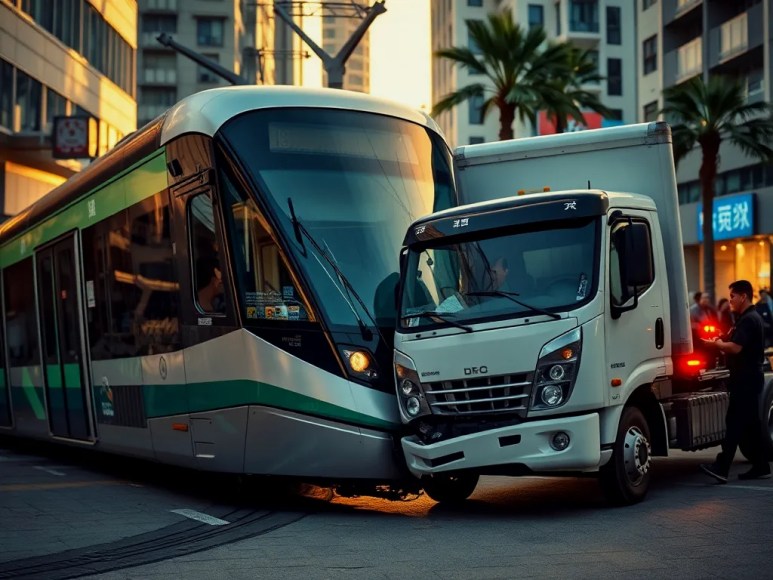
Three Light Rail Routes Suspended After Collision Near Melody Garden
The collision occurred at about 10:30 on 26 November 2026 at the intersection of Lung Mun Road and Wu Chui Road near Melody Garden. An unloaded MTR Light Rail vehicle turning left toward Tuen Mun Ferry Pier struck a truck that entered the junction. MTR suspended services at Melody Garden and rerouted the 610, 615 and 615P lines while emergency teams secured the scene. Police opened an investigation to determine the cause; no injuries were reported.
How the Operator Restored Service and Helped Passengers
MTR reacted immediately to keep passengers moving and reduce disruption. The operator implemented a phased recovery plan: assess track and vehicle safety, reopen safe track segments, and progressively restore full timetables. While diagnostics and clearance proceeded, MTR ran free shuttle buses between Tuen Mun Ferry Pier and intermediate stations Sam Shing, Butterfly, and Siu Hei. Traffic lanes at the junction were temporarily closed to allow rescue vehicles and investigators access. By 11:03 services were returning to normal on a staged timetable.
Why Light Rail–Road Junctions Create Elevated Risk
Hong Kong’s Light Rail shares road space at signalised junctions, which introduces multiple conflict points where road vehicles and rail vehicles cross paths. These crossing points rely on clear traffic signals, driver compliance, and robust signaling coordination. Historical official records show collisions involving Light Rail vehicles numbered 20 in 2012, 27 in 2013 and 29 in 2014 — illustrating that risk persists when any link in the chain fails: a misinterpreted signal, delayed braking, or unexpected vehicle movement can trigger impact. The current incident remains under investigation; Investigators typically review CCTV, signal logs and witness statements to determine sequence and cause.
Daily Demand and Network Context for Hong Kong Light Rail
The Light Rail network opened in 1988 and serves the New Territories’ northwestern towns. It spans about 36.2 kilometers and serves 68 stops. According to 2024 statistics, the network handles more than 420,000 passenger journeys per day on average, connecting to the MTR Tuen Ma Line at Yuen Long, Tin Shui Wai, Siu Hong and Tuen Mun. Because the system carries high daily demand and operates on mixed-traffic alignments, even brief disruptions cascade into congestion across feeder bus routes and local roads, which explains the rapid deployment of shuttle buses following the collision.
Immediate Investigation Steps Police and MTR Usually Take
Police and MTR investigators follow a standard sequence to assess such collisions. Typical steps include:
1. Scene preservation and initial evidence collection — cordon the site, photograph vehicle positions, collect CCTV and on-board recorder data.
2. Technical inspection — check light rail vehicle condition, track integrity, and signal equipment operation logs.
3. Witness interviews — take statements from train crew, vehicle driver, station staff and passengers.
4. Reconstruction and timeline analysis — combine telemetry, CCTV and witness accounts to reconstruct vehicle paths and signal states.
5. Report and recommendations — identify causal factors and recommend mitigations, which can include engineering changes, signal retiming, and targeted enforcement or education.
What Passengers Experienced and Practical Advice for Riders
Passengers faced short-term crowding and had to transfer to shuttle buses. MTR’s staged recovery limited delays to roughly 30 minutes for many travelers, but some experienced longer waits depending on their origin and destination. For commuters in similar scenarios, practical steps reduce stress and travel time:
• Check live service updates on the MTR website or apps before departing.
• Use alternative corridors such as nearby MTR stations on the Tuen Ma Line where possible.
• Allow buffer time for journeys through mixed-traffic sections during peak hours.
• Prepare for last-mile changes — carry an Octopus card or contactless payment to board shuttle buses quickly.
How Service Compensation Works After Long Disruptions
MTR’s service performance framework requires monetary allowances for severe delays caused by factors within the company’s control that last 31 minutes or longer. When the threshold is met, MTR funds compensation measures such as special discount days offering 50% off fares to affected passengers. Authorities will determine whether it applies compensation to this collision once the final service-impact duration and cause have been confirmed.
Potential System-Level Responses to Reduce Future Junction Collisions
Mitigations that authorities and operators typically consider include signal optimization, physical segregation, and targeted enforcement. Examples and their impacts:
• Signal interlocking improvements — better coordination between road and rail signals reduces conflicting movements and can prevent left-turn conflicts like the Tuen Mun collision.
• Dedicated turn restrictions and clearer lane markings — reduce driver confusion at complex junctions.
• CCTV and automatic violation detection — record and deter red-light breaches by road vehicles.
• Engineering works — where volumes and collision frequency justify it, eliminate grade separation or protected track alignments mixed-traffic conflict.
Key Takeaways and Expected Next Steps
Authorities confirmed no injuries and began standard investigative procedures. MTR restored services within about 30 minutes through staged reopenings and shuttle buses, reflecting the operator’s contingency protocols. Officials will examine signal logs, CCTV and witness statements; any recommended changes could range from procedural reminders and enforcement action to infrastructure upgrades if systemic risk is identified. Riders should monitor official MTR and police updates for the investigation’s outcome and any announced safety measures.