
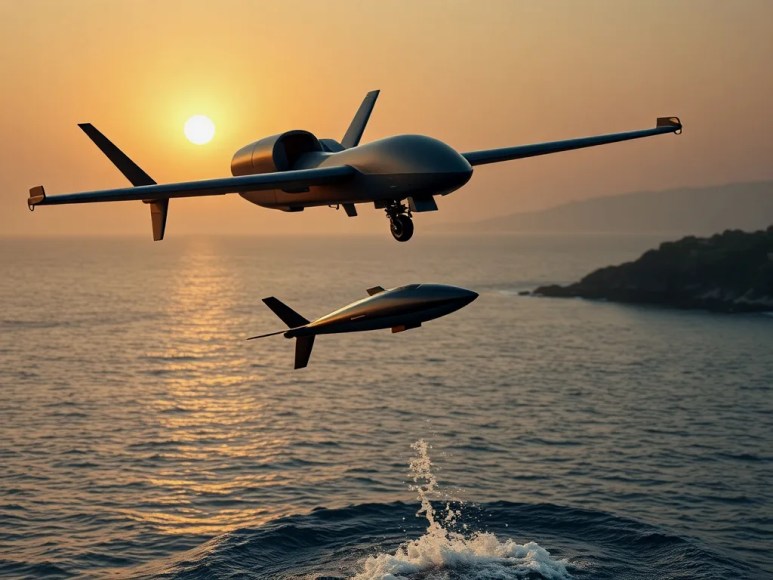
Turkey completed a landmark weapons integration test when ROKETSAN’s ORKA lightweight torpedo was released from Baykar’s Bayraktar AKINCI combat unmanned aerial vehicle (UAV). The trial demonstrated a new method of delivering anti-submarine ordnance from an aerial platform, expanding operational options for maritime strike and anti-submarine warfare (ASW).
Test overview and objectives
The live event validated release mechanics, timing sequence, and initial flight/delivery behavior when an ORKA torpedo is deployed from an AKINCI. Engineers monitored separation dynamics, free-fall behavior, and the torpedo’s water-entry phase to ensure the air-drop did not impair onboard guidance and propulsion. The test aimed to: 1) confirm safe carriage and release from the AKINCI payload bay/launcher interface; 2) verify impact and splashdown parameters within design tolerances; and 3) observe initial acoustic/sonar seeker performance after water entry. Telemetry, high-speed video, and recovery sensors provided the data set used to evaluate success criteria.
How ORKA is designed for multi-platform deployment
ORKA’s architecture incorporates modular interfaces and environmental hardening so a single munition can operate from ships, helicopters, and now fixed-wing UAVs. Key design elements enabling air delivery include reinforced casing for high-speed impact loads, a soft-entry sequenced nose section to preserve seeker calibration, and automated mode selection that switches the torpedo from carriage-safe to active-search upon water entry. Practical benefits: operators gain flexibility in force posture, logistics simplification through a common lightweight torpedo family, and increased reach when UAVs operate at standoff distances beyond ship-launched weapon ranges.
Technical capabilities and seeker guidance
ORKA integrates active and passive sonar seekers with onboard signal processing to discriminate targets in littoral and open-ocean environments. Typical performance characteristics reported by the manufacturer include an acoustic seeker optimized for small to medium submarine hulls, adaptive signal processing to reject reverberation in shallow water, and a homing routine that transitions from initial search to terminal intercept. In practical terms this means the torpedo can autonomously locate, track, and engage targets after aerial deployment with minimal operator intervention. Examples of seeker advantages: reduced false-alarm rates in cluttered seabeds, improved tracking stability against quiet diesel-electric submarines, and configurable engagement envelopes to prioritize high-value or maneuvering contacts.
Operational concepts enabled by UAV-launched torpedoes
Introducing torpedoes to UAVs reshapes ASW tactics. Commanders can now place sensor-and-strike packages where manned assets may be constrained by risk or access. Example mission flows:
1. Forward sensor-deliver-strike: An AKINCI carrying ISR sensors detects a suspected submarine signature, descends to a safe launch window, releases ORKA, and the torpedo engages autonomously while the UAV maintains overwatch.
2. Distributed ASW network: Multiple UAVs disperse to create rapid-response nodes; when one confirms a track, the nearest UAV releases a torpedo, shrinking time-to-engage and complicating enemy evasion.
3. Surge and attrition mitigation: In high-intensity scenarios, UAV-launched torpedoes supplement surface and air ASW assets to maintain coverage when vessels or manned aircraft are scarce.
Test data, safety measures, and validation steps
Successful validation follows a step-by-step acceptance path. During the AKINCI-ORKA integration test teams executed:
Step 1 — Ground compatibility checks: structural, electrical, and software interface acceptance to ensure proper mounting and arming safeties.
Step 2 — Captive-carry flights: flight envelope clearance with inert payloads and full telemetry to measure aerodynamic loads and center-of-gravity effects.
Step 3 — Controlled release trials: low-risk drops over instrumented ranges to record release kinematics and splashdown dispersion.
Step 4 — Live-water engagement tests: final demonstration launches with a fully configured torpedo, tracking the weapon through water entry and the seeker’s initial acquisition sequence.
Duration, redundancy in telemetry and a defined abort envelope ensured crew, platform, and range safety. Engineers compared measured values to predicted models to certify behavior before moving to the next phase.
Implications for maritime defense and force design
Air-launch capability for lightweight torpedoes changes procurement and operational calculations: navies can field longer-endurance ASW patrols with UAVs at lower life-cycle cost than manned aircraft. Tactical implications include expanded standoff engagement, faster reaction to fleeting submarine contacts, and improved area denial in chokepoints. Operational planners must adapt command-and-control, rules-of-engagement, and logistics to integrate UAV-launched anti-submarine munitions into combined maritime campaigns.
Limitations, certification steps remaining, and what to watch next
One successful test is a milestone, not final certification. Remaining items typically include repeated environmental and reliability trials, integration with tactical datalinks for shared targeting, legal and rules-of-engagement reviews, and full operational exercises simulating contested scenarios. Analysts should watch for formal qualification notices, results from multi-launch exercises, and demonstrations of networked launch-and-sensor handoff between platforms.
Real-world examples and comparable approaches
Several modern navies pursue similar concepts—airborne ASW torpedoes launched from helicopters and fixed-wing aircraft have long existed, but unmanned fixed-wing delivery is newer. Examples to compare include helicopter-dropped lightweight torpedoes used in routine ASW patrols and experimental drone-launched munitions in other countries. The AKINCI-ORKA test represents a convergence: combining endurance and reach of long-range UAVs with a proven lightweight torpedo form factor.
Practical recommendations for operators and decision-makers
Decision-makers should sequence adoption to manage risk and cost: prioritize interface standardization, invest in datalink resilience to support remote targeting, expand training for UAV crews in maritime ordnance procedures, and plan logistics for forward basing of torpedoes and UAV support equipment. Conduct combined-arms exercises early to refine tactics that leverage UAV-launched ASW while ensuring safe and lawful employment.
Closing note: The AKINCI-launched ORKA test demonstrates a practical, modular pathway toward broader use of unmanned platforms in ASW. Continued trials, doctrinal updates, and interoperability testing will determine how quickly this capability influences regional maritime balances.