
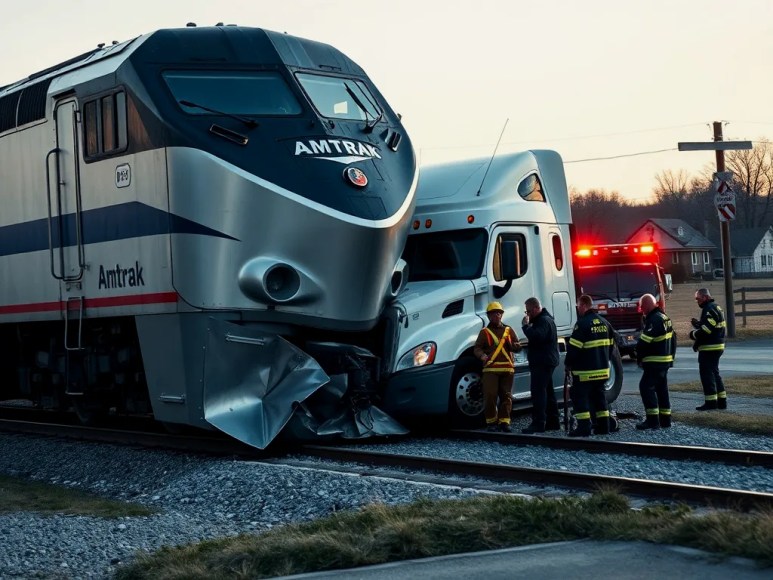
Locomotive and two baggage cars derail after collision at Broussard crossing
On the evening of November 22, 2026, Amtrak’s eastbound Sunset Limited (Train 2) struck a tractor-trailer hauling a bulldozer at the Thru-Way Park Road grade crossing near Broussard, Louisiana, about 10–15 miles south of Lafayette. The train’s lead locomotive and two baggage cars left the rails; passenger cars remained upright. Emergency responders triaged passengers on scene and transported four people to nearby hospitals with non-life-threatening injuries.
What happened at the crossing and why the truck stopped
Preliminary accounts from Lafayette police and local responders indicate the heavy-equipment trailer became stuck on the rail alignment as the train approached. Crossing warning lights and gates deployed while the truck remained immobilized across the tracks. The train engineer initiated emergency braking, but the combined length and mass of the Sunrise Limited prevented it from stopping before impact. Investigators continue to determine the mechanical or situational cause of the truck’s stall, including grade, trailer clearance, load distribution, and driver actions.
Immediate emergency response and passenger care
Acadian Ambulance dispatched a dozen ambulances and on-scene medical teams assigned every passenger. Four people were transported to hospitals; other passengers received first aid and medical screening beside the tracks. Incident command closed the southbound lanes of US‑90 near the crossing, established a secure perimeter, and coordinated rail-crash investigators, Amtrak personnel, and towing crews to stabilize equipment and recover wreckage.
Service disruption and passenger recovery plan
Amtrak arranged bus transfers to move affected passengers toward their destinations while crews inspected the route. The Sunset Limited’s schedule between Los Angeles and New Orleans was delayed and portions of the route temporarily suspended for track inspection and recovery operations. Amtrak and freight partners prioritized restoring a safe, inspected right-of-way; baggage from damaged cars was recovered when safe to do so and returned to passengers or inventoried for later claim processing.
Why low-clearance, heavy-load vehicles get stuck at crossings
Grade crossings with abrupt elevation changes or short approach ramps pose a disproportionate risk for low-clearance equipment carriers and heavy, low-slung trailers. When a trailer’s belly or a machine’s undercarriage contacts the railbed, momentum can stop the vehicle in the wheel-rail footprint. Factors that commonly contribute include: uneven road surface, misaligned approach ramps, excessive trailer sag from poorly distributed loads, and driver misjudgment of crossing angle or speed. Practical prevention measures include route planning to avoid low-clearance crossings, pre-approach visual checks, and using certified haul routes for oversized or heavy loads.
Investigation steps officials will take
Rail and highway inspectors follow a stepwise process: secure the scene, document positions of all vehicles and rolling stock, collect event data recorder information from the locomotive, interview crew and vehicle operators, and survey the crossing geometry and roadbed. Engineers will analyze braking distance, speed profiles, and signal timing. Regulatory agencies typically issue a preliminary finding within days and a final report after full reconstruction and analysis, which may include recommendations to change crossing signage, modify approach grading, or restrict heavy-equipment transports at that location.
Passenger safety and legal considerations after the crash
Passengers involved in the crash can expect Amtrak to provide emergency support, transportation alternatives, and instructions for baggage and claim filing. Liability claims often hinge on investigation findings; Insurers and legal counsel examine driver logs, vehicle maintenance records, carrier permits for oversized loads, and whether the crossing met federal and state standards for warning devices and surface geometry. Families and passengers should preserve—ticket information, photographs, and medical records—to support claims.
How crossings and carriers can reduce this risk
Mitigation strategies that materially reduce stuck-vehicle incidents include retrofitting approaches to smooth grade transitions, installing longer and clearer signage for oversized-load routes, and applying low-profile rail flangeways at select crossings. Carriers should implement a pre-trip route assessment for abnormal loads, train drivers on crossing clearance procedures, and use pilot vehicles where route clearance is uncertain. Where crashes occur, rapid communication channels between highway authorities and railroad dispatch can allow trains to be warned or stopped before reaching a blocked crossing.
Context: Sunset Limited route and crossing risk nationwide
The Sunset Limited traverses a long, primarily single-track corridor across the southern United States, creating multiple at-grade crossings with local and regional roads. Long-distance routes combine passenger and freight traffic, increasing exposure to grade-crossing conflicts. National data show that at-grade collisions with road vehicles remain one of the leading causes of rail-related fatalities and service disruptions; targeted infrastructure investment at high-risk crossings consistently lowers collision frequency and severity.
What travelers should know now
If you traveled on the Nov 22 Sunset Limited: keep boarding passes and all travel receipts, follow Amtrak customer-service instructions for claims, and seek medical attention for any delayed symptoms. For future travel through rural southern corridors, allow additional time for potential delays and monitor Amtrak alerts. Freight and heavy-equipment haulers should verify crossing clearance and coordinate with local authorities when planning moves near rail lines.
Cover image: AI-generated representation of the incident for illustrative purposes.