
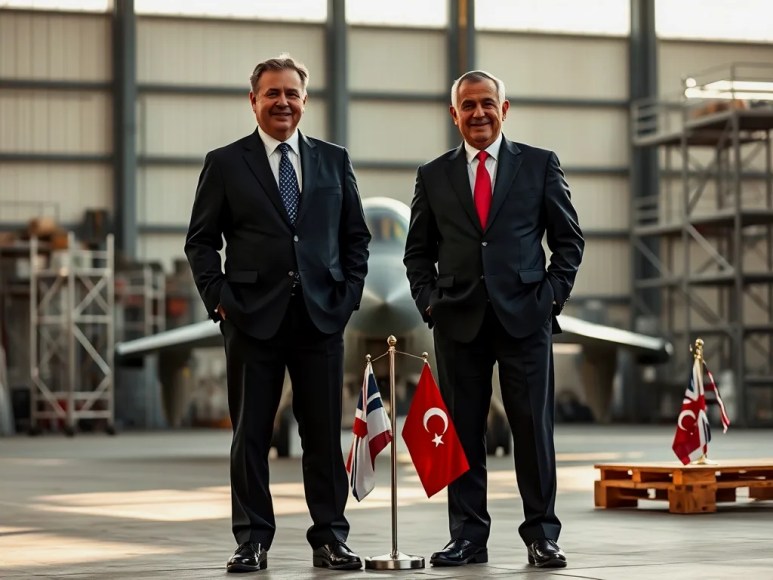
Ankara hosts second Turkey–UK Defense Industry Council meeting
The Turkey–UK Defense Industry Council (TUDIC) convened its second formal meeting on 19 November 2026 in Ankara, hosted by the Presidency of Defense Industries. Delegations from both countries evaluated active projects, identified specific partnership opportunities and mapped practical steps to convert institutional dialogue into joint programs. Participants included Prof. Dr. Haluk Görgün, Head of the Presidency of Defense Industries, Deputy Minister of National Defense Musa Heybet and the UK’s Minister for Defense Preparation and Industry, Luke Pollard, alongside technical and industry teams from both states.
What concrete partnership areas were prioritised?
Delegations prioritised four actionable areas: (1) joint development projects where UK and Turkish firms co-design platforms or subsystems, (2) technology sharing arrangements focusing on sensors, avionics and electronic warfare, (3) industrial cooperation and co-production to rebalance supply chains, and (4) workforce and capability exchanges to speed technology absorption.
Rather than broad statements, the meeting produced a short list of sectors for near-term collaboration: tactical unmanned aerial systems (UAS), maritime systems integration, composite materials for airframes, and secure data links. agreed to form technical working groups for each sector with defined deliverables, milestones and named industry leads from both countries.
How the councils turn participants dialogue into deliverables
The council adopted a step-by-step conversion plan to move from talks to signed agreements. Key steps include:
1) Technical working groups: Each sector will have a bi-national team with an initial 90-day gap analysis to identify interoperability gaps, certification pathways and IP management needs.
2) Joint project roadmaps: Teams will draft 12–24 month roadmaps defining prototype phases, trial campaigns and resource commitments, allowing companies to align investment timetables.
3) Pilot co-production agreements: For at least two demonstrator projects, partners will negotiate co-production terms that set local content targets, export rights and transfer-of-technology milestones.
4) Regular industry matchmaking: The council will host structured industry-days and virtual matchmaking sessions quarterly to pair prime contractors and SMEs based on capability matrices compiled during the working-group phase.
Industry engagement: company-to-company talks and TAI visit
Alongside ministerial exchanges, Turkish and British defense companies held bilateral business-to-business sessions. Those meetings focused on supply-chain integration, technology licensing and joint bids for third-country exports. No new procurement contracts were announced publicly, but industry delegates reported productive memoranda of understanding intended to proceed to feasibility studies.
After the council meeting, delegates visited Turkish Aerospace Industries (TUSAŞ). The visit showcased Turkey’s production lines, composite manufacturing capabilities and avionics test facilities. UK delegates examined demonstrators and test rigs, allowing engineers to identify practical collaboration points (for example, co-located testing campaigns for UAS integration and avionics interoperability trials).
Intellectual property, export controls and financing — how barriers will be handled
Participants recognized that IP management, sensitive technology controls and financing models are common obstacles. They outlined pragmatic mechanisms:
IP frameworks: Project agreements will include tailored IP clauses with defined ownership for jointly developed components, licensing windows for commercial exploitation, and escrow arrangements for critical source code and design data.
Export controls: The two governments agreed to coordinate export licensing in development cycles and to create a government-to-government clearance track for collaborative projects to avoid delays during early prototype tests and export approvals.
Financing & risk sharing: Partners will explore mixed models combining government-backed loans, export-credit agency support and private-sector co-investment. For demonstration projects, each side will specify cost-share limits and milestone-based disbursement to reduce front-loaded funding risk.
Statements from leadership and expected next steps
Haluk Görgün framed the Ankara meeting as the transition from periodic dialogue to implementation, emphasizing measurable outputs such as demonstrators, co-production pilots and joint industry days. The UK delegation emphasized interoperability and the potential for co-bids on third-country tenders, pointing to defense-industrial resilience and shared NATO commitments as incentives.
Next steps that both sides pledged to complete within three months include: establishing the technical working groups, publishing sector-specific roadmaps, scheduling the first round of industry matchmaking events and setting timelines for two demonstrator co-production agreements.
Why this matters: strategic and industrial impacts
A sustained Turkey–UK defense-industrial partnership can create several tangible outcomes: reduced single-source dependencies in critical subsystems, enhanced access for SMEs into expanded export markets through partnered bids, faster fielding of interoperable systems for NATO operations and shared risk on R&D investments. Practically, if the planned roadmaps proceed, expect demonstrator platforms (for example, a tactical UAS with binational avionics and a co-produced hull section for a medium-sized patrol vessel) within 18–30 months.
Potential risks and mitigation measures
Identified risks include mismatched certification standards, export-licensing delays and asymmetric industrial capacity. Mitigations agreed in principle are harmonised test standards, early government-level export clearance channels and capacity-building programs that place UK specialists alongside Turkish production teams to accelerate transfer and reduce quality gaps.
How companies can prepare to participate
Companies that want to engage should take these preparatory steps: update capability dossiers with measurable metrics, identify IP assets suitable for licensing, map potential subcontracts and prepare short feasibility notes for demonstrator proposals. Firms should register for the council’s industry matchmaking platform and nominate technical leads to join working groups once they are announced.