
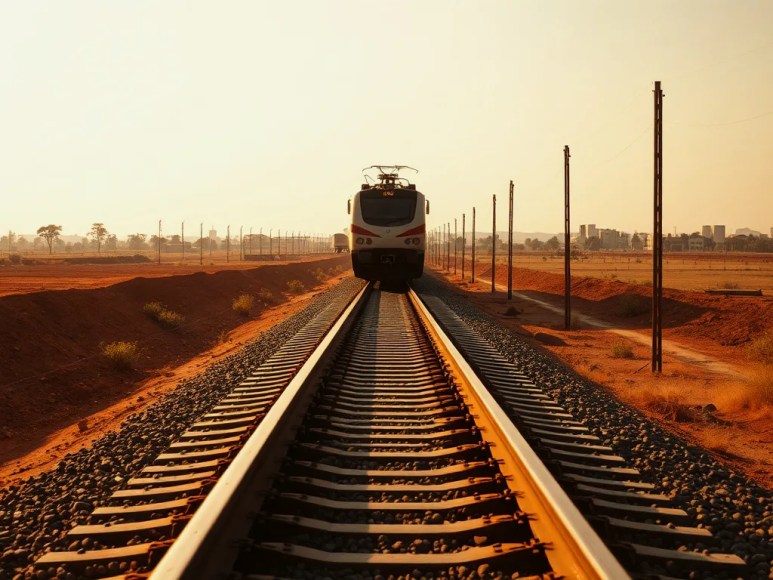
Land acquisition advances make 130 km of route accessible to contractors
Uganda has cleared land and site access for roughly 130 kilometers of the 272 km Malaba–Kampala standard-gauge railway (SGR), enabling contractors to mobilize equipment, conduct surveys and begin preparatory works. The cleared section lies mainly between Malaba (the Kenya border) and Mayuge, where the government reports that about 98% of the corridor is under public control.
This clearance does not equal to completed track laying or final civil works; it means formal possession of land parcels, removal or relocation of occupants, and physical access for construction teams. In practice the contractor can perform activities such as detailed topographic surveys, temporary road construction, spoil and plant staging areas, and geotechnical boreholes—all essential to reduce early-construction risk.
Compensation paid to 7,721 people so far; remaining liability and steps to finish acquisitions
The Ministry reports that out of 12,946 identified affected persons, 7,721 have received compensation totaling 373.07 billion Ugandan shillings. That payment covers land and asset losses across approximately 2,108 acres (about 853 hectares) of the roughly 3,536 acres required along the corridor.
Payments remain outstanding for 5,225 claimants, representing roughly 472.45 billion UGX in remaining liabilities. The government is sequencing compulsive acquisition so that critical sub-sections clear first—this approach minimizes delay to contractors while compensation processes continue on nearby parcels.
How authorities reached high acquisition ratios in Malaba–Mayuge
Three practical measures accelerated progress in the Malaba–Mayuge stretch:
1) Targeted, phased compensation: prioritizing parcels needed for immediate works rather than attempting simultaneous full-route settlement reduced delays and allowed contractor access.
2) Dedicated resettlement and valuation teams: teams stationed locally have sped claims processing and verification, limiting bureaucratic back-and-forth.
3) Early contractor engagement: limited mobilization permissions enabled the contractor to fund and perform preparatory works—survey, geotechnical investigation and temporary access roads—while final financial close was pending.
Limited early works authorized while main financing is finalised
The government granted the Turkish contractor Yapı Merkezi a restricted early-start window (estimated at approximately EUR 75 million worth of activity between May 2025 and October 2026). During that period the contractor completed:
– Detailed land surveys and parcel demarcation
– Geotechnical drilling and soil characterisation for bridges, embankments and tunnels
– Site preparation for temporary yards and equipment laydown
– Procurement of long-lead items and initial plant mobilization
Comprehensive main works—heavy earthworks, bridge spans erection, track formation and signalling—remain on full financial close and the issue of a formal Notice to Proceed (NTP).
Islamic Development Bank approves €650.75 million; scope tied to priority infrastructure
In June 2026 the Islamic Development Bank (IsDB) approved financing of €650.75 million scoped to core elements: the 553-metre Jinja Nile bridge, the 2.12 km Mbuya–Kampala tunnel, six stations and related maintenance facilities. The approval covers construction and associated project management and safeguards for those packages.
That approval constitutes a major tranche but not the entire funding package. Project sponsors must still finalize parallel credits, guarantees and any counterpart funding so that disbursement conditions for each lender align—particularly environmental and social compliance, land title transfers, and procurement arrangements.
How combined financing needs to align for a smooth start
For seamless mobilization and uninterrupted delivery, these elements must be synchronised:
– Financial close sequencing: lenders must complete due diligence and sign loan agreements in an agreed order so final receive staged cashflows to match planned activities.
– Disbursement triggers: common triggers include completed land handover, environmental management plan approval, and satisfactory contractor performance bonds.
– Currency and interest-rate hedging: aligning loan currencies with contractor liabilities and commodity import exposure reduces foreign-exchange disruption during build.
Practical example: If IsDB funds the Jinja Bridge package first, the government can instruct contractor mobilization to concentrate staff and plant on that package while parallel lenders finance tunnel and station packages—minimizing idle resources and optimizing cash burn.
Regional connectivity: integration with Kenya’s rail to Mombasa
The Malaba–Kampala SGR intends to connect directly with Kenya’s standard-gauge network and Mombasa Port. Kenya marked the Kisumu–Malaba link with a groundbreaking ceremony in March 2026. Once both sides complete their sections, freight flows can shift from long-haul road trucks to continuous rail movements across the border—cutting transit time, lowering unit transport cost and reducing road congestion.
Example flows: containerized imports from Mombasa destined for Kampala, up to western Uganda, or onward to the Democratic Republic of Congo would move by rail to Malaba, then Kampala, with efficient transshipment and customs processes reducing dwell time.
Risks that will determine the project timeline
Key risks and mitigations include:
1) Delayed payments: continued cash shortfalls could stall handovers Mitigation: ring-fenced escrow accounts or donor-bridging loans to settle outstanding claims for parcels required imminently.
2) Staggered lender conditions: inconsistent environmental or procurement covenants across lenders could pause package disbursements. Mitigation: harmonized common terms and a lead arranger to align conditions.
3) Construction supply-chain constraints: long-lead items such as heavy bridge bearings or tunnel lining segments require coordinated procurement; early procurement and pre-qualified suppliers reduce delays.
What to watch in the coming months
Three near-term indicators will signal progress or slippage:
– Completion of outstanding compensation for the 5,225 claimants; Clearing this pool will unlock additional contiguous route sections.
– Formal financial close across remaining lenders and receipt of a full Notice to Proceed; This will trigger large-scale civil works and materials importation.
– Visible deployment of heavy plant and sequential works (eg, pier construction for the Jinja bridge or portal works for the Mbuya–Kampala tunnel).
Practical implications for local communities and logistics operators
For communities, accelerated land acquisition brings immediate compensation and the prospect of jobs during construction—labor for excavation, security, catering and subcontracted trades. Local procurement of aggregates and fuel creates business opportunities, but contractors and authorities must manage environmental controls to limit dust, vibration and community disruption.
For logistics operators, a functioning SGR to Mombasa will change routing economics: operators should model blended rail–road tariffs, revise fleet deployment plans and investors in inland container depots (ICDs) near Kampala to consolidate cargo flows when rail freight volumes scale up.
Conclusion: milestone reached, full delivery still hinges on financing and residual acquisitions
The project has passed an important milestone: sufficient land and access for about 130 km allows concentrated early works to proceed. The IsDB financing decision substantially reduces the funding gap for priority infrastructure. Yet the delivery timetable remains conditional—full-scale construction depends on (a) closing remaining lender arrangements, (b) completing outstanding compensation to thousands of claimants, and (c) coordinated implementation of procurement and environmental safeguards. If these elements align, significant civil works can roll out beginning shortly after financial close, with cascading benefits for regional trade and domestic logistics capacity.