
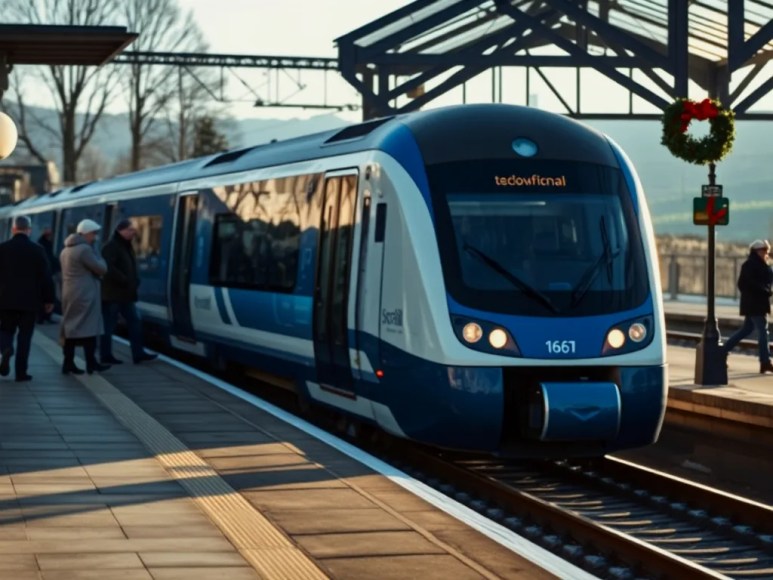
ScotRail expands Boxing Day routes to Tweedbank, North Berwick and Inverurie
ScotRail will run hourly services on three routes on Boxing Day, 26 December 2026, introducing scheduled trains to Tweedbank, North Berwick and Inverurie for the first time on that holiday. Trains will depart from Edinburgh Waverley to Tweedbank at 09.43, from Edinburgh to North Berwick at 09.40, and from Aberdeen to Inverurie at 10.10. These changes increase availability for day trips and local travel while retaining a simplified network on the holiday.
Which routes will not operate on 26 December and why
Edinburgh–Dundee and Edinburgh–Aberdeen services will not run on 26 December because of ongoing infrastructure works around Dundee. The diversion or suspension of these long-distance services concentrates available crews and rolling stock on the new Boxing Day routes and on essential peak links that can operate safely during maintenance activity.
Holiday schedule outline and dates for return to normal service
ScotRail will not operate services on 25 December (Christmas Day) or 1 January (New Year’s Day). On the eves of Christmas and New Year’s, last departures will leave earlier than on a standard evening timetable. The company plans to restore full, pre-holiday timetables across all routes on 5 January 2027, after completing scheduled maintenance and post-holiday fleet reallocation.
How the Boxing Day timetable was structured to maximize coverage
ScotRail built the Boxing Day timetable around three practical constraints: available trains, staffing levels and track access during maintenance windows. By selecting shorter regional routes—Edinburgh–Tweedbank, Edinburgh–North Berwick and Aberdeen–Inverurie—it can deliver hourly frequency with fewer trainsets and fewer crew changes. This approach preserves a usable network for shoppers, visitors and staff traveling between towns while limiting single-day operational complexity.
Practical tips for passengers planning Boxing Day travel
Check departure times in advance: The first departures are mid-morning on the newly added routes, so passengers should confirm platform and departure information the day before. Allow extra time for connections because some long-distance connections will be suspended. Buy tickets ahead where possible to reduce queuing at staffed stations, noting that retail hours may be limited on the holiday. For journeys affected by the Dundee works, plan alternative transport or change travel dates.
Borders Railway electrification: funding, fleet and timeline
The Scottish government has announced a £342 million package to electrify the Fife and Borders lines and to procure new rolling stock. Under this investment, ScotRail expects to add at least 69 electric and battery-electric vehicles to its fleet. The procurement aims to deliver a mixed fleet that can run under overhead wires and on battery power to bridge non-electrified gaps, with entry into passenger service targeted for the early 2030s. That mix helps reduce operating emissions quickly while avoiding the need to fully electrify every remaining track immediately.
What electrification means for service frequency, journey times and carbon impact
Electrifying the Borders line will enable faster acceleration and deceleration, which directly reduces journey times on regional services with frequent stops. Expect modest frequency improvements where infrastructure and signaling allow. Operationally, battery-electric units allow through-running on partially electrified routes—preserving direct services without costly wire installations on low-traffic sections. Carbon emissions will fall substantially: replacing diesel multiple units on regional services typically cuts CO2 per train-kilometer by 60–80% depending on electricity generation mix, and battery operation further reduces local air pollutants in towns.
Fleet examples and operational scenarios
Examples of realistic fleet mixes include 40 electric multiple units for core electrified corridors and 29 battery-equipped units to operate on the Borders branches and other partially electrified lines. In one scenario, a battery-electric unit runs under overhead power between major stations, then switches to battery mode to serve a branch line without overhead wires—avoiding interchange for passengers and allowing through service extensions to smaller towns.
Impact on passengers and local economies
Hourly Boxing Day services on the added routes improve access for local retail, tourism and family visits, encouraging spending in towns outside city centres. Over the longer term, electrification and newer trains will increase capacity reliability and attract more regular travel, benefiting commuter patterns and reducing local road congestion where modal shift occurs. Faster, quieter trains also make public transport more competitive for leisure trips, which supports local hospitality and retail sectors.
How to prepare for timetable changes and infrastructure works
Passengers should subscribe to ScotRail service alerts, use journey planner apps updated by National Rail and check station noticeboards before travel. For businesses and local authorities, coordinate event timings and staff shifts with the published holiday and post-holiday timetables to avoid disruption. Where long-distance links are suspended for engineering work, arrange bus replacements or coach options early and communicate those plans to customers and employees.
Key dates and quick reference
26 Dec 2026: Hourly services on Edinburgh–Tweedbank (from 09.43), Edinburgh–North Berwick (from 09.40), Aberdeen–Inverurie (from 10.10). No Edinburgh–Dundee or Edinburgh–Aberdeen trains (Dundee works).
25 Dec 2026 & 1 Jan 2027: No ScotRail services.
5 Jan 2027: Planned return to full, normal timetables.
Early 2030s: Targeted entry into service for new electric and battery-electric trains under the £342m investment.
Further actions for stakeholders
Passengers: check timetables and buy tickets early; have contingency plans for suspended long-distance services. Local businesses: adjust opening hours and staffing to match holiday service levels. Transport planners: monitor the delivery schedule for new rolling stock and coordinate last-mile investments (station charging, depot upgrades) so the electrification delivers on journey-time and environmental promises.