
What happened in Houston’s Fifth Ward and where did the derailment occur?
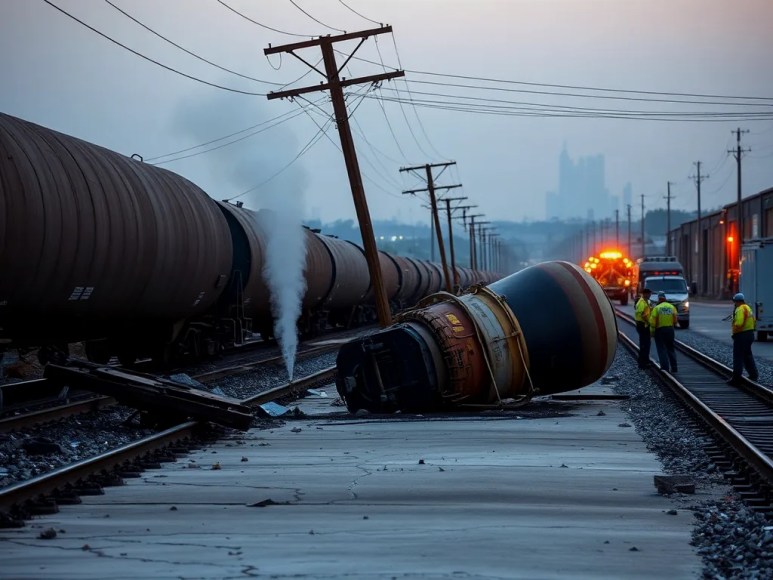
On the night of November 25, 2026, a Union Pacific freight train in Houston’s Fifth Ward derailed about 10 empty cars near the intersection of Press Street and Gillespie Street. Emergency responders from Houston Fire and Police Departments arrived quickly, secured the scene, and confirmed there were no injuries among crew or nearby residents. Union Pacific personnel were on-site preparing to re-rail the cars and clear the track.
How responders assessed hazardous materials risk and what they found
Fire crews conducted a layered hazardous-materials check that included a visual sweep, air monitoring with multi-gas detectors, and an inspection of tank and boxcar seals. Those standard, sequential steps—visual inspection, instrument survey, and container integrity check—revealed no signs of leaking liquids, vapors, or residue. Because the derailed cars were empty, the probability of contamination was low; crews nevertheless treated the scene as a precautionary HAZMAT incident until testing confirmed otherwise.
Why no evacuations were ordered and the safety measures implemented
Officials did not order evacuations because air-monitoring results remained within normal background levels and there were no visible spills. Instead, authorities established a safety perimeter, controlled traffic flow near Press and Gillespie Streets, and restricted pedestrian access within the immediate derailment footprint. Union Pacific coordinators worked with city emergency management to schedule re-railment during daylight for better visibility and public safety.
What caused the derailment and how authorities will determine responsibility
As of the initial on-scene report, no definitive cause had been released. Investigators follow a standard process: secure the scene, photograph and document wheelsets and track conditions, collect rail and equipment data recorder files, interview crew and witnesses, and examine maintenance records for both rolling stock and track infrastructure. Potential contributors under review typically include track defects, switch or turnout problems, wheel or axle failures, improper car security, or operator error. Responsibility will be assigned after the Federal Railroad Administration and Union Pacific complete technical analyzes and root-cause evaluations.
How common are similar incidents in Harris County and what the data show
Federal Railroad Administration summaries show that reported derailments in Harris County tied to Union Pacific decreasing in the January–August 2026 window compared with the same period in 2025: four incidents versus 11. These counts reflect reported events and can lag behind real-time occurrences due to investigation and reporting timelines. The recent Fifth Ward derailment is not yet included in those publicly released figures. Analysts caution against drawing broad safety conclusions from single-year snapshots; instead, trend analysis over multiple years and by meaningful incident type (eg, loaded hazardous versus empty cars) provides more insight.
What residents and local businesses should do after a nearby derailment
Residents in proximity to a derailment should follow these steps: 1) heed official instructions from police and fire departments; 2) keep windows and doors closed if asked; 3) avoid the scene and traffic detours; 4) report any health symptoms such as difficulty breathing or persistent coughing to emergency services; and 5) document property damage with photos and contact local authorities for claims guidance. Businesses should inventory potentially affected goods, log employee exposure reports, and coordinate with Union Pacific and municipal officials on access and recovery operations.
How re-railment and track restoration proceed step by step
Re-railment typically follows a defined sequence: 1) establish a secure exclusion zone and confirm no hazardous materials; 2) stabilize and brace derailed cars to prevent shifting; 3) bring in re-rail equipment (hydraulic jacks, rerailing bolsters, cranes as needed); 4) lift and guide wheelsets back onto the rail one car at a time; 5) inspect track and replace damaged ties or ballast; and 6) perform a clearance sweep and test-run with a light engine to verify safe operations. The timeline depends on equipment availability and extent of track damage but is often completed within hours for incidents involving empty cars and minimal infrastructure harm.
What this means for rail safety policy and local infrastructure maintenance
While a single derailment of empty cars presents limited immediate public risk, it highlights operational pressure points that planners and regulators monitor: track inspection frequency, maintenance backlogs, rail component fatigue, and coordination between freight railroads and municipal emergency services. Practical responses can include targeted inspections along urban corridors, data-driven scheduling of tamping and tie replacement, and joint drills between carriers and first responders to refine rapid-response routines.