
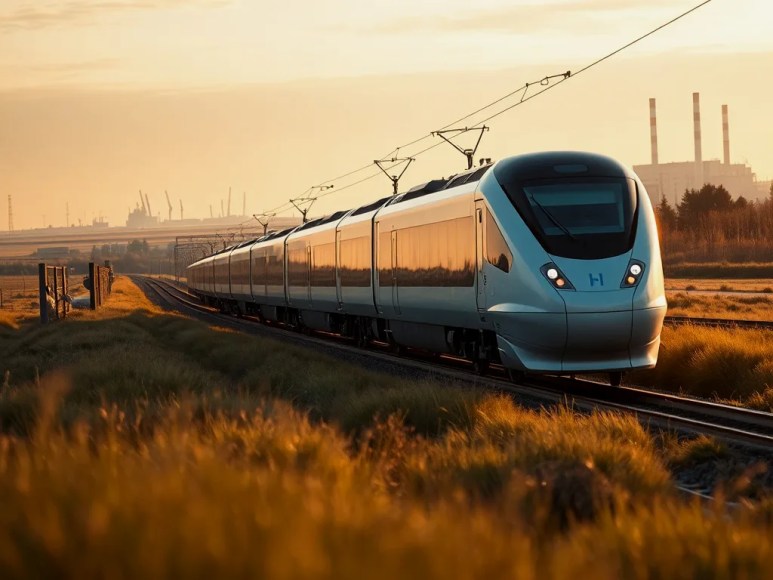
Russia advances hydrogen-powered passenger train assembly
Transmashholding (TMH) has completed major assembly work on the 62-4584 hydrogen fuel-cell passenger train at the Demikhovo plant, aiming for trials certification in 2027. Engineers assembled a two-car passenger set with a dedicated energy module designed to replace diesel traction on non-electrified routes. TMH and the Tver Carriage Plant collaborated on the vehicle architecture and systems integration, focusing on modular construction that simplifies maintenance and future upgrades.
How the 62-4584 generates and manages propulsion power
The train uses proton exchange membrane fuel cells that combine stored hydrogen with atmospheric oxygen to produce direct current electricity. That electricity drives the train’s traction motors and charges onboard battery packs that smooth power delivery during acceleration and capture braking energy. The integrated power-management system coordinates fuel cells and batteries: fuel cells provide steady cruising power while batteries handle peak loads and regenerative braking, extending hydrogen range and reducing transient stress on fuel stacks.
Planned hydrogen storage and range performance
Design documents specify roughly 230 kilograms of onboard hydrogen storage housed in composite high-pressure tanks in the energy module. TMH targets a single-fill range above 700 kilometers for the standard two-car plus energy unit configuration. If operators add a third passenger carriage, designers project the range will remain above 480 kilometers under the same storage capacity. Those figures reflect factory test-performance targets; actual route range will vary with payload, gradient, climate, auxiliary loads (HVAC), and duty cycle.
Why hydrogen sourcing and logistics shape real emissions
Fuel-cell propulsion emits only water at the point of use, but lifecycle emissions depend on hydrogen production and transport. Green hydrogen made by electrolysis using renewable electricity yields the lowest lifecycle carbon footprint. Hydrogen produced from natural gas (grey) or with carbon capture (blue) raises emissions and cost considerations. TMH’s environmental benefit on a route therefore depends on local refueling infrastructure and hydrogen supply chain choices. Regional refuel depots on Sakhalin or near depots outside Moscow would impact operating carbon intensity and commercial viability.
Safety systems: sensing, containment, and automatic shutdown
Designers installed multiple safety layers: distributed hydrogen sensors in tanks and service compartments to detect leaks, automatic isolation valves to cut flow on fault detection, and fire-detection systems tailored to hydrogen’s wide flammability range. Structural tank protection and venting routes prioritize controlled dispersion to avoid accumulation in confined spaces. Control software runs continuous diagnostics on pressure, temperature, and cell-stack health and commands fail-safe shutdowns if thresholds exceed safe limits. The train will undergo dedicated hydrogen-safety certification that assesses those systems under simulated leaks, impact, and thermal events.
Passenger features and operational ergonomics
The 62-4584 emphasizes passenger accessibility and onboard services: a low-floor layout for level boarding, wide doors for fast dwell times, gangway passage between cars, and both USB-A and USB-C power outlets at seats. Designers balanced weight distribution by locating the energy module centrally to keep passenger areas low and stable, which aids ride comfort and platform compatibility. Interior HVAC design integrates with power-management strategy to minimize auxiliary energy draw and protect fuel-cell performance in extreme temperatures.
Testing schedule and choice of test lines
After final technical checks around Moscow, TMH plans staged acceptance trials culminating in comprehensive tests on Sakhalin Island’s network. Sakhalin offers non-electrified routes with operational profiles representative of regional services (frequent stops, mixed gradients, and harsh winter conditions). TMH intends to run endurance, cold-start, and refueling-cycle evaluations during these trials to validate range targets, reliability metrics (mean distance between failures), and maintenance intervals under real-world conditions.
Operational examples and expected maintenance regime
Operators could schedule hydrogen refuels similarly to diesel servicing windows but expect different turnaround tasks: fuel-system inspections, leak tests, periodic stack conditioning, and replacement intervals for fuel-cell modules based on calendar life and cumulative hours. Predictive maintenance using onboard diagnostics will trigger targeted interventions before failures. TMH expects maintenance to shift labor from engine overhauls to electronics, sensors, and thermal-management subsystems; depot tooling will include hydrogen-handling equipment and certified leak-test gear.
Collaborations, objectives, and next technical milestones
The project stems from a 2019 collaboration between TMH, Russian Railways, Rosatom, and Sakhalin authorities to evaluate hydrogen’s technical and economic fit on non-electrified lines. Key near-term milestones include completing factory acceptance tests, full integration trials of refueling interfaces, and third-party safety certification in 2027. Test outcomes will inform decisions on hydrogen- refueling infrastructure placement, commercial pricing models, and expanded trainset variants.
What to watch for in trial results
Watch three categories in published test data: verified operational range by duty-cycle; hydrogen consumption per seat-kilometer and per gross-tonne-kilometer; and reliability metrics such as mean time between service-affecting failures. Secondary indicators—refueling time, depot turnaround procedures, and interoperability of refueling hardware—will shape how quickly operators can adopt hydrogen fleets. Practical route trials on Sakhalin will reveal real-world trade-offs between range, payload, and climate performance.