
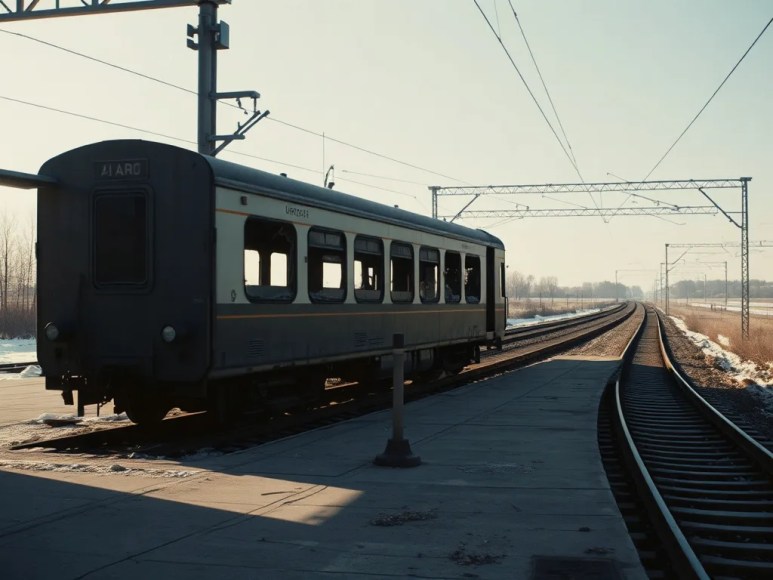
A Russian strike that downed an unmanned aerial vehicle about 300 meters from Mukachevo railway station forced Hungary to suspend cross-border passenger services on 17–18 November 2026 while authorities evacuated Hungarian rail staff and assessed risks. Hungarian Prime Minister Péter Magyar said the drone fell near the station and Hungarian crew members were safely extracted; for safety reasons Budapest paused international trains on the Budapest–Mukachevo route for two days.
How the drone incident unfolded and immediate safety actions
Officials reported that a Russian Geran‑2 type loitering munition struck a location roughly 300 meters from Mukachevo station during a series of morning attacks. Train personnel from Hungary were on site when the unmanned aerial vehicle impacted. Hungarian authorities organized an immediate, controlled evacuation of the crew and temporarily halted cross-border rail movements while military and railway safety specialists scanned the area.
Ukrainian emergency teams and the state rail operator Ukrzaliznytsia inspected the site and found the device had fallen into an industrial sector outside the passenger facilities. Initial field checks reported no fatalities or injuries among railway staff and no visible, direct damage to the station platforms or track geometry.
What Ukrainian rail operator says about infrastructure and services
Ukrzaliznytsia issued an operational bulletin confirming rails, switches and signaling in the immediate station zone sustained no measurable damage after a technical inspection. Despite that, the operator acknowledged that the elevated risk from ongoing air attacks necessitated temporary restrictions on train operations to protect passengers and staff.
To maintain passenger flow, rail managers rerouted local travelers onto high‑capacity suburban services between Chop and Mukachevo. That measure preserved cross‑border connectivity for passengers on the Budapest–Mukachevo corridor while keeping long‑distance trains out of the higher‑risk terminal area until security assessments completed.
Sequence and scale of the attack reported in Zakarpattia
Hungary’s foreign minister, Anita Orbán, reported three successive waves of Geran‑2 drones struck targets across Zakarpattia that morning, concentrating around Mukachevo and Uzhhorod. Ukrainian air defense forces engaged multiple drones; Officials said several were intercepted, while others reached ground targets. The multi‑wave pattern increases the complexity of protective responses because successive salvos can exploit momentary gaps in local air‑defense coverage.
Examining flight profiles and impact patterns of Geran‑2 systems shows they typically loiter then dive on relatively small, fixed targets. Their impact can create blast and fragmentation hazards that extend well beyond a single structure, which explains conservative decisions to suspend operations even where direct infrastructure damage is absent.
Operational lessons: why rail operators suspended services even without visible damage
Rail operators balanced three practical factors when suspending international trains: proximity of an explosive impact to passenger areas, presence of foreign crew in the danger zone, and the unpredictability of follow‑on strikes. Closing the route for a brief interval allowed evacuation, forensic inspection, and coordination with military air‑defense units.
Cases from recent conflicts show that temporary suspensions reduce casualty risk and facilitate rapid infrastructure inspections. Example: a 2024 cross‑border pause in another European corridor after nearby drone strikes permitted engineers to perform ultrasonic rail scans and verify signaling integrity; full service resumed the next day without incident.
Passenger alternatives, scheduling and operational continuity
Rail operators implemented a multi-step passenger continuity plan: 1) Immediate transfer of affected onboard crew to safety; 2) Use of suburban high‑capacity trains between Chop and Mukachevo to carry cross‑border passengers; 3) Clear station announcements and digital notices explaining delays and alternative routing; 4) Staged restoration of international services after security clearance.
Applying this layered approach minimizes disrupted journeys and concentrates risk management on the threatened zone rather than across the entire corridor. Rail operators also typically keep reserve trainsets and staff on call to accelerate service recovery when authorities lift restrictions.
What to watch next: indicators for reopening and service normalization
Restoration of scheduled international services depends on three measurable indicators: confirmed cessation of local strike activity, successful air‑defense assessments showing no immediate follow‑on threat, and completion of technical inspections verifying track, signaling and rolling‑stock safety. Authorities indicated a two-day pause for 17–18 November, but each reopening decision requires cross-agency agreement.
Travelers should monitor official operator channels for timestamped notices. If the three indicators are met, operators typically publish a staged timetable with buffer times to absorb any residual recovery tasks.
Regional implications and practical recommendations for travelers
The Mukachevo event highlights how proximate military activity can disrupt international transport even without direct infrastructure damage. For travelers between Central Europe and western Ukraine, practical steps include: carry valid travel documents, register travel plans with carriers if offered, subscribe to operator SMS/email alerts, expect transfer to regional commuter trains on short notice, and allow additional connection time when crossing the Zakarpattia border.
Railway staff and operators apply conservative safety protocols that prioritize life and allow rapid resumption of services once the operational picture clears. Monitoring official Ukrzaliznytsia and MÁV statements provides the earliest, most accurate information about reopening and timetable changes.