
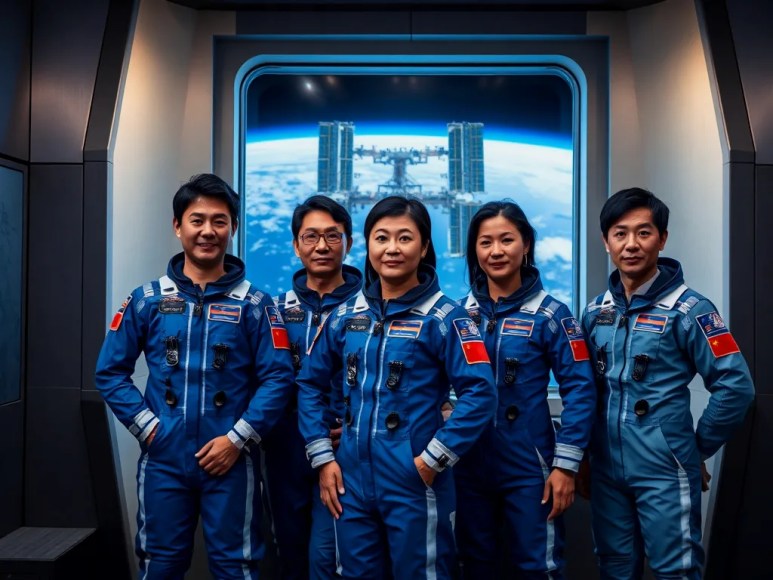
Shenzhou-24 crew composition and launch timeline
The China Manned Space Agency (CMSA) confirmed a three-person Shenzhou-24 crew: commander Tang Hongbo, flight engineer Wu Yi, and payload specialist Muhammad Zeshan Ali. The vehicle was lifted off from the Jiuquan Satellite Launch Center at 08:18 local time. The mission will dock to the Tiangong space station immediately after orbital insertion and then execute a planned crew rotation before returning to Earth.
Individual roles, experience and mission tasks
Tang Hongbo (commander) brings prior long-duration station experience from Shenzhou-12 and Shenzhou-17, so he will lead docking, in-orbit operations, and emergency procedures. His primary tasks include commanding extravehicular activity readiness, overseeing life-support contingencies, and coordinating research scheduling.
Wu Yi (flight engineer) will manage spacecraft systems, conduct rendezvous-and-docking monitoring, and support integration of scientific payloads. Expect Wu to lead routine system checks, performance troubleshooting, and maintenance of environmental control and power subsystems.
Muhammad Zeshan Ali (payload specialist) represents Pakistan as the first astronaut from that country to fly on China’s human spaceflight program. Ali’s responsibilities focus on payload handling, experiment execution, and participating in the crew exchange. He will operate biomedical and materials experiments, manage cargo transfers, and train with station procedures developed specifically for short-duration visiting crew.
How Pakistan selected and trained its astronaut
CMSA and SUPARCO (Pakistan’s space agency) signed a cooperation agreement in February 2025. Pakistan’s candidate pipeline followed a multi-stage process: application screening, medical and psychological evaluations, technical testing in engineering and life sciences, and simulator-based performance trials. Two candidates—Muhammad Zeshan Ali and Hurrem Dawood—won training slots in April; mission planners selected Ali for Shenzhou-24.
Ali completed a comprehensive program in China that included spacecraft systems training, high-fidelity docking simulations, neutral-buoyancy extravehicular practice, microgravity adaptation protocols, and hands-on execution of the scientific experiments he will run. Training emphasized cross-cultural crew communication, operational checklists, and contingency drills to ensure rapid integration with the resident crew.
Planned crew exchange sequence and mission duration
Shenzhou-24 conducts a crew exchange designed to overlap crews for continuity. After docking, the incoming crew will transfer experiments and supplies to the station. Members of the previous crew (Shenzhou-23) will depart on a staggered schedule: some return with the visiting crew, while at least one resident remains to extend their mission — one crew member, Cu Yangchu, will remain to complete a one-year cumulative stay. Ali’s stay is short-term by design; he will join the existing rotation and return aboard the earlier vehicle once the handover completes.
Physiological effects of long-duration spaceflight and how the mission studies them
Extended microgravity exposure reduces bone mineral density, decreases skeletal muscle mass, shifts fluid distribution causing cardiovascular adaptations, and heightens radiation dose concentration that raises DNA-damage risk. Shenzhou-24 and the Tiangong program will collect multi-modal data over the one-year extension to quantify those effects.
Protocols include serial bone-density scans, muscle-strength testing, cardiac ultrasound and ambulatory blood-pressure monitoring, sleep and circadian rhythm tracking, and genomic assays for radiation biomarkers. Countermeasure experiments will test resistance-exercise regimens, tailored nutritional plans, pharmacologic protection, and radiation-mitigating shielding approaches. The mission pairs physiological endpoints with operational metrics—such as crew workload and system resource usage—to evaluate real-world effectiveness of countermeasures.
Tiangong station architecture and daily operations
Tiangong consists of a core module (Tianhe) and two laboratory modules (Wentian and Mengtian) arranged in a T-shaped configuration. The station supports crew transfer via Shenzhou vehicles and cargo resupply via Tianzhou freighters. Daily operations center on life-support management, power generation from deployable solar arrays, thermal control, waste processing, and scheduling of multidisciplinary experiments across biology, fluid physics, and materials science.
Operational routines establish overlapping roles: one crew member focuses on vehicle interface and EVA readiness, another manages payload execution and data downlink, while the third handles maintenance and housekeeping. Automation handles many nominal control loops, but crew intervention remains essential for anomaly resolution and experiment manipulation that requires manual dexterity.
Why China built its own station and the program timeline
Restricted cooperation with certain international partners and limited access to the ISS incentivized an independent, modular approach. China launched Tianhe (core) on 29 April 2021, Wentian on 24 July 2022, and Mengtian on 31 October 2022. The modular design mirrors lessons from Mir and offers incremental expansion: future add-ons such as the planned Shuntian space telescope can integrate with existing docking nodes to expand scientific capability.
Frequently asked operational questions and concise answers
Who are the Shenzhou-24 crew? Tang Hongbo (commander), Wu Yi (flight engineer), and Muhammad Zeshan Ali (payload specialist).
Why does Ali’s flight matter? He becomes the first Pakistani national to fly on a Chinese human spaceflight mission, marking a diplomatic and technological partnership milestone.
How long will the mission last? The overall timeline depends on the overlap and handover with the resident crew; At least one crew member will remain to reach a cumulative one-year stay, while visiting crew members have shorter assignments tied to the rotation schedule.
How is Tiangong funded? China funds the program through national budgets and interagency coordination to build sovereign orbital infrastructure and expand domestic science capabilities.
Scientific and diplomatic significance of the mission
Scientifically, Shenzhou-24 provides controlled testbeds for long-duration human physiology research, in-orbit life-support validation, and materials processing experiments. Data from resistance-exercise regimens and radiation-mitigation trials will inform future lunar and deep-space crew health planning. Diplomatically, the mission solidifies China–Pakistan collaboration in human spaceflight, opens training pathways for partner nations, and demonstrates a model of bilateral technology transfer and educational exchange.
Expected outcomes, data release and next steps
Anticipated outputs include longitudinal physiological data sets, curated experiment results, operational lessons for modular station maintenance, and recommendations for crew rotation cadence. CMSA and SUPARCO plan to expand joint training and science projects, identify additional Pakistani candidates for future missions, and broaden cooperative payloads. Public data releases will focus on peer-reviewed experiment results and high-level operational reports that support the international scientific community’s ability to compare countermeasure effectiveness across space agencies.