
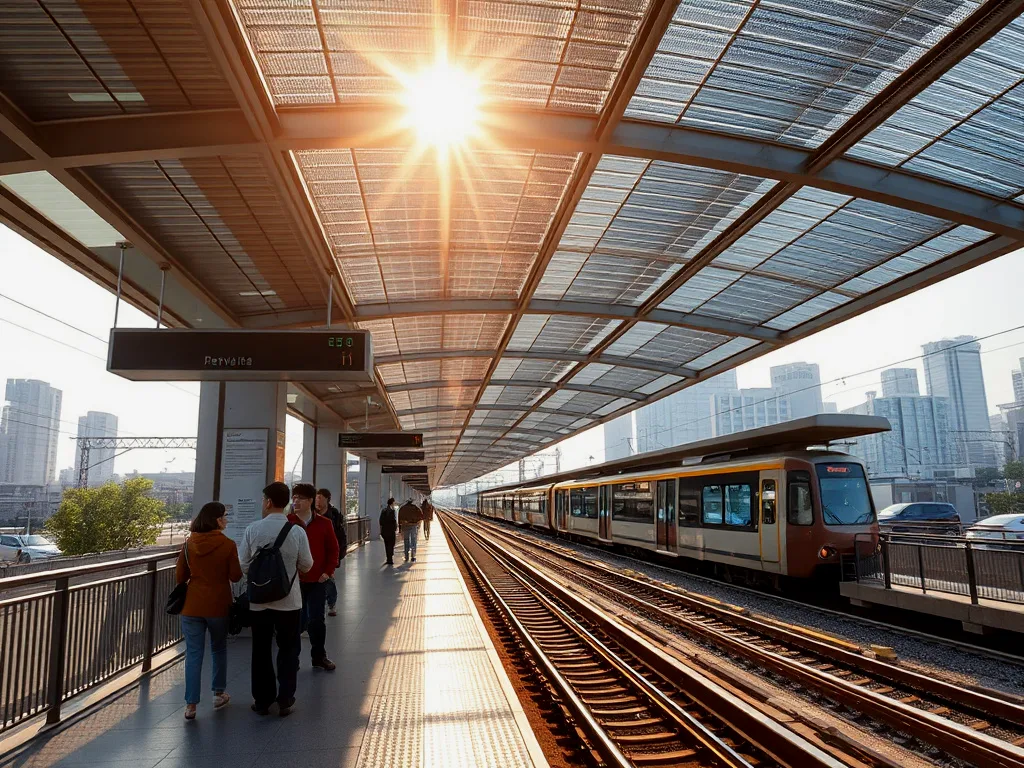
JR East will install a 5.28 kW flexible perovskite solar film array on the roof of Platform 2 at Shinagawa Station between April and September 2027. Forty-eight modules manufactured by Sekisui Solar Film will cover 69 square meters and are expected to generate about 5,800 kWh per year. The electricity will power platform lighting, staff offices and electrical outlets, and the project serves as JR East’s first full-scale perovskite deployment within its railway facilities.
How the perovskite film array is configured and why it fits Shinagawa
The system uses thin, flexible perovskite cells laminated into a lightweight film. Forty-eight modules produce a combined peak capacity of 5.28 kW across 69 m², averaging roughly 76 W per square meter peak. The low mass and conformability let crews mount the film to a curved, load-sensitive platform roof without major structural reinforcement. JR East selected Platform 2 because it offers continuous unobstructed roof area and close proximity to the station’s electrical distribution panels, reducing conversion and cabling losses.
What annual production 5,800 kWh means in real operations
Annual generation of ~5,800 kWh translates to practical operational savings: continuous LED platform lighting (estimated 8–12 kW equivalent during daytime operation) and staff-area consumption will absorb much of the output during service hours. For example, if platform lighting consumes an average 6 kW for 12 hours of daily service, the array offsets roughly 80–100 days of that lighting load annually; combined with office and outlet use, the array can cut station electricity purchases by an estimated 10–15% for the immediate microgrid served. Actual savings will vary by schedule, lighting control strategies, and seasonal irradiance.
Performance, degradation and monitoring plan to validate perovskite in rail conditions
JR East will monitor real-world power yield, temperature-dependent performance, and humidity resilience throughout the trial. Perovskite films typically show faster initial performance drop than crystalline silicon but can stabilize if encapsulation is effective. The project will log energy output, incident irradiance, module temperature, and visible-condition inspections at regular intervals. JR East intends to compare measured specific yield (kWh/kW) and annual degradation rate (%) against manufacturer claims and against nearby crystalline installations to determine lifecycle competitiveness.
Installation steps and safety procedures for platform-mounted flexible solar films
Installation will follow a staged process: site survey and load analysis; modular layout and attachment-point design; procurement of pre-laminated modules; preparatory cleaning and primer application on the roof substrate; adhesive or mechanical attachment of modules; electrical stringing and inverter placement; commissioning and safety verification. Crews will schedule work during low-traffic windows, implement fall protection and overhead-clearance controls, and coordinate with station operations to maintain passenger safety. Waterproofing and roof warranty preservation are explicit checkpoints during attachment and after completion.
Why JR East chose film-type perovskite over conventional panels
Film perovskite offers three decisive advantages for this location: much lower weight per square meter, conformability to irregular or low-load roofs, and shorter, potentially lower-cost routes manufacturing that can suit smaller, distributed projects. The tradeoffs include shorter demonstrated field lifetimes to date and sensitivity to moisture and UV without robust encapsulation. JR East’s trial targets those tradeoffs by measuring encapsulation effectiveness under train-induced vibration, shading transients, and urban pollution exposure.
Context: Japan’s national push and Sekisui Solar Film’s supply plan
Japan aims for roughly 20 GW of perovskite capacity by 2040. The Shinagawa pilot sits within a public-support program and follows earlier demonstrations such as the 2025 Hakata Station test in Fukuoka. Sekisui Solar Film plans to start supplying product from a 100 MW Sakai production line in the first half of fiscal 2027, aligning commercial volumes with JR East’s deployment window.
What successful validation would enable across JR East’s network
If the Shinagawa deployment meets yield and durability targets, JR East can scale perovskite films to other low-load station canopies, signal shelters, and rolling-stock auxiliary-power applications where weight and flexibility matter. The company will use degradation measured curves and lifecycle cost models to identify sites where perovskite’s lower installation cost and higher area-normalized output outweigh shorter warranty windows compared to glass-backed silicon modules.
Key metrics JR East will track and report
Annual energy yield (kWh), specific yield (kWh/kW), initial performance ratio, temperature coefficients, month-by-month degradation rate (%/year), inverter and balance-of-system losses, and incident-related maintenance events. JR East will publish operational data sufficient to evaluate economic payback windows under different electricity price scenarios and to inform procurement specifications for future perovskite purchases.
Practical implications for station staff and passengers
Passengers will experience no change to platform operations; Scheduled works will avoid peak boarding hours. Station staff gain a demonstrable local renewable source for lighting and outlets, potentially increasing resilience during short grid interruptions. The array’s on-site monitoring can feed a dashboard to operations teams showing live generation and alarms for rapid fault response.
Lessons other operators should consider before adopting perovskite films
Operators should run a pilot that mirrors worst-case environmental stress: seasonal humidity swings, regular wind-driven rain, and particulate deposition. Require manufacturer-provided accelerated-aging test data, confirm robust encapsulation and repair routes, and plan for module replacement logistics if degradation exceeds thresholds. Weight-savings open deployment options, but procurement must balance short-term capacity gains against maintenance and eventual replacement costs.
What to watch for next
Watch for Sekisui’s initial deliveries from the Sakai line and JR East’s published monitoring reports after six and 12 months of operation. Those publications will clarify perovskite’s practical life expectancy in rail environments and shape follow-on procurement across Japan’s rail network and international transit agencies considering flexible solar on constrained roofs.
Be the first to comment