
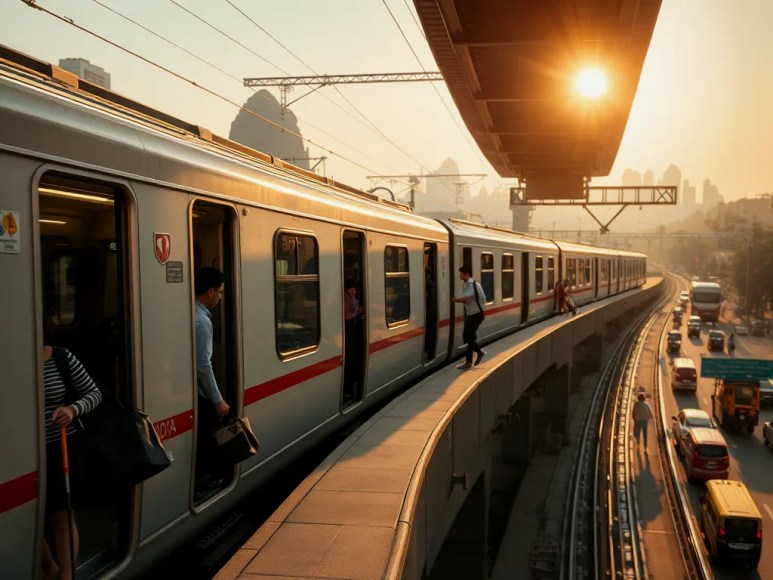
Metro Line Records Strong Growth: 41.6 Million Passengers Since Opening
Ben Thanh–Suoi Tien Line carried approximately 41.57 million passengers from commercial opening on 22 December 2024 through the end of October 2026. In the first ten months of 2026 alone the line transported 20.25 million riders, a year-on-year increase of about 21% compared with the same period in 2025. The operations team reported 155,069 safe train trips overall and 72,933 trips during January–October 2026, with an average daily ridership near 66,645 passengers.
Why Ridership Is Rising and Who Uses the Service
Commuter behavior has shifted from casual, touristic trips towards routine work and education travel. Monthly subscription trips reached roughly 3.1 million in the first ten months of 2026 — about 15.43% of total trips — while student journeys exceeded 1.7 million. These figures indicate a maturing travel pattern: the line now serves daily mobility needs rather than only occasional riders.
Peak-Period Load and Operational Performance
Detailed counts show high concentration during commuting windows. In September 2026, morning peak (07:00–09:00) load averaged 793 passengers per train, and evening peak (16:30–18:30) load averaged 718 passengers per train. By contrast, the monthly overall average stood at about 273 passengers per train. During October peak intervals the system handled roughly 5,700 passengers every 30 minutes in both directions, underscoring the need for targeted capacity strategies.
Short-Term Capacity Lever: Reduce Headways on Existing 3-Car Trains
The current fleet comprises 17 three-car trainsets. Technical assessments indicate that operators can reduce peak headways from about 6 minutes to as low as 4 minutes 30 seconds without adding vehicles, by optimizing dwell times, signaling margins and turnaround procedures. Implementing shorter headways involves coordinated steps:
Step-by-step for reducing headways
1. Measure and standardize dwell times: collect automated door and passenger flow data at busiest stations and set target dwell times by direction and platform.
2. Adjust timetable buffers: compress non-essential padding while keeping safety margins verified by signaling engineers.
3. Optimize platform and on-board operations: increase staff at key stations during peak hours, deploy passenger guidance to speed boarding and alighting.
4. Monitor in real time: use operational dashboards to detect ripple effects and return intervals to nominal values quickly.
These measures can yield immediate frequency improvements and raise throughput by roughly 25–35% during peak windows without capital procurement.
Medium- and Long-Term Capacity Options: New Cars and 6-Car Trains
Longer-term solutions include procuring additional cars and converting service to six-car trainsets. That approach multiplies per-train capacity but requires:
• Rolling stock procurement: contract terms, vehicle specifications, manufacturing slots and delivery timelines typically span 24–48 months from tender to commissioning.
• Depot and platform readiness: yard modifications, longer platform edges or platform door adjustments, and updated maintenance regimes.
• Signaling and power upgrades: verify that signaling blocks and power supply can handle longer consists and potentially tighter headways.
Project planning should align purchase schedules with projected demand curves and funding windows to avoid stranded capacity or interim crowding.
Access, Last-Mile Links and Station Amenities to Improve Ridership Experience
Eleven of the line’s 14 stations already provide dedicated parking; However, many riders still face last-mile challenges. Planned 2027 improvements include:
• Feeder bus services and timed transfers: design routes and schedules to match peak train arrivals and reduce transfer wait times.
• Pedestrian access upgrades: clearer walkways, signage, and safer crossings to increase station catchment on foot.
• Park-and-ride enhancements: expand or better manage existing lots where space and demand justify it.
• Integrated information systems: real-time multimodal journey displays at stations to guide transfers and reduce uncertainty.
Operators also plan to use electronic ticketing and operational telemetry data more effectively for dynamic service planning (adjusting frequency and deploying short-turn services where needed).
Network Expansion and System Integration
City authorities intend to complement operational fixes on Line 1 with network expansion projects — including the Ben Thanh–Tham Luong Line 2 and improved links between Thu Thiem and Suoi Tien — creating a more connected urban rail network. A multi-line network will:
• Spread passenger loads: provide alternative corridors so individual lines carry less peak burden.
• Improve accessibility: reduce transfer distances and times across the metropolitan area.
• Support journey transit-oriented development: coordinate land use and station-area design to increase ridership and local economic activity.
Phased integration should prioritize interchange design, unified fares, and interoperable information systems to maximize ridership benefits as new segments enter service.
Operational Metrics to Track and Targets to Set
To guide investments and operational changes, the operator should track a compact set of KPIs and set measurable short-term targets:
Key KPIs
• Peak passengers per train (target reduce congestion below 650 per train at morning peak within 6 months).
• On-time performance (target 95% trains within scheduled headway).
• Average dwell time (target reduce by 10–20% at top 5 busiest stations).
• Modal-transfer wait (target <10 minutes average for feeder connections).
• Customer satisfaction on access and comfort (quarterly surveys).
Meeting these targets combines service planning, small capital works, and focused customer-facing operations to improve throughput and passenger experience quickly while larger procurements proceeds.
Practical Example: Short-Term Frequency Boost in One Busy Corridor
A test program at the three busiest consecutive stations could demonstrate the benefits and risks of compressed headways. Example design:
Trial elements
• Duration: four-week pilot during weekday peaks.
• Intervention: reduce scheduled headway from 6:00 to 4:30 minutes using the existing 17 trains; add two mobile supervisors per peak direction to manage dwell times.
• Data collection: automatic passenger counters, door-close times, delay incidents, and passenger experience surveys.
• Success criteria: maintain safe separations, increase peak throughput by ≥20%, and keep incident rate near baseline.
Successful pilots give operators empirical confidence to scale frequency changes systemwide or to justify accelerated procurement of rolling stock.
Conclusions and Immediate Action Points
Ben Thanh–Suoi Tien Line shows both strong demand and operational levers that can relieve crowding quickly. Immediate actions that produce high impact:
1. Implement a four-week reduced-headway pilot at peak periods.
2. Standardize and reduce dwell times at busiest stations through staff deployment and passenger guidance.
3. Launch coordinated feeder-bus and last-mile improvements for 2027 roll-out.
4. Begin procurement planning for additional cars and depot upgrades with 24–48 month timelines.
These steps balance short-term frequency gains with medium-term fleet expansion and longer-term network integration to sustainably meet rising ridership.
Be the first to comment