
Bozankaya secures two top-10 positions in OSBÜK 2026 research
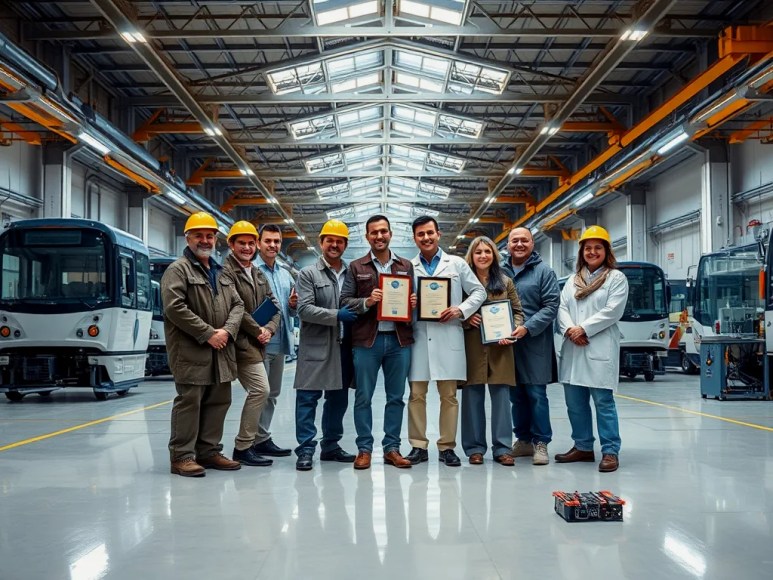
Bozankaya Rail Systems placed 4th in the “Best Performing Company in OSBs” category and 10th in the “Highest R&D Expenditure in OSBs” category in the 2026 OSB Stars Research organized by OSBÜK. The awards reflect measurable performance across production output, operational efficiency and R&D investment intensity reported by organized industrial zone enterprises.
Why the OSBÜK ranking matters for industrial competitiveness
The OSBÜK methodology evaluates firms on a combination of quantitative indicators: production volume, value-added, export performance, R&D spending relative to revenue, patent activity and workforce qualifications. Bozankaya’s 4th place in performance points to strong manufacturing throughput and market reach, while the 10th place in R&D spending confirms sustained investment in product and process innovation. These placements increase the company’s visibility to supply-chain partners, investors and public procurement units.
Concrete R&D investments and capabilities at Bozankaya
Bozankaya reports more than €50 million invested in research and development to date, completion of 41 R&D projects and a technical staff exceeding 200 engineers and specialists. These figures translate into repeatable capabilities: modular vehicle architecture development, traction and energy management systems, and local sourcing strategies that reduce unit costs. Example: a recent R&D cycle reduced energy consumption on a light-rail vehicle by optimizing regenerative braking and inverter control software — measurable gains in kWh/km across urban duty cycles.
How international projects amplify local R&D
Participation in Horizon Europe (Cluster 5) programs gives Bozankaya access to cross-border consortia, testbeds and co-financed pilot deployments. The company completed two Cluster 5 projects and participates in four additional international projects focused on climate, energy and mobility. These collaborations enable technology transfer, shared validation protocols and accelerated market entry for sustainable mobility solutions. For example, joint trials under EU-funded projects often provide standardized KPIs — energy per passenger-km, lifecycle emissions and downtime rates — that feed back into product roadmaps.
Product portfolio emphasis: trams, metros and electric buses
Bozankaya designs and manufactures trams, metro cars and electric buses, emphasizing local engineering and production. Their approach combines platform standardization with configurable modules for different city profiles: short-radius tight-turn trams for historic centers, high-capacity metro cars for trunk corridors, and battery-electric buses optimized for stop-start routes. This modularity shortens time-to-deploy, simplifies spare-parts logistics and supports export offers backed by lifecycle cost models.
Operational outcomes and measurable examples
Production-scale outcomes include reduced lead times through lean assembly practices, improved first-pass yield on electronic control units, and reductions in total cost of ownership for clients through energy-efficient propulsion subsystems. Example metrics that buyers track and that Bozankaya reports improving: procurement-to-delivery lead time (reduced by investment and collaborative execution. The company commits to continuing investments targeted at smart mobility features (telemetry, predictive maintenance analytics), battery and grid-integration improvements, and expanding international partnerships to scale production and exports.
What this means for cities and buyers
For municipal operators and procurement teams, Bozankaya’s OSBÜK rankings signal a supplier with measurable production performance and a track record of R&D commitments. Cities evaluating vendors can expect clearer technical documentation, local engineering support, and project proposals that include energy and lifecycle cost estimates — useful when comparing total-cost-of-ownership and sustainability objectives.
Next steps and indicators to watch
Watch for these indicators to assess ongoing momentum: published results from Horizon Europe pilots, new patent filings, announced export contracts, changes in R&D spend relative to revenue, and demonstrable improvements in fleet operational KPIs (energy per passenger-km, availability percentage, and maintenance intervals). These data points will show whether rankings convert to sustained market leadership.