
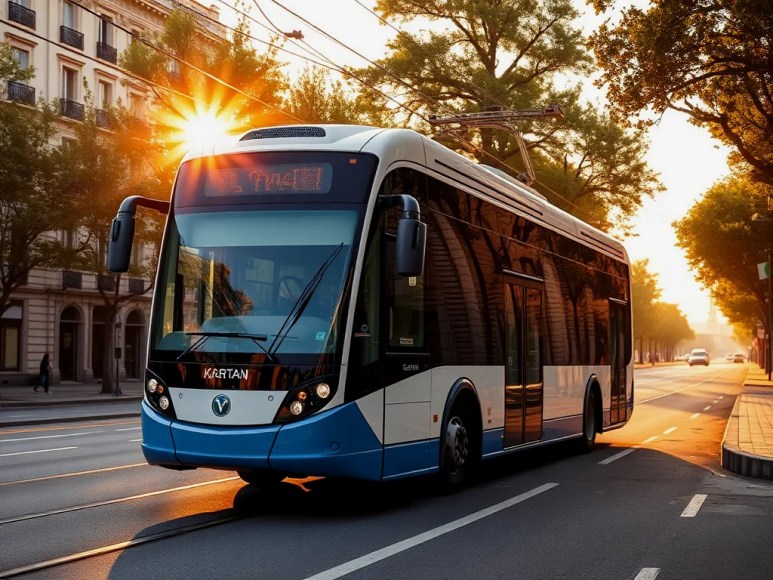
Karsan’s Italian partner KMOBILITY signed a contract to supply 35 18-metre e-ATA trolleybuses to Bologna public transport operator TPER, with options that could raise the total to 70 vehicles. The agreement builds on a 2022 order for 24 e‑ATA electric buses and brings Karsan’s local fleet to 59 units. KMOBILITY will also provide maintenance, spare parts and technical support to ensure continuous operation.
How the new e-ATA trolleybuses charge and why In Motion Charging matters
The e-ATA uses In Motion Charging (IMC) technology to draw power from overhead catenaries while simultaneously recharging its batteries. When trolley wires are absent, the vehicle switches to stored battery energy and continues the route uninterrupted. This dual‑mode capability reduces dependency on continuous overhead infrastructure and enables flexible route design. The vehicle also accepts external DC fast charging up to 200 kW, shortening turnaround times during peak operations.
Capacity, interior layout and passenger comfort details for Bologna configuration
Configured for Bologna with four doors and a full low-floor layout, each e-ATA can carry up to 146 passengers. The interior includes dedicated wheelchair and stroller spaces with integrated access ramps, multiple USB charging outlets for passengers, and a climate control system with enhanced air filtration. These elements improve dwell times and accessibility while maintaining passenger comfort during high‑load urban services.
Performance figures and drivetrain characteristics
The electric drive system can deliver up to 22,000 Nm of peak torque, supplying the acceleration and grade performance required for dense urban lines. Battery and engine management systems optimize energy use during stop‑start operation, regenerative braking returns energy to the pack, and thermal management preserves battery life across seasonal extremes. These combined features lower operating costs per kilometer compared with comparable diesel alternatives.
Safety and driver assistance technologies included
The e‑ATA comes equipped with multiple advanced driver assistance systems (ADAS): acoustic vehicle alerting for vulnerable road users, forward collision and pedestrian collision warnings, lane departure alert, adaptive following distance monitoring, and traffic sign recognition. Together these systems reduce incident risk on busy inner‑city routes and assist drivers in maintaining schedules while prioritizing safety.
Operational benefits for TPER and route planning implications
By integrating IMC trolleybuses, TPER gains route flexibility: operators can deploy overhead wiring where most efficient and rely on battery operation across intersections, historical centres, or temporary obstructions. This mix lowers infrastructure costs compared with fully wired networks and allows staged electrification—installing catenaries only on high‑energy segments. Fleet sizing to 59 Karsan vehicles creates resilience and simplifies parts inventory and technical training.
Maintenance, spare parts and lifecycle support model
KMOBILITY’s package includes preventative maintenance schedules, stocked spare parts and technical training for TPER’s crews. Preventative regime highlights include high‑voltage system checks, cooling system inspections, and scheduled battery health diagnostics. Proactive servicing preserves battery capacity and reduces in‑service failures, which directly impacts availability rates and lifecycle total cost of ownership.
Examples and data points operators should evaluate before ordering
Operators considering similar procurements should quantify: expected daily duty cycles in kWh, percent of route under catenary, peak charging power availability, depot charging capacity, and anticipated annual mileage. For example, a 150‑km daily duty cycle with 60% catenary coverage can cut required battery capacity by more than half versus full off‑wire operation, lowering upfront costs. Assess depot grid upgrades early: a 200 kW external charger per vehicle requires coordinated utility planning to avoid bottlenecks.
What this delivery means for urban electrification in Bologna
Adding 35 e‑ATA trolleybuses reinforces Bologna’s electrification momentum by expanding zero‑tailpipe public transport capacity while preserving route adaptability. The approach—combining IMC vehicles, selective catenary deployment and fast charging—offers a replicable model for medium-sized European cities aiming to decarbonize transit without full infrastructural overhaul.