
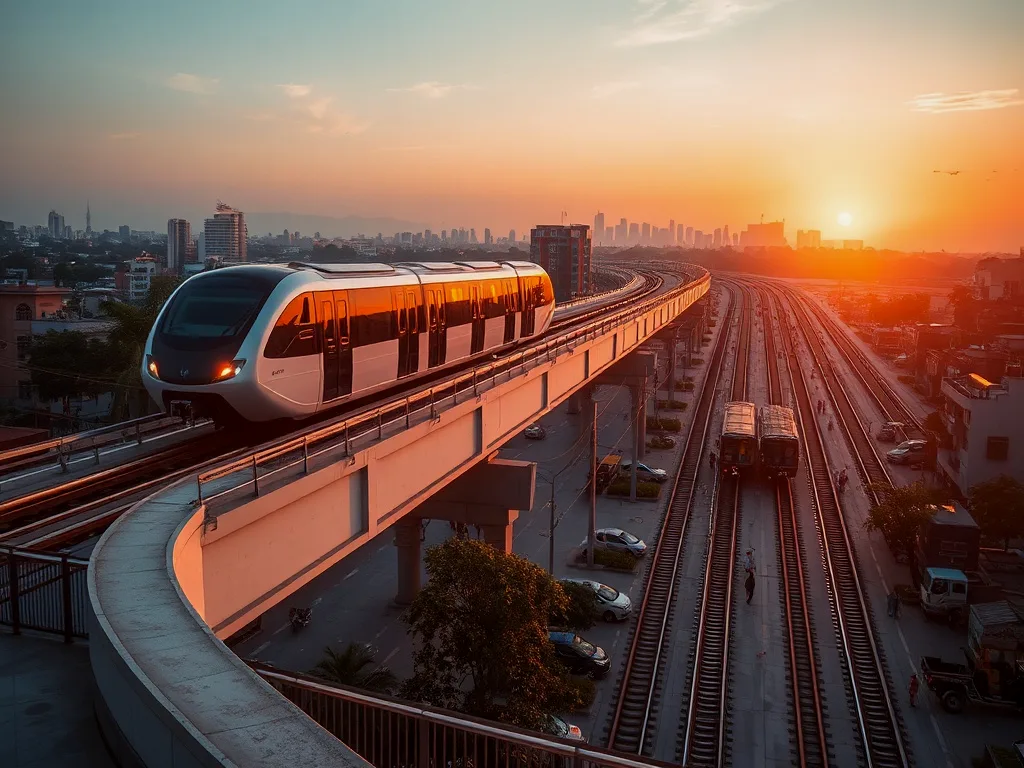
Five metro lines funded mainly by bond issuance
Hanoi will finance the construction of five new metro lines through a mix of central and local budget contributions and a planned bond issuance of up to VND121.7 trillion. City planners allocated VND62.4 trillion from existing public budgets for lines 1, 2, 8, 10 and 14, and intend to cover the remaining 66.1% of the VND184.1 trillion total requirement with municipal bond sales. This split financing shortens the funding gap immediately while preserving fiscal flexibility for other priority projects.
How the bond program will be structured and executed
The bond program is designed as a three-tranche issuance offering tenors of five, ten, 15 and 20 years. Each tranche will be priced and sized based on market conditions at time of sale and may be issued by auction or through committed placement. Planning scenarios estimate recurring annual interest and fees near VND9.7 trillion under current rate assumptions. The VND121.7 trillion figure represents an upper legal cap rather than a firm commitment to that exact issuance amount.
Why tranche lengths and issuance methods matter
Choosing a mix of 5–20 year maturities staggers debt service and limits refinancing concentration in any single year. Auctions help discover competitive market rates; Committed placements can accelerate funding when time-sensitive procurement or construction milestones require immediate cash flows. City finance officials will balance rate risk, liquidity needs and investor demand when sequencing tranches.
Construction timeline, contractors and scope
The Vinhomes–VinSpeed consortium has been contracted to perform engineering, procurement and construction works for the five lines. Groundbreaking ceremonies took place in June 2026 and the city targets substantial completion of major works by 2030. Final route lengths remain provisional because of differing official statements; Procurement packages still under negotiation will lock exact alignments and station counts. Project management teams intend to phase construction to allow parts of lines to open earlier and generate operational revenue while other segments remain under build.
Operational projections and ridership buildup
Existing Hanoi lines — including Line 2A and the elevated segment of Line 3 — carried more than 20.6 million passengers in 2025 across roughly 162,000 services. Officials expect partial openings of the third line in 2027 to accelerate modal shift, with full integration of the five new routes boosting network capacity and connectivity. Ridership forecasts factor in transit-oriented development near station nodes and expected population growth; phased openings will create incremental ridership that helps validate revenue assumptions used in bond-payback modeling.
Public investment priorities and alternative funding sources
Hanoi’s 2027 public investment plan totals VND373.2 trillion, positioning metro expansion as a priority within that envelope. The city is also evaluating financing alternative: land-value capture from increased property values around stations, targeted urban redevelopment projects aligned with mass transit, and proceeds from strategic land sales. Combining these sources with bond finance reduces reliance on annual budget appropriations and spreads the fiscal burden across beneficiaries of improved transit access.
Key risks, mitigation and monitoring
Major risks include route finalization delays, construction cost overruns, interest-rate spikes that widen debt service costs, and slower-than-expected ridership growth. Risk mitigation measures under include consideration:
– Phased openings: Shorter segments open earlier to produce revenue and demonstrate progress.
– Cost-controls: Fixed-price contracts where feasible and independent construction audits.
– Interest management: Staggered maturities and potential use of interest-rate hedges for a portion of floating exposure.
– Revenue diversification: Capturing land value uplift, station-area commercial leases and advertising to supplement farebox income.
Practical timeline and next steps for implementation
Practical steps remaining include finalizing exact alignment and station plans, completing procurement for major systems (rolling stock, signaling, power supply), preparing bond offering documentation and credit support decisions, and obtaining approvals for tranche-by-tranche issuance. Expected near-term milestones are: final route confirmation and procurement awards in late 2026, initial bond tranche offered in early-to-mid 2027 to match construction cashflow needs, and stepped commissioning of line segments through 2027–2030.
What residents and investors should watch
Residents should monitor phased opening dates, station-area redevelopment plans and updates on fares and service frequency; These will directly affect travel choices and property values. Investors and bond market participants should track tranche pricing, any municipal credit enhancements, and how the city allocates proceeds between capital works and initial operating subsidies. Transparency in procurement and independent progress reporting will be crucial to maintain investor confidence and control costs.