
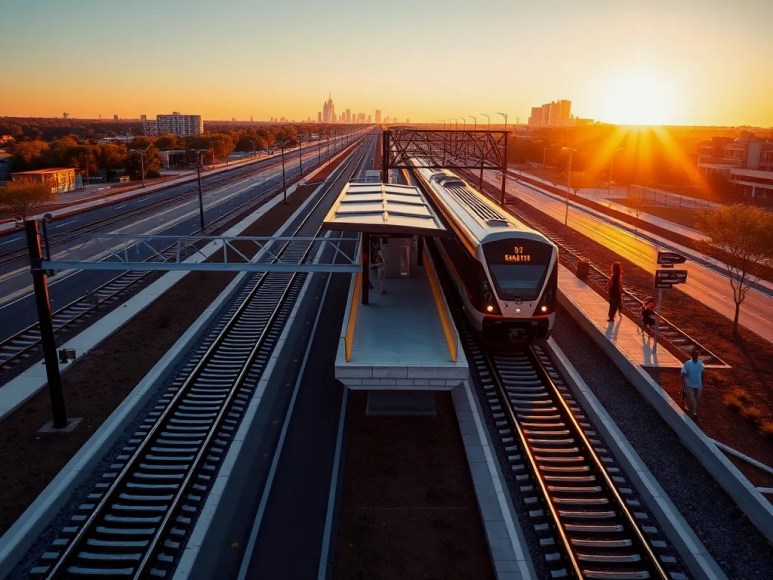
Project scope and contract overview
CapMetro has proposed a construction contract of up to $51.12 million with Jay-Reese Contractors to extend Plaza Saltillo station and add double-track segments along the Red Line. The planned work includes two new side platforms, each roughly 280 feet (about 85.3 meters) long, upgrades to signaling and Positive Train Control (PTC), pedestrian-grade crossing safety improvements, and a shared-use pedestrian/bicycle path between Chicon and Pedernales. The contract recommendation appears in agenda item AI-2026-1970 for the November 16, 2026 board meeting.
Why the expansion is needed now
East Austin has seen growing housing and commercial development that increases demand for reliable transit. Plaza Saltillo currently limits train length and operational flexibility because of single-track constraints. Adding a second track through the corridor and longer platforms will allow longer train consists, reduce delays from opposing moves, and provide more consistent headways—particularly during peak periods and special events near downtown.
What the construction will deliver, step by step
The program breaks into clear, sequenced elements:
1. Site preparation and utility work: early 2027 work to relocate utilities, conduct right-of-way clearing, and perform geotechnical and subgrade preparation.
2. Track and rail bed installation: spring 2027 installation of the second mainline rail where single track exists, including ballast, ties, and drainage improvements across the Onion Paseo–Robert T. Martinez Road corridor.
3. Platform construction: simultaneous construction of two 280-foot side platforms with accessible ramps/paths, tactile edging, lighting, and passenger amenities to support longer trainsets.
4. Signaling and PTC upgrades: staged installation and integration so that Positive Train Control and interlocking logic support safe bi-directional operations without major service interruptions.
5. Grade crossing and pedestrian works: safety enhancements at Navasota, Comal, Onion, Chalmers, and Robert T. Martinez crossings; repaving and reconfiguration on East 5th Street; and construction of the Chicon–Pedernales shared-use path.
6. Testing and commissioning: phased system tests through 2029, including vehicle acceptance runs, PTC verification, and signal timing adjustments before full passenger service resumes on the enhanced corridor.
Funding, procurement, and bids received
CapMetro included the project in its FY2027 capital budget and five-year CIP. The solicitation issued August 3, 2026, generated three bids by the September 24 deadline; Jay-Reese emerged as the highest-scoring offer on combined price and technical criteria. The recommended base contract is $44,451,967; a 15% contingency adds $6,667,795 to reach the not-to-exceed $51,119,762. Earlier planning documents from November 2024 showed a $32.184 million estimate with partial RAISE grant support; the new contract reflects scope and market updates rather than a direct apples-to-apples increase.
Construction timeline and operational effects
CapMetro’s schedule anticipates initial work in early 2027, with rail and platform builds starting in spring 2027 and ancillary work stretching into 2029. Staged construction aims to keep Red Line service operating where possible, but short-term speed restrictions, temporary closures at crossings, or limited Single-tracking will be necessary during critical tie-in phases. The plan calls for coordination with TxDOT I-35 and 4th Street bridge projects because periodic bridge work may affect rail operations and require schedule adjustments.
Safety upgrades at crossings and pedestrian connectivity
Grade crossing improvements will combine physical, visual, and signal-based measures: higher-visibility signage, renewed pavement and approach geometry, upgraded active warning devices where appropriate, and better pedestrian delineation. The Chicon–Pedernales shared-use path will improve last-mile access and create a safer bicycling and walking corridor, reducing informal crossing behaviors that often increase risk at busy neighborhood intersections.
How this fits into the Red Line’s broader double-track program
The Red Line runs roughly 32 miles (51.5 km) and serves growing commuter flows into and through Austin. CapMetro has incrementally expanded double-track segments—previously at Leander-Lakeline and around McKalla station—to enable more frequent and reliable operations. Plaza Saltillo’s double-tracking is a strategic infill that increases passing opportunities and operational resilience in the dense East Austin corridor.
Community impacts and mitigation measures
Short-term construction impacts include noise, dust, temporary lane or sidewalk closures, and changes to local traffic patterns. CapMetro’s standard mitigation package emphasizes limited working hours, dust control, public notification of schedule changes, and coordination with local businesses to preserve access. Long-term forecast benefits improved transit reliability, increased transit capacity, and safer pedestrian and bicycle options near the station.
Comparison to earlier budget estimates and what changed
The jump from the November 2024 $32.184 million planning estimate to the 2026 recommended base contract reflects several likely factors: updated design scope (longer platforms and expanded crossing work), inflation and higher construction market costs, refined PTC and signaling specifications, and more contingency planning. Without a detailed budget breakdown published in the new documents, the two figures should be read as successive planning milestones rather than the same deliverables priced differently.
Practical examples and what riders can expect
When complete, Plaza Saltillo will support longer trains that reduce crowding on peak trips and enable schedule recovery when trains meet on the corridor. For example, during an afternoon commute the additional passing point can prevent a delayed inbound train from cascading into subsequent departures; During festival days the longer platforms will accept multi-car consists of handle surges. Pedestrians will gain a consistent, signed route along Chicon–Pedernales and safer crossing environments at five nearby grade crossings.
Key risks and recommended oversight actions
Primary risks include utility relocations that uncover unknown conditions, signal integration complexity with PTC, and third-party schedule conflicts (TxDOT bridge work). Recommended oversight steps: enforce strict site-geotechnical surveys before mobilization, maintain a detailed PTC integration plan with staged milestones, require regular coordination meetings with TxDOT and city traffic engineers, and use a phased testing regimen to validate systems early.