
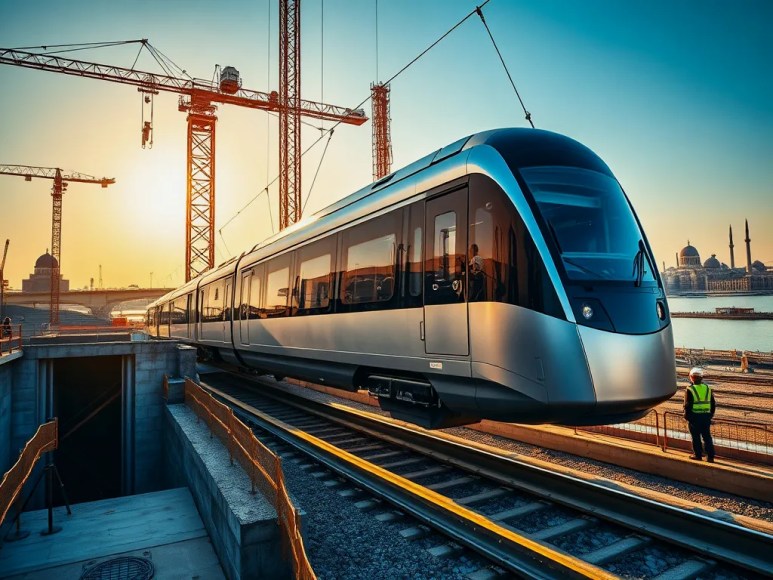
AIIB proposes $820 million loan to extend Baku’s Green Line
The Asian Infrastructure Investment Bank (AIIB) has advanced a proposal to provide $820 million toward a 7.4-kilometer extension of Baku’s Green Line, stretching from Hatayi to Hazi Aslanov. The line extension will create four new underground stations, directly linking eastern neighborhoods to the central metro network and forecasting a marked rise in daily ridership. The total project cost stands at $981.3 million, with the Azerbaijani government expected to fund the remaining $161.3 million. If approved, AIIB’s contribution will raise its cumulative financing for the Baku Metro to about $1 billion.
What the physical works include and why the route matters
Construction will involve tunnel boring and cut-and-cover techniques adapted for heavily built-up urban corridors. Engineers will face contaminated soils and perched groundwater in sections; Designers plan to use ground-freezing, slurry walls and multi-stage dewatering to protect adjacent structures and maintain safe excavation. The four new subterranean stations will be sited to serve high-density residential and commercial blocks, improving first-mile/last-mile connectivity and reducing surface congestion.
Digital modernization: signaling, SCADA and communications
The investment package includes modernization of operational control systems. Project works specify installation of CBTC-compatible train control interfaces to enable shorter headways and higher throughput. A new SCADA backbone will monitor electrical distribution, ventilation, and pump systems in real time. Communications upgrades will deploy fiber rings with redundant paths, MIG/VoIP radio backbone for operations staff and passenger Wi‑Fi-ready infrastructure to support future customer information systems.
How the AIIB loan ties to ADB financing and phased execution
The Asian Development Bank (ADB) approved a separate $302.38 million loan on 13 October 2026 for signalization modernization and digital operations. AIIB’s anticipated co-financing contribution of $79.98 million toward that package is nested within the broader Green Line proposal. AIIB previously approved $180 million on 6 February 2026 for the first phase covering the Darnagul and Hocasan depot works; the new would financing fund the next construction and systems integration stages. AIIB expects to decide on the $820 million proposal in the first quarter of 2027.
Environmental and risk management measures planned
Project developers will implement an environmental and social management plan focusing on soil remediation, groundwater management and settlement monitoring to mitigate risks associated with contaminated fill and tunneling beneath dense urban fabric. Contractors must use closed-loop water treatment systems, lined spoil containment and continuous inclinometer arrays to detect any movement that could affect adjacent foundations. Noise and vibration limits, night-work protocols and traffic management plans will reduce community impact during construction.
Operational outcomes and passenger benefits quantified
Modeling conducted for the extension forecasts a passenger increase of tens of thousands per peak day, a 15–25% cut in peak-hour travel times for affected corridors and modal shift from private cars that can lower localized emissions. Shorter headways enabled by CBTC interfaces could increase line capacity by up to 30% without new rolling stock. Depot upgrades will shorten turnaround times and support more intensive service patterns.
Procurement, financing structure and implementation timeline
Procurement will follow multistage international competitive tendering: design-build contracts for tunnels and stations, specialized system contracts for signaling and SCADA, and separate civil-electro-mechanical integration packages. Financing is structured as a sovereign loan to the Azerbaijani government, with tranche disbursements tied to completion milestones and compliance with environmental and social covenants. Key milestones: detailed design and permits (6–9 months after approval), main tunneling (18–30 months), systems installation and testing (12–15 months), and progressive commissioning by station.
Examples and comparable projects lessons offering
Similar urban extensions that combined tunneling and CBTC upgrades—such as recent metro works in Eastern European capitals—demonstrate that overlapping civil and systems works accelerates commissioning if rigorous interface management is in place. Projects that invested early in redundant fiber and SCADA testing reduced later disruption during system cutover. Baku’s phased depot investments mirror best practices where yard works enable more intensive service once signaling is live.
Questions riders and stakeholders typically ask
When will construction start? Subject to AIIB approval in Q1 2027 and timely permits, main works can start within 6–9 months.
How will daily service be affected? Operators plan staged construction and night-time work to minimize daytime disruptions; temporary bus bridges will cover affected sections.
Who monitors environmental compliance? A third‑party environmental monitoring consultant will report quarterly to the lenders and national authorities.
Be the first to comment