
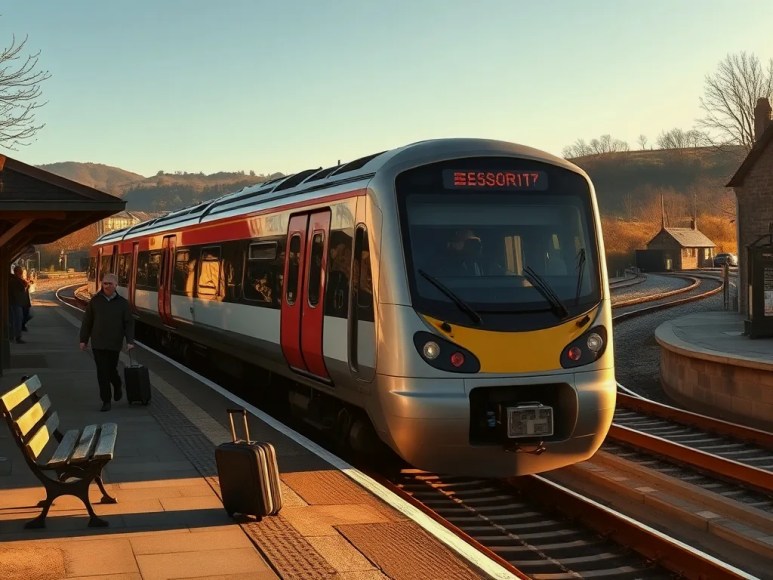
Renewal completed and passenger services restored on 23 November 2026
Network Rail finished a concentrated nine-day engineering possession and reopened the Derby–Matlock line to passengers on 23 November 2026 after a £3 million infrastructure renewal. Crews laid 4.6 kilometers of new rail across a series of strategic locations to restore track geometry and extend service life across the route.
Scope of work: rails, sleepers and ballast replaced
Teams removed worn rails and installed 3,509 new sleepers (traverses) and placed 6,400 tonnes of ballast to reprofile the formation. The work took place near Matlock Bath, Cromford and Whatstandwell stations where track condition and historical settlement required targeted intervention. Using a dedicated track-laying train that installs rails and sleepers while moving, engineers completed long stretches of work efficiently without piecemeal interruptions.
How the nine-day blockade was organized and executed
Network Rail planned a continuous possession from 14 to 22 November 2026 to avoid multiple weekend shutdowns. Organizers scheduled eight engineering trains and tightly sequenced tasks: initial removal, formation inspection, sleeper placement, continuous welded rail insertion, ballast profiling and tamping, followed by geometry measurement and final sign-off. Continuous-working enabled teams to deliver consistent quality across the 4.6 km corridor and reduced exposure to repeated mobilization costs.
Passenger arrangements and service continuity during works
East Midlands Railway ran replacement bus services between Derby and Matlock for the duration of the closure while through services between Derby and Sheffield continued to operate. The continuous nine-day approach prioritized a single, predictable disruption window rather than multiple short closures, reducing recurring inconvenience for season-ticket holders and simplifying timetable planning for rail operators.
Expected operational benefits and maintenance implications
Replacing rails, sleepers and ballast restores track geometry and improves ride quality, reducing wear on rolling stock and lowering the likelihood of speed restrictions. Network Rail expects fewer delay incidents caused by track failures and lower medium-term maintenance expenditure. Real-world data from similar projects show that comprehensive renewals of this scale can cut reactive maintenance episodes by 30–50% in the first five years when combined with improved drainage and ballast cleaning.
Ridership context: station usage and line demand
Office of Rail and Road figures for April 2025–March 2026 recorded 243,128 entries and exits at Matlock, 90,180 at Matlock Bath and 256,930 at Belper. These counts reflect turnstile or ticket-barrier movements aggregated as station entries/exits rather than unique passengers. The Derwent Valley route, which offers hourly services between Matlock, Belper, Derby and Nottingham, supports both commuter volumes and tourism flows to the Peak District; therefore, infrastructure reliability directly influences local connectivity and visitor economy resilience.
Why this investment matters for local routes and future planning
Targeted investments on regional corridors reduce the probability of emergency interventions that cause longer unplanned closures. The renewal preserves line capacity and supports timetable stability as passenger numbers recover. Past works on the same corridor included the 2019 Ambergate junction renewal and 2023 rail repairs in Clay Cross and Milford tunnels; this project continues a phased approach to bring the corridor to a consistent state of good repair.
What to expect next: monitoring and performance checks
Following reinstatement, Network Rail will run a program of early-life monitoring: track geometry surveys, periodic tamping if settlement appears, and targeted ultrasonic rail inspections. Operators will review timetable performance and customer feedback to confirm benefits materialize in reduced delays and improved punctuality. If any hot spots appear, small-scale follow-up interventions will be scheduled during off-peak or single-track possessions to avoid another full closure.