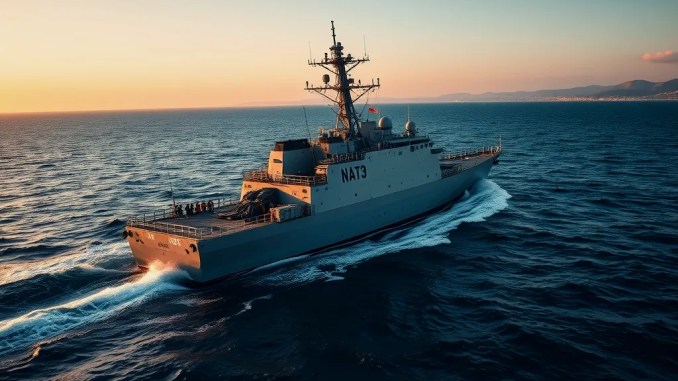
Japan’s Strategic Shift Toward Autonomous Maritime Defense
In a bold move to enhance its maritime security, Japan is actively developing advanced unmanned underwater systems tailored for anti-submarine warfare (ASW). This strategic initiative marks a significant evolution in how Tokyo plans to integrate cutting-edge technology into its national defense infrastructure.
Airbus and Kawasaki Heavy Industries Join Forces
Recently, Airbus, the European aerospace giant, signed a comprehensive Memorandum of Understanding (MoU) with Kawasaki Heavy Industries (KHI), a leader in Japanese defense manufacturing. This collaboration aims to co-develop a specialized unmanned underwater vehicle (UUV) based on the Eurodrone platform, customized specifically for Japan’s maritime needs.
The Importance of Unmanned Submarines for Japan
Japan’s geographical position, with an extensive network of vital sea lanes and territorial waters, makes maritime patrols and undersea defense essential. As geopolitical tensions rise with neighboring countries, Japan recognizes the need to implement robust, autonomous underwater systems that can operate seamlessly in deep waters for extended periods.
By adopting unmanned systems, Tokyo aims to augment intelligence, surveillance, and reconnaissance (ISR) capabilities without risking human lives. These vehicles are designed to carry complex payloads such as sonobuoys, torpedoes, and high-resolution sensors, enabling real-time data collection and analysis critical for early threat detection.
Design and Development of Japan-Specific Variants
The joint venture focuses on designing a new underwater drone adapted from the Eurodrone model, with modifications to handle ASW missions effectively in Japan’s unique maritime environment. These modifications include advanced stealth features, enhanced maneuverability, and integration of locally-produced sensors and effectors compatible with Japan’s existing defense infrastructure.
Commercial production is set to be localized, fostering Japan’s independent capabilities in UUV manufacturing. The collaboration emphasizes training local engineers and establishing maintenance and upgrade facilities to sustain the platform over decades.
Operational and Strategic Benefits
Deploying unmanned underwater vehicles offers Japan several operational advantages:
- Extended deployment durations compared to traditional manned submarines, thanks to autonomous power and navigation systems.
- Ability to operate covertly in hostile environments, providing early warning of submarine threats.
- Enhanced collaborative capabilities with existing naval assets through network-centric warfare strategies.
- Potential for multi-mission adaptability, including mine detection, reconnaissance, and signals intelligence.
Strategic Independence and Technological Sovereignty
This partnership aims to reduce reliance on foreign nations for critical defense components and strengthen Japan’s technological sovereignty. By working with Airbus, KHI ensures the integration of state-of-the-art European technology with local innovations, creating platforms that are tailored to Japan’s strategic needs.
The project also aligns with Japan’s broad goal of achieving full operational independence in underwater domain awareness, crucial for deterring hostile actions and maintaining regional stability.
Broader Implications for Regional Security and Defense Industry
Japan’s move toward developing indigenous unmanned underwater systems sparks shifts within Asia-Pacific’s security dynamics. Nearby nations are increasingly investing in unmanned and autonomous maritime platforms to counterbalance China’s expanding submarine fleet and North Korea’s undersea activities.
This alliance also signals a series of collaborative efforts across Europe and Asia to accelerate innovative defense technology development. It underscores the trend that regional security architecture increasingly relies on autonomous systems for strategic deterrence.
Potential Challenges and Future Outlook
Despite promising prospects, the collaboration faces hurdles such as technological integration complexities, local regulatory frameworks, and export control laws. Ensuring robust cybersecurity measures for these unmanned systems against hacking and electronic warfare is paramount.
Looking ahead, Japan’s push into autonomous maritime systems is expected to expand, with potential for global export and joint international missions. The success of this partnership could establish Japan as a leader in unmanned underwater technology, reshaping the future of undersea warfare and maritime security worldwide.