
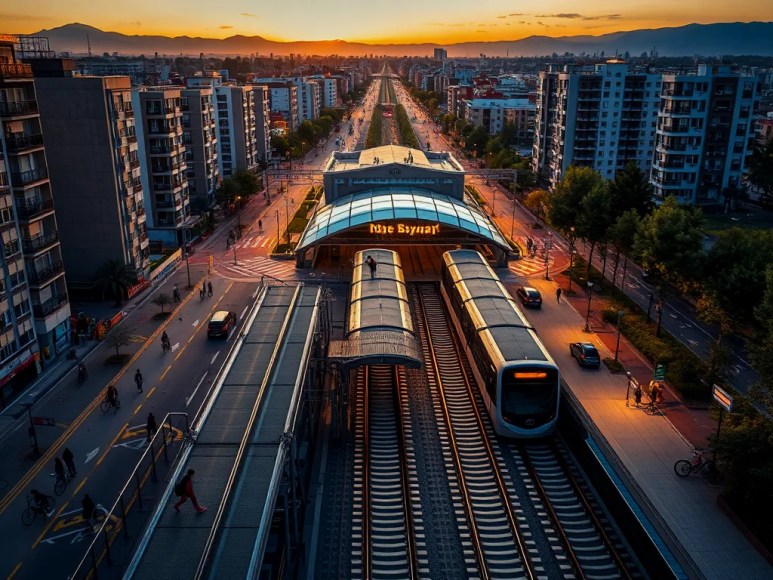
Mamak Metro Will Transform Local Mobility
The Dikimevi–Natoyolu line (7.43 km, eight stations) is under construction and will connect Mamak’s neighborhoods to the existing ANKARAY network. Stations planned—Abidinpaşa, Âşık Veysel, Tuzluçayır, General Zeki Doğan, Fahri Korutürk, Cengizhan, Akşemsettin and Natoyolu—create multiple new interchange and access points. By linking previously underserved corridors, the line shortens commutes, concentrates transit-oriented activity around station nodes, and enables faster, more reliable travel to central employment and education centers.
Yaşamkent–Bağlıca Extension Opens New Growth Corridors
The Koru–Yaşamkent–Bağlıca extension (9.36 km, five stations) entered the 2026 Public Investment Program. It will add Koru, Konutkent, Yaşamkent Giriş, Yaşamkent Merkez, Başkent Üniversitesi and Bağlıca access points, simplifying transfers onto the existing metro network. Developers and local councils expect higher footfall around station entrances; practical effects include improved bus-rail integration, increased pedestrian flows, and opportunities for last-mile micro-mobility services.
Kızılay–Dikmen Line: What the Plan Covers
The proposed Kızılay–Dikmen alignment spans 15.25 km with 11 stations (Esat, Kuğulu Park, Dikmen Vadisi, Öveçler, Keklik Pınarı, Akpınar, Oran, among others). Although not yet included in the investment program, its route targets high-demand residential and commercial pockets. If funded and delivered as designed, the project will redistribute peak loads away from central corridors and provide redundancy that reduces single-point congestion in the downtown spine.
M6 Link Connects Eryaman, Sincan, and Çayyolu
The M6 proposal (12.5 km, five stations) aims to join Çayyolu and Sincan lines with stops at Ahimesut, Alsancak, Ahi Evran, Eryaman YHT and Şapka Revolution. This cross-connection promotes balanced network capacity and creates direct inter-suburban journeys that today require multi-leg transfers. For commuters, expected outcomes are shorter journey times and fewer transfers; for network planners, the line provides operational flexibility during disruptions.
Quick Reference: New Metro Projects and Key Facts
Below is a concise project summary for quick decision-making and comparative analysis.
Projects and specifications:
Dikimevi–Natoyolu — 7.43 km, 8 stations, construction ongoing.
Koru–Yaşamkent–Bağlıca — 9.36 km, 5 stations, included in 2026 investment program.
Kızılay–Dikmen — 15.25 km, 11 stations, planning stage.
M6 Çayyolu–Sincan — 12.50 km, 5 stations, proposed.
How New Metro Stations Typically Change Neighborhoods
Stations alter urban dynamics through measurable channels. Expect these direct effects:
Accessibility gain: Average door-to-door travel times shrink when high-frequency rail replaces long bus rides. For a 30–45 minute bus commute, a metro link can cut travel time by 20–30% depending on transfers.
Land-use response: Mixed-use and higher-density development commonly cluster within a 400–800 meter radius of stations. Municipal zoning updates often follow to capture increased demand.
Rental and sales dynamics: Proximity premiums appear first in rental markets and then in sale prices; However, magnitude depends on supply elasticity, building condition, and local amenities.
Investment and speculation: Early public announcements can prompt speculative buying around planned stations. The risk/reward profile varies by project delivery certainty and timeline.
Step-by-Step: Evaluating a Property Near a Planned Station
Follow this checklist to assess whether proximity to a planned metro justifies purchase or repositioning:
1) Confirm project status—construction start, procurement, or merely feasibility studies affect timing and risk.
2) Map exact station locations and planned entrances to determine walk-shed (400–800 m).
3) Review local zoning and planned municipal upgrades that may allow densification or commercial change of use.
4) Compare recent rental and sales transactions within the station walk-shed against a control area 2–3 km away to estimate current premiums.
5) Factor in building-level attributes: age, structural condition, heating/cooling efficiency, parking, and elevator access influence net premium capture.
6) Model cashflow scenarios with conservative and optimistic completion timelines, including vacancy and construction disruption risks.
Examples and Data Points That Matter
Use real-world comparators: in many cities, median rents within 500 m of new metro stations rise 5–15% in the first 12–24 months after opening; sale prices typically follow after 1–3 years if supply remains constrained. In Ankara’s context, neighborhoods already integrated with metro or ANKARAY showed improved retail occupancy and shorter commute times—indicators investors track when projecting post-completion demand.
Risks and Mitigations for Buyers and Planners
Common risks include construction delays, changes in project scope, and overbuilding of housing that dilutes premiums. Mitigate these by prioritizing projects with secured funding, phased delivery, and municipal commitments to station-area public realm improvements. For developers, offering flexible floor plans and ground-floor commercial fronts increases resilience to market shifts.
Operational and Network Benefits Beyond Travel Time
New lines add resilience: alternative routes reduce overloads on main corridors. Interchanges created by the Koru extension and M6 link enable direct cross-suburban trips, lowering dependence on central transfers. Operationally, this allows the transit agency to reroute services during maintenance and emergencies, stabilizing system-wide punctuality.
What to Watch Next—Timelines and Decision Points
Watch these milestones to understand when impacts will materialize:
– Procurement awards and contractor mobilization (signal for imminent construction).
– Utility relocation and right-of-way clearance (periods of local disruption but necessary progress).
– Station shell completion and systems installation (indicates timeline for trial operations).
– Official opening and service ramp-up (when market premiums commonly begin to realize).
Covering Common Reader Questions
Will property values rise automatically near new stations? Not automatically—value change depends on delivery certainty, nearby amenities, supply constraints, and building quality. How long until benefits appear? Rental effects often show within months after opening; sale-price effects may take 1–3 years. Should I buy now or wait? If you accept development risk and can secure favorable purchase pricing, buying earlier can capture upside; risk-averse actors prefer to wait for operational proof.
Conclusion: Balancing Opportunity and Risk
Ankara’s planned and under-construction metro projects create clear mobility gains and localized opportunities for urban renewal and property value appreciation. Decision-makers and investors should combine project-level verification, walk-shed mapping, and conservative financial modeling to translate transport infrastructure into sustainable asset value.