
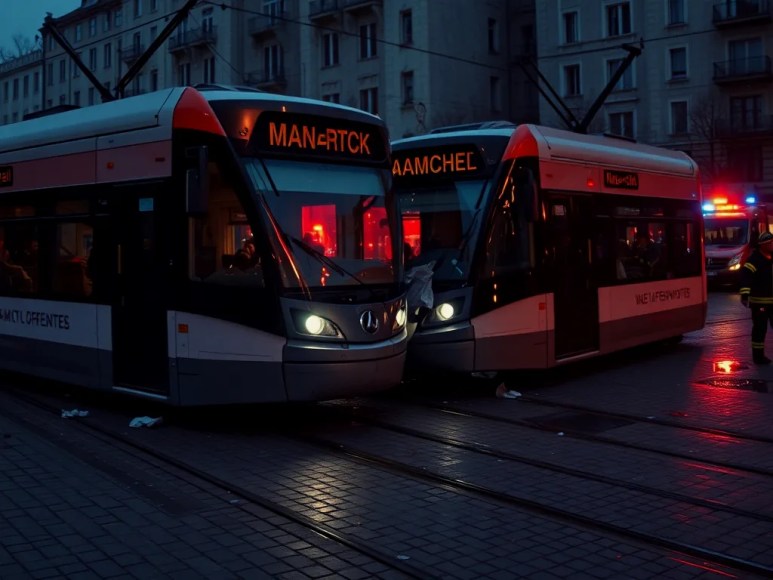
On the evening of November 17, 2026, two T9 trams collided at Verdun-Hoche station in Thiais, south of Paris, leaving eight people with minor injuries and causing significant front-end damage to one vehicle. Emergency teams responded quickly, and operators suspended tram services while putting replacement buses into operation to maintain passenger flow.
What happened at Verdun-Hoche and how did responders act?
At 19:47 local time, a tram that was stationary at Verdun-Hoche was struck by another tram traveling on the same track. Keolis, the line operator, dispatched inspection and emergency teams immediately. First responders treated eight passengers with minor injuries on site; no critical injuries were reported. Crews secured the scene, assessed structural damage to the vehicles, and coordinated movement of replacement buses to continue service on the corridor.
Extent of damage and evidence from the site
Photographs and video shared from the incident show heavy deformation to the struck tram’s front section, indicating a substantial impact at the point of contact. Technical teams documented deformation patterns, broken exterior panels, and displaced interior fittings to guide the initial forensic assessment. Operators removed the damaged unit from service for a detailed mechanical inspection and structural integrity check.
How did authorities restore passenger service and manage disruptions?
Keolis announced that T9 services would not resume that evening. To reduce disruption, the operator immediately deployed a fleet of replacement buses covering stops between Porte de Choisy and Orly, preserving connections for commuters in Val-de-Marne and Paris’s southern neighborhoods. Staff positioned at key stations provided real-time updates, passenger re-routing advice, and assistance for those with reduced mobility to ensure continuity of travel.
What investigations are underway and what will they examine?
An on-site investigation began to determine the collision’s root causes. Investigators plan to examine event recorder data from both trams, braking system performance logs, driver duty and communication records, and the signaling and track control systems for anomalies. They will also interview crew members and review maintenance histories. The investigation will separate potential human factors from technical failures and operational procedures, and will include a timeline reconstruction of movements and control commands before impact.
Immediate technical checks and the typical forensic steps after a tram collision
Investigators follow a standard multi-step approach: 1) secure the scene and collect witness statements; 2) isolate and preserve electronic event recorders and onboard diagnostics; 3) photograph and map vehicle damage; 4) recover braking system data and check wheel/rail interactions; 5) review signaling logs and track circuitry; 6) cross-check driver rostering, fatigue factors, and radio communications; and 7) analyze maintenance records for both trams. These steps produce a factual dossier to determine whether human error, equipment malfunction, signaling fault, or a combination contributed to the collision.
Why replacement buses were chosen and how they were organized
Operators often select buses as the fastest scalable alternative to maintain capacity when rail vehicles are removed from service. In this case, Keolis staged buses to follow the T9 corridor, aligning stops with tram platforms where possible to minimize walking distances. Crews prioritized wheelchair-accessible units and increased departure frequency during peak segments to replicate tram throughput. Real-time adjustments were made based on passenger demand and traffic conditions.
What this means for T9 passengers and short-term service expectations
Passengers should expect service disruption on T9 until investigators release clearance for normal operations and any damaged infrastructure is repaired. In similar incidents, full service restoration can take from hours to several days depending on damage severity and the time required for safety inspections. Customers were advised to check operator updates, use alternative tram or RER lines where feasible, and allow extra travel time while replacement buses operate on variable schedules.
Context: T9 line role and ridership significance
The T9 connects Porte de Choisy in Paris’s 13th arrondissement with Orly, serving dense residential and commercial zones in the city’s southern suburbs. It functions as a key feeder route to airport connections and other mass transit nodes, carrying commuters, students, and airport-bound travelers. Disruption on this axis therefore affects multimodal transfer points and local traffic patterns, amplifying the importance of rapid restoration and a thorough investigation.
Likely outcomes and recommended operator actions after the inquiry
Following completion of the technical and operational review, likely outcomes include targeted maintenance or component replacement, modifications to signaling or safety protocols, retraining or procedure updates for drivers, and potential timetable adjustments. Best practice recommendations typically prioritize implementing corrective measures swiftly, publishing clear findings to restore public confidence, and scheduling follow-up safety audits to verify remediation effectiveness.
Key facts at a glance:
• Date/time: November 17, 2026, 19:47 local time.
• Location: Verdun-Hoche station, Thiais (T9 line).
• Casualties: eight people sustained minor injuries.
• Operational impact: T9 services suspended; replacement buses deployed.
• Investigation: ongoing — will examine recorders, braking systems, signaling, maintenance, and human factors.
Be the first to comment