
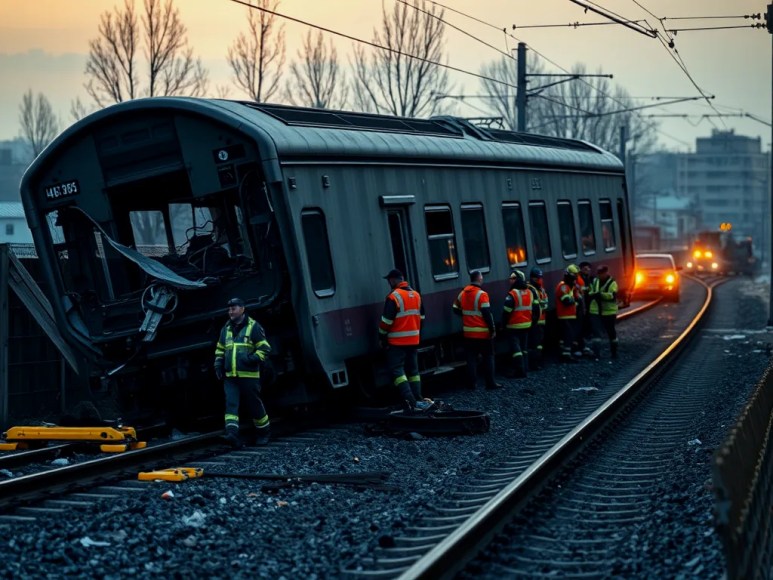
Forty-six passengers were injured when two suburban trains collided head-on on a rail bridge near Prague Main Station early on the morning of 17 November 2026. Emergency teams responded immediately to the crash on Seifertova Street in Prague 3. Officials reported four people in serious condition, including both train drivers; 12 were moderately injured and 30 sustained minor injuries. Local hospitals received patients to avoid overwhelming any single facility.
What happened at the scene and how responders acted
Trains approaching from opposite directions struck each other at low speed while traveling toward Prague Main Station. The collision occurred between 07:00 and 07:20 local time on a rail overpass, which limited the speed and therefore the extent of structural damage. Firefighters, police, ambulance crews and railway emergency specialists secured the area, triaged victims, and transported them to multiple hospitals across the city.
Rescue teams prioritized stabilizing seriously injured passengers and separating the scene for forensic examination. Because the trains remained largely intact, responders did not require heavy extrication equipment; instead they carried out rapid medical assessments, bandaging, spinal precautions where indicated, and stretcher transfers to waiting ambulances.
Initial casualty breakdown and care logistics
Officials updated the injury count from an early estimate of roughly 15 to a verified total of 46 after on-site medical evaluation. The breakdown provided by state television ČT24 shows:
– 4 seriously injured (including two drivers)
– 12 moderately injured
– 30 with minor injuries
To reduce hospital congestion, authorities distributed patients among Prague hospitals according to injury severity and bed availability. Emergency departments adjusted staffing and mobilized trauma teams for the seriously injured, while outpatient clinics handled minor cases and discharge follow-ups.
Possible causes under investigation: signal, technical failure, or human error?
The Transport Minister Ivan Bednárik said early findings indicate one train may have passed a red signal. Investigators treat a signal violation as a plausible hypothesis but have not concluded the cause. The central safety system issued an overall stop command that did not entirely prevent the impact; trains collided while braking at low speed.
Rail accident investigators typically follow a step-by-step process that examiners at the Czech Rail Inspectorate are now using:
1. Secure scene and preserve evidence — isolate wreckage, log positions, and protect onboard data recorders.
2. Collect technical data — download event recorders (black boxes), review braking logs, and inspect signaling hardware and track circuits.
3. Interview crew and witnesses — obtain immediate statements from drivers, dispatchers, and passengers.
4. Reconstruct sequence — use data, video, and marks on the infrastructure to model speed, braking, and signal aspects.
5. Identify root causes — determine if human error, equipment malfunction, software fault, or procedural gaps led to the collision.
This methodology helps separate proximate causes (eg, a signal overrun) from underlying systemic factors (eg, maintenance lapses, training, or interlocking failures).
Operational impact on Prague rail services
Authorities suspended or limited traffic around Prague Main Station and on lines toward Libeň and Vysočany while crews cleared wreckage and inspectors surveyed the site. Passengers experienced delays, cancellations, and reroutes; station announcements and railway company channels provided rolling updates.
Rail operators phased reopening of affected tracks after structural inspections confirmed platform and track integrity. Contingency measures included bus substitutions on severed sections, timetable compression on alternate corridors, and coordination with long-distance services to mitigate ripple effects across the network.
Scope of damage and estimated financial impact
Preliminary assessments by the Czech Rail Inspectorate estimate material losses could exceed 16 million Czech Koruna. Damage categories under review include:
– Rolling stock repair or write-off costs
– Track and signaling equipment repairs, especially on the overpass structure
– Station platform and overhead line inspections and fixes
– Emergency response and medical expenses
– Potential compensation and legal costs
Investigators will refine the damage estimate once full technical surveys and component-level inspections conclude.
What investigators are examining on signals and safety systems
Inspectors are auditing the interlocking logic, signal aspect histories, and the central control command that issued a stop. They will:
– Download and analyze event recorders from both trains for speed, brake application, and driver actions.
– Retrieve signal box logs and SCADA-type records showing when signals changed and whether any faults were logged.
– Physically inspect track circuits, axle counters, and point machines on the approach to the collision site.
– Review CCTV and any third-party video to correlate timing.
If a signal was overrun, investigators will study whether the cause was a dispatcher instruction, a misread signal aspect, driver distraction or incapacitation, or failures in in-cab warnings and automatic train protection systems.
Practical steps passengers and commuters should expect next
– Check official rail operator advisories and live station displays before traveling.
– Allow extra journey time; expect altered platforms and longer interchanges.
– Use alternative transport (buses, trams, metro) when available; operators often run shuttle buses across disrupted corridors.
– Keep receipts and documentation if you incur extra travel costs; guidance on guidance or refunds will follow from the operator.
Why this crash compensation matters for urban rail safety
The incident highlights how even low-speed collisions near major hubs can produce concentrated casualties and substantial operational disruption. Analysts will watch whether the probe reveals failures in automatic protection layers—such as automatic train stop or European Train Control System (ETCS) functionality—or in human procedures that rely on signal observation under heavy traffic.
Improvements that typically follow such investigations include tightened interlocking redundancy, enhanced driver training, additional in-cab warnings, and prioritized modernization of legacy signal systems on congested approaches.
Next steps and timeline for the investigation
The Czech Rail Inspectorate and police are jointly investigating and will publish interim findings as they complete key technical downloads. A comprehensive final report usually takes weeks to months depending on data complexity, component repair needs, and legal investigations. Until then, authorities will continue phased restoration of services and brief the public with updates on safety assessments and any operational changes.
Who to watch for updates: Ministry of Transport press releases, Czech Rail Inspectorate statements, Prague rail operator customer channels, and national broadcasters providing official casualty and service-status information.
Be the first to comment