
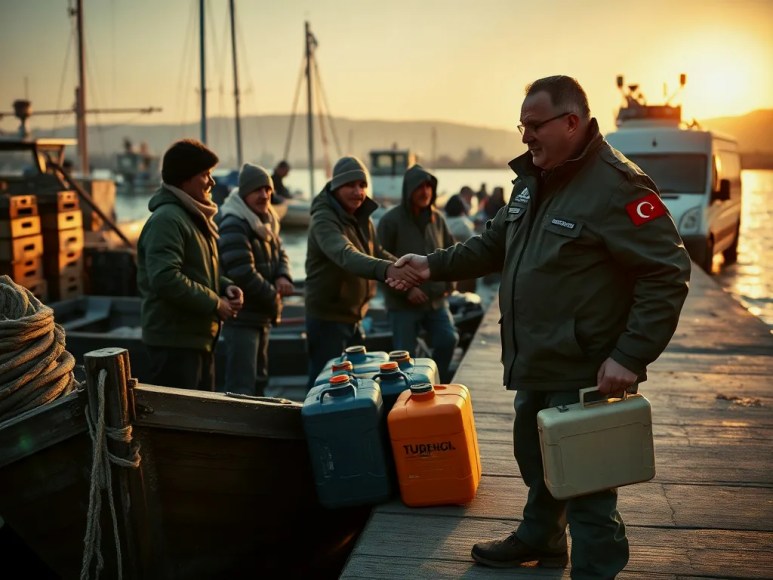
Why this targeted diesel support matters for inland fisheries
Fuel is one of the largest variable costs for small-scale inland fishers: outboard motors, transport to fishing sites, and boat generators consume a disproportionate share of operating budgets. By covering roughly two months of typical fuel use for many recipients, the 5,000 TL payment immediately increases liquidity for inputs such as bait, ice, and net repair, and lowers the risk that fishers suspend trips when prices spike. In places where catch volume has declined, small injections of working capital protect both household income and local fish supply chains.
Eligibility and verification: how recipients were selected
The municipality limited eligibility to fishers who meet three conditions: (1) recorded in the national registry maintained by the Ministry of Agriculture and Forestry, (2) possessing a current professional fishing license, and (3) being an active member of a registered cooperative. Administrative checks matched registry records to cooperative lists and verified license status. Payments were executed via Başkent Kart to ensure quick distribution and traceable delivery.
Technical and advisory support accompanying the cash aid
Alongside diesel payments, the Rural Services (Rural Services) directorate provided technical assistance. Engineers and aquaculture specialists offered on-site troubleshooting for gear maintenance, simple fuel-efficiency measures for small outboards (propeller selection, regular tuning, correct trim), and best-practice handling to preserve product quality after harvest. This combination of cash plus technical input improves the odds that the aid translates into sustained operations rather than one-time relief.
Practical examples: how fishers used the support
Local cooperative leaders reported concrete uses: paying for two months of diesel during lower-yield seasons, buying ice and packaging to preserve catch for market, and replacing worn propellers that improved fuel consumption by measurable margins. One cooperative president estimated the 5,000 TL roughly equated to two months of fuel under current prices; another fisher noted that in prior years similar municipal payments prevented short-term layups when fuel prices rose abruptly.
Step-by-step: what a fisher should do to access and use such a program
1. Confirm registration: Verify inclusion in the Ministry’s fisher registry and that your professional license is valid and up to date.
2. Join a cooperative: If not already a member, join a local registered cooperative because membership was a program requirement.
3. Submit documentation: Provide cooperative confirmation, license copies, and identity details to the municipal rural services office when requested.
4. Receive payment: Accept the 5,000 TL credit on your Başkent Kart and record the transaction for household budgeting.
5. Apply technical advice: Implement recommended fuel-efficiency steps—propeller inspection, regular engine tuning, stable trim—to stretch the fuel purchase further.
6. Track outcomes: Log days at sea, fuel used, and catch weight to measure program impact on productivity across the season.
Local economic impact and supply-chain effects
Small, targeted fuel transfers can stabilize local supply chains. When fishers keep operating, buyers, transporters, local markets, and processors maintain demand and cash flow. The municipality’s 485,000 TL injection helps preserve local availability of fresh water fish and contributes to rural employment continuity. In addition, predictable diesel support reduces the chance that producers sell assets or permanently exit the sector, which would constrain regional supply long term.
Limitations, measurable outcomes and follow-up actions
The payment size does not fully offset all input costs and cannot substitute for structural investments like modern fuel-efficient engines or cold-chain infrastructure. To maximize impact, municipalities can complement direct payments with co-financing for engine upgrades, bulk ice facilities, and training on post-harvest handling. Measuring outcomes requires tracking indicators such as days fished per month, average catch per trip, household income changes, and cooperative-level sales volumes in the six months following aid distribution.
How similar municipalities can replicate this approach
Other local governments can replicate the model with a checklist: confirm accurate registries; tie payments to cooperative membership and licensing to reach practicing producers; deliver funds through traceable cards to reduce administrative delay; pair cash support with technical services to boost effectiveness; and set simple monitoring metrics to assess short-term and medium-term impact. This combination preserves fishing livelihoods, supports local food availability, and buys time for longer-term investments.