
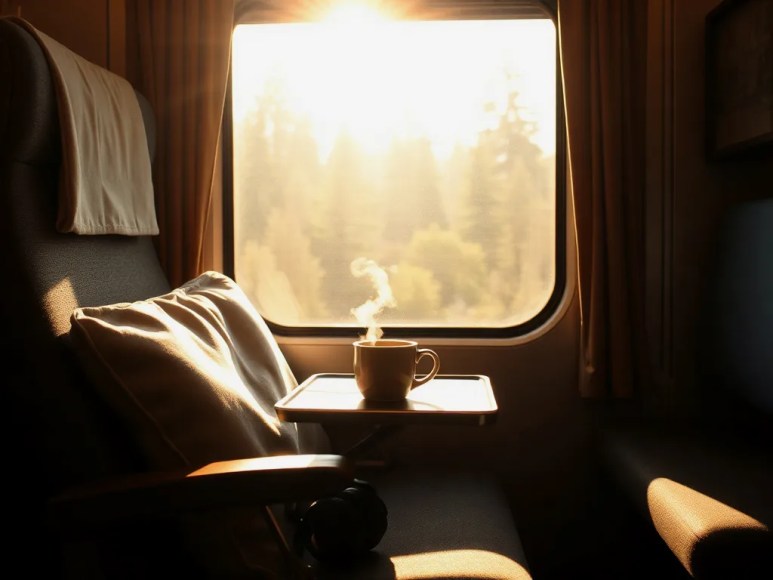
VIA Rail launches a purely recorded train-sound series for sleep and relaxation
VIA Rail Canada released a digital campaign called “Tracks to Relax” that uses authentic onboard recordings from five Canadian rail routes to create long-form sleep and relaxation audio. The campaign features uninterrupted soundscapes captured during real scheduled services rather than studio-produced loops, giving listeners the full length and natural cadence of each journey.
What routes were recorded and how long each track is
The campaign covers five routes recorded live on active trains. The longest track captures the full Toronto–Ottawa run at 4 hours 30 minutes, while the shortest captures a 15-minute Sarnia–Wyoming segment. Together the recordings total 9 hours and 44 minutes, allowing listeners to choose a brief sound clip or a multi-hour background for sleep or focused rest.
Route list and durations
These are the exact routes and durations released on VIA Rail’s YouTube channel:
• Toronto–Ottawa: 4 hours 30 minutes
• Sainte-Foy–Rivière-du-Loup: 2 hours 19 minutes
• Halifax–Truro: 1 hour 32 minutes
• Montréal–Drummondville: 1 hour 8 minutes
• Sarnia–Wyoming: 15 minutes
• Total duration: 9 hours 44 minutes
Why real journey recordings matter for relaxation audio
Recorded onboard while trains operated their normal schedules, these files preserve subtle, non-repeating elements that studio loops cannot replicate: wheel-rail microvariations, track joints at different speeds, ambient carriage noise, and occasional distant horns or station announcements. Those organic variations produce a complex soundscape that many listeners find easier to fall asleep to or to keep as a nonintrusive focus aid.
Creative intent and campaign strategy
Cossette developed the campaign with VIA Rail to place the railway’s presence into daily life outside stations. The creative team prioritized authenticity over synthesized sound, arguing that longer, genuine recordings better hold listener attention compared with short, repetitive loops. VIA Rail positions the initiative as both a brand touchpoint and a demonstration that rail connects more than destinations — it connects people and places through shared sensory experience.
Performance so far: which track resonated most
As of 25 November 2026, the five YouTube uploads amassed 15,351 total views. The Montréal–Drummondville recording accounted for 13,923 views — about 90.7% of the campaign’s viewership — indicating a strong preference for that particular route’s auditory signature. Public view counts don’t reveal listening duration or completion rates, but the concentration of views on one clip suggests route-specific appeal that could guide future releases.
How VIA Rail will measure campaign success
VIA Rail and Cossette plan to evaluate the project using direct engagement metrics and brand indicators: total listening time, average session duration, retention throughout long-form uploads, and changes in brand perception among listeners. They also consider expanding distribution to audio platforms such as Spotify to reach habitual podcast and sleep-aid listeners and to gather platform-level metrics like completion rate and follower growth.
Operational context: fleet renewal and passenger numbers
VIA Rail reported stable ridership of approximately 4.4 million passengers in 2025 while raising total revenue by 7.7% to CAD 514.8 million. The company attributes revenue growth — CAD 36.8 million year-over-year — in part to a new reservation system that offers travelers more choices. In parallel, VIA Rail received all 32 new trainsets ordered for the Québec City–Windsor corridor, supporting service reliability and helping reduce dependence on public subsidies.
Why brands are using long-form ambient audio
Long-form ambient audio offers brands a low-friction way to insert themselves into daily routines: people use sleep and relaxation tracks at night, during naps, or while studying. By delivering an authentic environmental experience tied to VIA Rail’s core service, the campaign leverages utility (helping listeners relax) and relevance (connects sound identity to rail travel). The real-recording approach also gives the brand a defensible creative differentiation in a crowded market of synthesized and algorithmically generated sleep audio.
Practical listening suggestions and use cases
Listeners can use the tracks for different contexts: short-session relaxation (15–30 minutes) to unwind after work, multi-hour background noise during deep-focus sessions, or full-night playback for insomniac listeners who prefer nonmusical sound beds For best results, set playback volume to a comfortable low level, use stereo headphones or a speaker placed to avoid direct loudness, and choose routes whose pacing matches the desired effect (eg, the longer Toronto–Ottawa track for extended sleep sessions).
Potential next steps for the campaign
VIA Rail could expand by releasing seasonal variants (rain-on-window recordings, winter-wheel signatures), publishing route metadata (speed, track type, carriage class) to help listeners choose sounds, and offering curated playlists by intended use (sleep, focus, meditation). Deploying these tracks on audio platforms will also enable richer analytics to refine route selection and inform marketing spend.
Key takeaway
Tracks to Relax demonstrates how a transport operator can repurpose operational assets into owned-media experiences: by using genuine onboard recordings, VIA Rail created a unique, long-form audio product that supports relaxation and strengthens brand association with the sensory qualities of rail travel.