
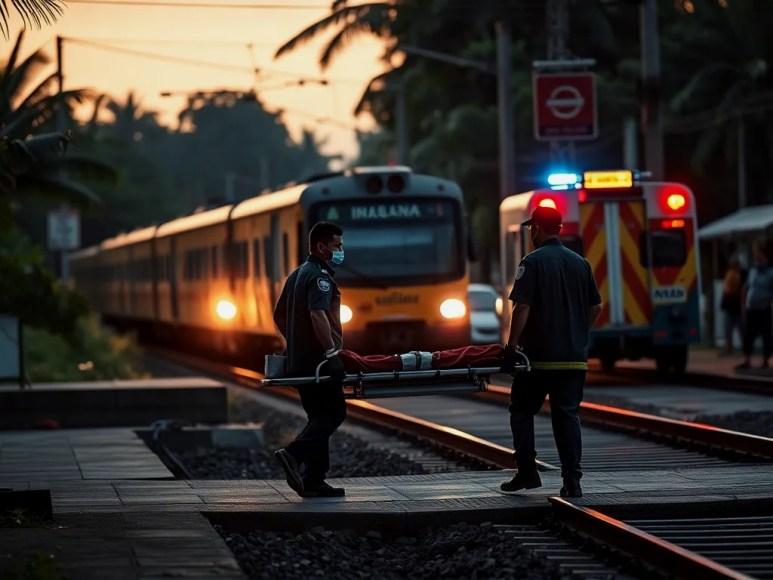
Collision details and immediate response
On 20 November 2026 in Simalungun, North Sumatra, the Siantar Express (U103) struck a minibus at an uncontrolled level crossing. The locomotive caught fire immediately after impact; Emergency teams halted the service, extinguished the blaze and secured the site. Local responders focused first on containing fire spread to passenger cars and on safely evacuating 264 passengers. Authorities confirmed the minibus driver died at the scene and three railway staff suffered injuries.
How the crash unfolded — timeline and witness reports
Eyewitnesses and preliminary incident statements indicate: the train was traveling the regular Siantar–Medan route when a minibus entered the track area between Siantar and Dolok Merangir stations. Impact occurred on approach to the uncontrolled crossing; the train’s front-end sustained major damage and ignited. Rescue teams arrived within minutes to perform passenger triage, remove debris and provide first aid to crew members. Investigators secured the scene to preserve evidence for an engineering and human-factors probe.
Passenger outcomes and safety actions taken onboard
PT Kereta Api Indonesia (KAI) confirmed all 264 passengers escaped without injury. Train personnel enacted emergency protocols: immediate brake application, carriage-to-carriage checks, and coordinated communication with station command. Evacuation routes were used in sequence to avoid the fire zone, and KAI dispatched replacement rolling stock and customer-relief teams while arranging transport for onward journeys. These procedural steps limited passenger harm despite the severity of the locomotive damage.
Cause investigation: what authorities will examine
Investigators will examine four primary dimensions: vehicle driver behavior, level-crossing design and controls, signaling and train operation data, and maintenance/inspection history. Forensically relevant items include event data recorder logs, CCTV or mobile footage, eyewitness interviews, axle and brake condition of the train, and the minibus’s registration and roadworthiness. The crossing’s signage, sightlines, and any history of prior near-misses will also be scrutinized to determine causal factors and liability.
Level crossing risks: data, examples, and mitigation options
Level crossings combine high-speed rail dynamics with variable road user behavior; Global studies show that uncontrolled crossings account for a disproportionate share of rail-vehicle collisions. Practical mitigations that reduce collisions include physical grade separation (bridges/underpasses), active protection (boom barriers and flashing lights), passive measures (clear sightlines, rumble strips, reflective markings), and targeted community education. Example: replacing an uncontrolled crossing with active barriers reduced incident rates by over 70% in comparable regional projects. A cost–benefit analysis often prioritizes crossings near dense settlements or high-traffic roads for earliest upgrades.
Immediate operational impacts and recovery steps
Following the accident, KAI suspended services on the affected segment to permit firefighting, debris clearance, and forensic inspection. Recovery steps included: 1) isolating and removing damaged rolling stock, 2) track inspection and repairs where thermal or impact damage occurred, 3) progressive testing under speed restrictions before resuming full service, and 4) passenger reimbursements and alternative transport provision. These steps aim to restore safe operations while preserving evidence for the official investigation.
Policy and enforcement angles that can prevent repeats
Authorities can reduce recurrence by prioritizing crossings for upgrades based on a risk matrix that factors traffic volume, train speed, and accident history. Additional enforcement measures: stricter licensing of commercial minibuses, routine roadside inspections, and automated detection systems that trigger road-side warnings when a train is approaching. Funding models combine national safety budgets with targeted regional grants and public–private partnerships to accelerate high-return interventions.
What technical researchers will report and when
Expected investigative outputs include a preliminary within days outlining fatalities, injuries and immediate causes (eg, vehicle on track), and a final technical report after weeks or months with root-cause analysis and safety recommendations. The final report will likely present: event recorder data plots, timeline reconstruction, physical evidence photographs, crossing design assessment, and recommended corrective actions with prioritized timelines for implementation.
Practical guidance for communities near crossings
Communities can reduce risk now by installing clear marking and local warning signs, organizing local speed-control measures near crossings, and establishing community alert networks (eg, mobile alerts when maintenance or train activity increases). For drivers: stop, look and listen at crossings; avoid overtaking near tracks; and do not attempt to cross if lights/flashing devices indicate an approaching train.
Longer-term lessons and measurable steps forward
This collision highlights concrete lessons: uncontrolled crossings present predictable risk that scalable engineering and enforcement measures can reduce; timely emergency protocols on trains preserve lives even when equipment is damaged; and data-driven prioritization speeds safety investment to crossings with the highest risk. Measurable next steps include a crossing inventory audit within 90 days, a prioritized upgrade schedule for the top 10% most dangerous crossings, and a public progress dashboard showing upgrades, enforcement actions and incident reductions.
Be the first to comment