
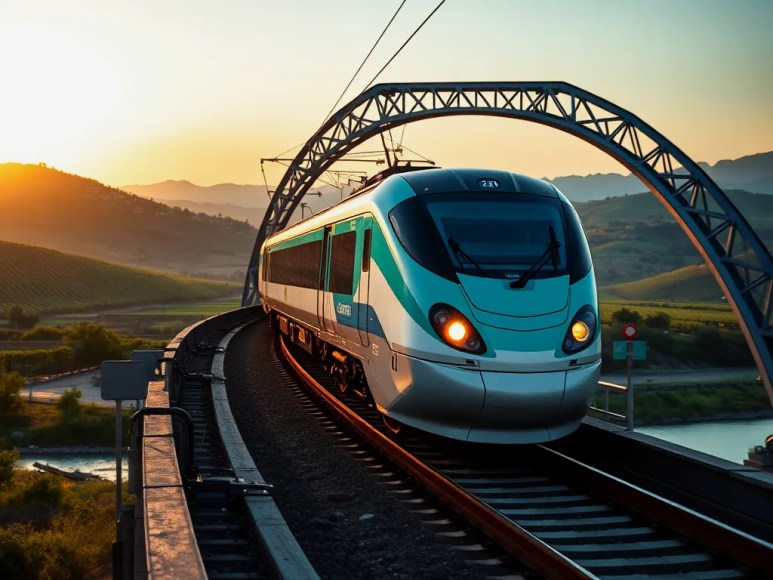
More sustainable transportation by railways
TCDD Taşımacılık AŞ highlights rail as a high-capacity, energy-efficient mode that cuts carbon emissions compared with road freight and passenger travel. By connecting production centers and logistics hubs directly to the rail network, freight shifts reduce vehicle-kilometers on highways, lower fuel consumption, and decrease congestion-related emissions. Concrete examples include container-block trains replacing multiple truck trips and electrified regional lines that move commuters with far less energy per passenger-kilometer.
How rail reduces emissions: data-driven mechanisms
Rail reduces emissions in three measurable ways: lower rolling-resistance energy use, higher passenger and cargo density per trip, and the ability to electrify. Average CO2 emissions per tonne-kilometer for heavy freight on modern electric rail can be 60–80% lower than long-haul trucking. Passenger emissions per seat-kilometer on intercity electric trains can be 50–70% lower than single-occupant cars. These gains are amplified when the electricity mix includes renewables.
Practical steps to shift freight and passengers to rail
Operators and planners can apply a stepwise sequence to grow rail modal share: 1) Map high-volume origin–destination pairs where rail terminals can serve both production sites and ports; 2) Invest in last-mile intermodal links such as short feeder lines, efficient terminal cranes, and road-rail transfer yards; 3) Prioritize electrification on busy corridors and deploy hybrid or battery locomotives on secondary lines; 4) Align timetables and pricing to make rail competitive for time-sensitive freight and commuters. An example sequence: identify a corridor with 1,000 truck trips/day, construct a dedicated freight terminal, start two block trains/day, measure diversion rate, then scale frequency to demand.
Improving urban–regional integration to attract passengers
To convert car commuters, TCDD-style operators can synchronize schedules with urban transit, offer integrated ticketing, and increase off-peak frequency. Small changes produce measurable shifts: a 15-minute reduction in average wait time can raise rail ridership by 8–12% on suburban corridors. Real-world upgrades include park-and-ride expansions, through-ticketing to city metros, and targeted marketing to workplaces near stations.
Cost, policy and financing instruments that accelerate rail adoption
Public investment, user pricing that internalizes external costs, and targeted subsidies for electrification accelerate modal shift. Instruments that work: carbon pricing to narrow rail vs truck costs, congestion charges on busy highways to reflect social costs, availability payments or capacity contracts that underwrite new services, and public–private partnerships for terminal and rolling-stock financing. Each tool addresses a specific barrier—capital intensity, operating risk, or market price distortions.
Operational examples and lessons learned
Successful implementations show a few common elements: focused corridor strategies, reliable service frequency, and streamlined terminal operations. For instance, converting a daily single-block freight service into two daily departures increased utilization and allowed shippers to reduce inventory buffer days. Electrifying commuter corridor factors while upgrading signaling systems improved punctuality and energy efficiency simultaneously—yielding both emissions and service-quality gains.
Measuring impact: KPIs and monitoring
Trackable indicators include modal share percentage, CO2e per tonne-km or passenger-km, on-time performance, terminal dwell time, and average train loading. Regular monitoring with publicly available dashboards helps stakeholders assess progress and fine-tune interventions. Setting short-term targets (12–24 months) for frequency, load factor, and emissions per km produces actionable milestones that inform next investments.
Practical checklist for decision-makers
Short-term (0–2 years): identify corridors with high truck volumes, implement intermodal terminal pilots, introduce integrated ticketing pilots for key urban routes.
Medium-term (2–5 years): electrify priority lines, expand block-train schedules, deploy upgraded signaling for capacity gains.
Long-term (5+ years): scale national electrification, retrofit freight terminals, align national transport pricing policies to reflect externalities.
Why rail matters now
Rail delivers measurable emissions reductions, resilience to fuel-price shocks, and scalability for future demand. When combined with electrification and renewable power, rail becomes a backbone for low-carbon freight and passenger networks. Implementing the steps above yields quantifiable benefits in emissions, costs, and service quality—turning rail investment into a durable contribution to sustainable mobility.