
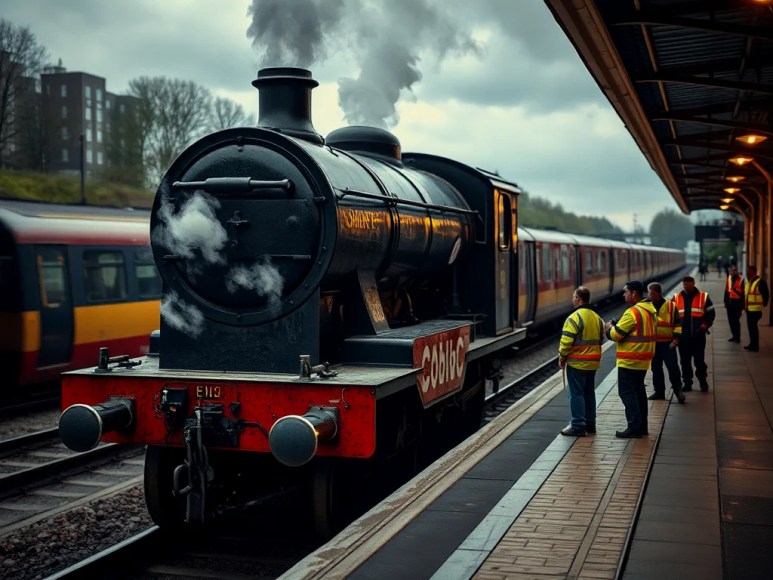
On 21 November 2026, a mechanical failure on the historic LMS Jubilee-class steam locomotive Galatea forced a suspension of services on the West Coast Main Line near Lockerbie, Scotland. Fragments from the locomotive’s running gear fell onto the track and a following freight train ran over the debris, prompting an immediate closure of the Lockerbie–Carlisle section and disruption to dozens of passenger services.
What broke and how the line was closed
Network Rail inspectors identified that several major components detached from the Galatea: a coupling rod, a slide bar and a cylinder cover. Those parts fell onto the formation near Kirtlebridge and created a safety hazard on the rails. Crews and signallers halted traffic between Lockerbie and Carlisle from about 20:00 to 22:30 while teams cleared debris and inspected the track for damage.
Immediate operational impacts and affected services
Avanti West Coast, Lumo and TransPennine Express timetables all suffered knock-on delays. One Avanti London–Edinburgh service terminated at Carlisle rather than continuing to Edinburgh, and London–Glasgow trains experienced delays of up to three hours. In total, 41 train movements were recorded as affected while recovery worked proceeded.
How passengers completed their journeys
The Galatea had been operating a Railway Touring Company special between York and Edinburgh carrying roughly 350 passengers to a Christmas market event. After the mechanical failure, a trailing diesel locomotive coupled to the tour worked the train to York. The diesel-hauled movement reached York at 02:23 on 22 November, completing the journey for customers with minimal additional routing complexity.
Track repairs, inspections and return to service
Network Rail Scotland engineering teams repaired minor sleepers (traverses) and ancillary track equipment during the night. Additional safety checks were carried out the following morning; Once teams verified the integrity of the alignment, signaling and track components, the line reopened to normal timetabled traffic. Work included visual inspections, ultrasonic rail checks where appropriate and re-fastening of any disturbed fittings.
Investigation and next steps for the locomotive
West Coast Railways confirmed that Galatea will move to its Carnforth base maintenance for a detailed strip-down and root-cause examination. The Rail Accident Investigation Branch (RAIB) has deployed inspectors to assess the failure, collect physical evidence and review maintenance, overhaul and certification records for both the locomotive and the train formation.
Context: similar historic incident and prior RAIB recommendations
RAIB investigated a comparable failure in 2013 when the coupling rod of the preserved steam locomotive Tangmere fractured near Winchfield, causing rail damage. Following that incident the RAIB issued four safety recommendations focused on maintenance regimes, restoration standards and mainline certification for preserved locomotives. Investigators will now consider whether prior guidance was followed and whether additional measures are required for mainline steam operation.
Passenger compensation: how Delay Repay applies
Avanti West Coast’s Delay Repay scheme allows passengers arriving at their destination 15 minutes or more late to claim compensation, subject to eligibility. For single tickets the published compensation tiers are:
• 15–29 minutes: 25% of the single fare
• 30–59 minutes: 50% of the single fare
• 60 minutes or more: 100% of the single fare
For return tickets, passengers can claim the full fare when delays exceed 120 minutes. Claims must be submitted within 28 days of the travel date. Season ticket calculations differ and are handled under separate rules. Passengers should use Avanti’s Delay Repay online form and include booking references and journey details.
What investigators will examine step-by-step
RAIB and maintenance teams typically follow a structured process:
1. Secure scene and preserve evidence — Record positions of detached components, photograph damage and secure loose parts.
2. Inspect track and rolling stock — Carry out detailed inspection of the locomotive’s running gear, bearings, fasteners and any recent overhaul work.
3. Gather documentation — Review maintenance logs, certificate of fitness for mainline use, engineer sign-offs and any third-party contractor records.
4. Metallurgical and component testing — Send fractured parts for laboratory analysis to determine fatigue, manufacturing defect or improper assembly.
5. Human factors and procedural review — Interview crew and maintenance staff, and assess whether procedures and safety-critical tests were followed.
6. Produce findings and recommendations — Publish interim safety notices if immediate action is needed and follow with a formal report that can mandate industry changes.
Practical takeaways for operators and passengers
Operators running preserved steam on main lines should ensure non-destructive testing (NDT) schedules for high-stress components are current, record traceability for replacement parts and verify assembly procedures after overhauls. Passengers planning rail travel on days when special trains operate can check advance notices and allow extra connection time; if disrupted, retain tickets and booking references to support Delay Repay claims.
Example: a preserved locomotive undergoing recent cylinder or rod work should have ultrasonic or magnetic particle inspection performed on critical joints and documented sign-off by a certified engineer before conditional return to traffic.
Key facts at a glance
• Date: 21 November 2026
• Location: Kirtlebridge, Lockerbie–Carlisle section, West Coast Main Line
• Locomotive: Galatea, LMS Jubilee class (built 1936)
• Passenger count: About 350 on the York–Edinburgh tour
• Services affected: 41 movements across Avanti West Coast, Lumo, TransPennine Express
• Investigations: West Coast Railways maintenance team and RAIB
Officials will publish further details when RAIB completes its on-site work and West Coast Railways reports back on the locomotive overhaul findings.