
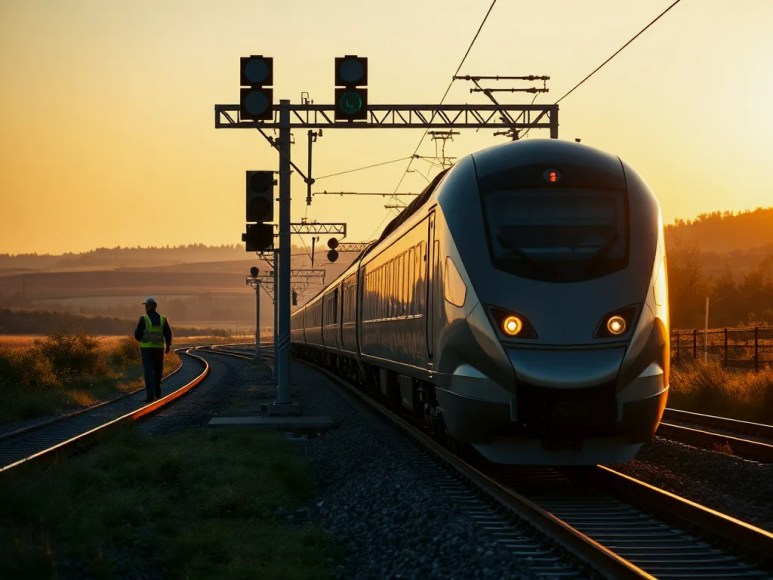
Overview of the competitive dialogue and bidders
Centralny Port Komunikacyjny (CPK) initiated a competitive dialogue to procure signaling, safety and traffic management systems for the Y‑shaped high‑speed network connecting the new Central Communication Port (Port Polska). The process yielded nine valid applications announced on 23 November 2026, including global rail technology suppliers such as Alstom, Hitachi Rail and Siemens Mobility alongside strong local integrators. The procurement divides into two packages: a safety & communications package (signaling, ETCS, field equipment) and a traffic management package (centralized traffic control, TMS, scheduling automation).
What the Y network covers and why design matters
The Y network consists of two new lines: Line 85 linking Warsaw to the new airport, Łódź and Sieradz, and Line 86 running from Sieradz toward Wrocław. Control centers will manage traffic across the Warsaw–Bierutów corridor, with an optional extension of the control scope to Wrocław. Designing for a branching high-speed topology requires tight interlocking between field signaling and centralized traffic logic so trains can be routed dynamically between diverging high-speed flows without reducing line capacity.
Scope and technical content of Package 1 — Safety & communications
Package 1 covers trackside and on-line safety systems. Core deliverables include installation of radio‑based ETCS train control, line‑side diagnostic devices, fiber‑optic and other telecom networks, fire protection systems, turnout heating, and associated technical facilities. Deliverables require full lifecycle responsibility: design, supply, installation, factory & on-site testing, commissioning and maintenance handover. The package emphasizes interoperability with existing Polish rail systems and modularity for future upgrades.
Scope and technical content of Package 2 — Traffic management and automation
Package 2 focuses on centralized traffic control (CTC), a Traffic Management System (TMS) with real‑time timetable management, automatic route generation, conflict detection and resolution, and operator interfaces. The TMS must provide deterministic automation for timetable adjustments during disturbances and support fast re‑routing across the Y junction while preserving headways. Integration points include connection to ETCS/RBC, passenger information, energy management and wayside diagnostics.
Which bidders applied for the signaling package and what they bring
Four consortia applied for Package 1:
• Alstom Polska consortium (with KOMBUD and Krakowskie Zakłady Automatyki) — brings Alstom’s radio‑based ETCS solutions, systems integration experience across Europe, and proven wayside diagnostics platforms.
• Compagnie des Signaux — offers compact signal interlocking and trackside equipment with a focus on modular field appliances.
• Hitachi Rail GTS Polska consortium (with WASKO) — pairs Hitachi’s modern automatic train protection and communications stack with WASKO’s local systems integration and software engineering.
• ZUE led consortium including Siemens Mobility — combines Siemens’ high‑speed signaling portfolio with ZUE’s Polish delivery capability.
Which bidders applied for the traffic management package and their strengths
Five bidders submitted for Package 2:
• Alstom Polska — proposes integrated TMS components aligned with its ETCS offerings for reduced integration risk.
• Alstom Polska & KOMBUD with Indra Sistemas — blends Alstom hardware with Indra’s traffic control and dispatching software widely used in Europe.
• Accenture & Stadler Signalling — pairs Accenture’s systems integration and digital transformation skills with Stadler Signalling’s control‑centric software modules.
• ZUE & Siemens Mobility — offers Siemens’ mature CTC/TMS platforms with a local delivery partner to speed deployment.
• Hitachi Rail GTS Polska & Hitachi Rail Portugal — offers Hitachi’s cross‑border TMS capabilities and experience in automated timetable generation.
Procurement process, evaluation limits and selection plan
CPK will conduct technical dialogues with each candidate to refine solutions and implementation conditions, then invite up to seven candidates per package to submit final bids. Evaluation will weigh technical compliance, systems integration approach, project delivery timelines, verification & testing plans, and whole-life cost. Successful contractors will undertake detailed design, component supply, on‑site installation, system integration and both factory and on‑network testing before formal handover.
Timeline and delivery milestones
CPK targets signing contracts by the end of 2027. Core network construction and systems work carries a milestone-driven schedule: basic signaling and TMS scope aims for completion in Q1 2034, while broader network electrification and infrastructure align to earlier and later milestones described below. Contractors must present phased test plans that enable progressive commissioning of line segments while the network remains under construction.
Electrification design for 350 km/h operation
Separately contracted electrification for Line 85 will use a 2×25 kV AC system — a configuration selected to support operations up to 350 km/h. That design choice affects placement of termination sections, neutral sections and return circuits, and demands coordination between power supply engineers and signaling teams to avoid electromagnetic interference with radio‑based ETCS equipment. The Warsaw–Łódź segment together with the new airport aims for service readiness by end of 2032; the remaining Y connections target completion by end of 2035.
Rolling stock procurement and fleet readiness
To operate at design speeds, PKP Intercity is procuring a high‑speed fleet of 20 trains capable of 320 km/h, plus 35 optional trainsets. The train procurement process targets contract signature in October 2027. Parallel timelines for train delivery and infrastructure commissioning require coordinated vehicle acceptance testing, ETCS on‑train integration and joint on‑line testing windows to achieve timely introduction of commercial services.
Why integrated system procurement reduces network risk
Procuring signaling and traffic management in distinct but tightly coordinated packages reduces vendor lock‑in while ensuring mature interfaces. Advantages include: clear allocation of responsibility for on‑site acceptance, staged commissioning enabling earlier partial operations, and modular upgrades without wholesale replacement. Risks to manage include software interoperability, radio spectrum coordination and cross-contract test scheduling; bidders must submit mitigation plans and staged test protocols.
What to expect next and how bidders progress
Over the coming months CPK will run technical dialogues to refine functional and performance requirements, then shortlist and invite detailed bids. Expect negotiation of delivery schedules, acceptance criteria and penalty regimes in the dialog phase. Once contracts are signed, the selected teams will proceed with detailed design, long‑lead procurement, factory testing of signaling interlockings and progressive integration tests that culminate in full line acceptance tests ahead of passenger operations.