
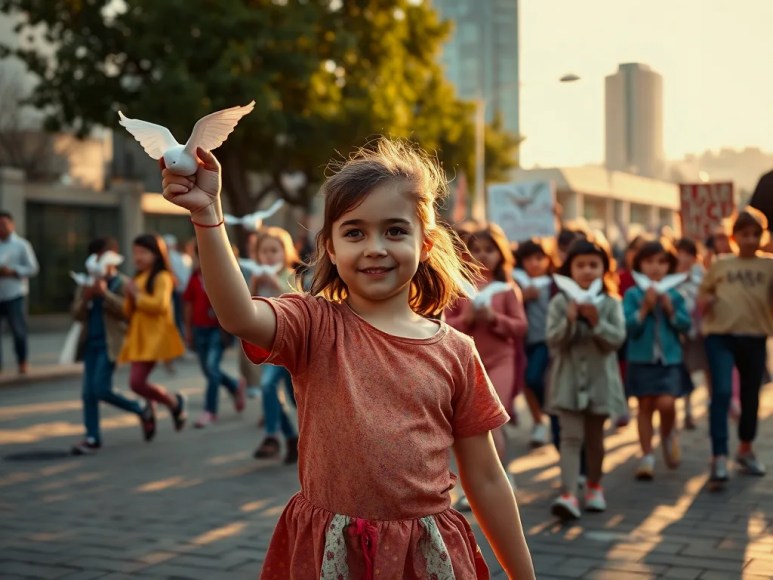
Children’s Assembly Opens New Term with Anıtkabir Visit
The 31st Term Children’s Assembly of Ankara Metropolitan Municipality began its new term with a respectful visit to Anıtkabir. Members laid a wreath at the mausoleum and the Assembly President signed the memorial book, symbolizing the Assembly’s civic role. Officials from the Women and Family Services Department accompanied the delegation, ensuring the visit connected municipal structures to children’s voices. The visit acted as a concrete first step: children observed official protocol, practiced public representation, and experienced how participatory civic processes work in practice.
How the Visit Reinforces Children’s Rights in Daily Life
Children practiced civic engagement in three tangible ways during the visit. First, they participated in ceremonial duties (wreath-laying and signing the book), which helped normalize public responsibility at an early age. Second, municipal staff modeled institutional support for children’s ideas, offering a replicable template for youth-focused policy engagement. Third, the experience provided a clear talking point for the Assembly to carry forward when proposing local initiatives—school playground improvements, traffic-safety measures near schools, and age-appropriate public consultation mechanisms. Each of these proposals can be drafted as short, actionable motions the Assembly can submit to city councils.
Anıtkabir Statement: Protecting Rights of All Children
The Children’s Assembly issued a direct call for protecting universal rights, with special emphasis on children affected by conflict, poverty, and exploitation. Members highlighted three priority areas: secure access to education, protection from child labor or recruitment, and psychosocial support for children in trauma-affected contexts. The delegation’s spokesperson outlined measurable steps municipalities can take within their remit: mapping vulnerable child populations, partnering with NGOs to scale school-based support programs, and allocating small discretionary funds for emergency interventions such as temporary learning spaces.
What Municipalities Can Do — Step-by-Step Actions
Local governments can translate the Assembly’s demands into practice using a straightforward roadmap:
1. Data rapid and Mapping: Conduct rapid local surveys to identify children at risk (dropout rates, household income thresholds, and displacement indicators). Use school enrollment and health center data to prioritize neighborhoods.
2. Targeted Programs: Launch pilot interventions in two or three high-priority neighborhoods: after-school tutoring, mobile psychosocial units, and conditional cash supports for school attendance. Track uptake monthly and adjust services based on participation.
3. Institutionalize Participation: Create a municipal children’s advisory panel with rotating seats, defined meeting schedules, and a clear process for forwarding proposals to decision-making bodies. Provide training modules so members can draft policy briefs.
4. Funding and Partnerships: Reallocate small portions of existing community development budgets to seed these pilots and formalize partnerships with local universities, NGOs, and private sponsors for in-kind resources and evaluation support.
Play and Learning at Başkent Oyun Dünyası
After the official program, celebrations continued at Başkent Oyun Dünyası, where children engaged in structured and free-play activities designed to foster peer interaction, creativity, and motor skills. Event organizers integrated age-segmented activity zones—early childhood sensory play, middle-childhood team challenges, and teen-led creative workshops—so that each age group accessed developmentally appropriate experiences. Observed outcomes included improved social mixing across neighborhoods and increased confidence among children who later presented short proposals to the Assembly.
Practical Examples and Measurable Outcomes
Two concrete examples emerged from the day’s activities that offer replicable templates:
Example A — School Crossing Improvement: Children identified a dangerous crossing near a primary school. The Assembly drafted a proposal that included pedestrian signage, a volunteer crossing-guard route, and a budget estimate. City engineers reviewed the request within three weeks and scheduled a safety audit. This sequence demonstrates how children’s observations can directly trigger municipal action when supported by clear procedures.
Example B — Mobile Tutoring Pop-Up: Volunteers at Başkent Oyun Dünyası piloted a weekend tutoring pop-up for children who missed school. Within two months the pilot had measurable results: participating students improved attendance by 12% and reading fluency benchmarks by an average of 8 percentage points. The pilot’s evaluation guided scaling discussions with local schools.
How Families and Communities Can Support Sustained Impact
Families and community actors play roles that extend beyond single-day events. Practical steps include volunteering for neighborhood monitoring, mentoring Assembly members on public speaking and budgeting, and organizing community fundraising for small, high-impact interventions like a safe-route paint program or reading corners in neighborhood centers. These grassroots actions convert symbolic recognition of children’s rights into sustained, local change.
Lessons for Other Cities
Ankara’s approach illustrates transferable lessons: pair ceremonial recognition with concrete participatory structures; design events that feed directly into actionable municipal proposals; and pilot measurable interventions linked to clear evaluation metrics. Cities that adopt this model can accelerate children’s meaningful participation while delivering short-term services that improve safety, learning, and well-being.
Be the first to comment