
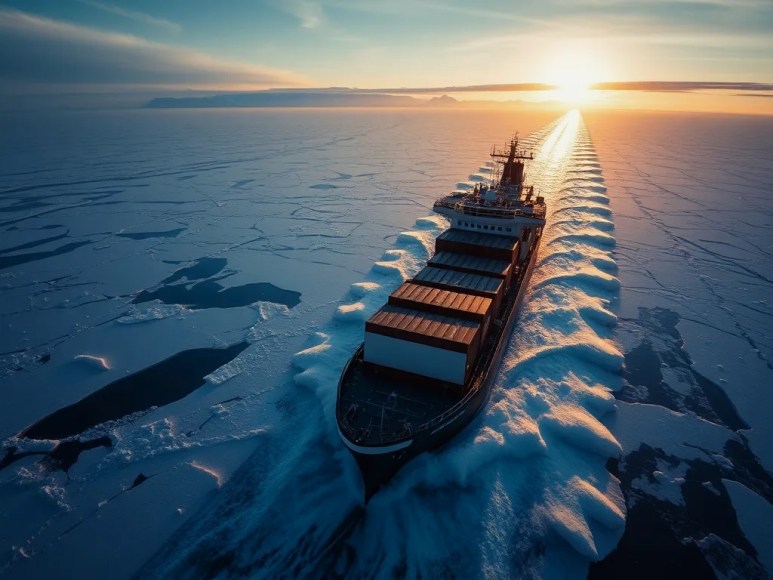
Arctic shipments reach 13.2 million barrels in 2026
S&P Global Commodities at Sea tracked 13.2 million barrels of crude oil and petroleum products shipped from Russian ports to Asia via the Northern Sea Route (NSR) in the 2026 navigation season. That figure follows 12.2 million barrels in 2025 and 10.8 million in 2024, showing a steady rise in Arctic-bound energy flows. The dataset covers specific port loadings and tracked voyages; alternative trackers and aggregation methods may report different totals because they follow different vessels and trip scopes.
Why Russia shifted more oil to the NSR
Targeted sanctions, insurance and financing limits, and the EU’s import bans pushed many Russian exporters to diversify destination and transit routes. Companies responded by increasing direct northbound voyages that avoid traditional chokepoints. The NSR shortens some Asia-Europe legs, reduces time at sea when ice conditions permit, and can bypass higher-risk regions such as parts of the Black Sea and the southern Red Sea corridor during periods of regional instability.
How much time and distance the NSR saves
When ice conditions and escorts allow, the NSR can cut voyage distance and duration significantly versus the Suez route. S&P Global’s analysis indicates the NSR can reduce trip time by up to 40% on certain Asia–Russian-European terminal pairings. For example, a tanker sailing from Northwest European loading terminals to northeastern Chinese ports via Suez might take six weeks; the NSR alternative can shorten that run to roughly three-to-four weeks in favorable seasons, reducing fuel burn and time charter costs for appropriately classified vessels.
Which logistical and cost factors offset savings
Time savings do not automatically translate to cheaper voyages. The NSR requires ice-class tankers or icebreaker escorts in many windows, driving higher capital and operating costs. Additional costs and constraints include elevated insurance premiums for Arctic operations, specialized crewing and training, unpredictable weather and ice that can cause delays or reroutes, and limited SAR and port support infrastructure compared with major global hubs. Together, these raise the effective per-barrel transport cost for many operators.
Vostok Oil’s first load signals new Arctic export capacity
Rosneft began loading the first Vostok Oil cargo from the Buhta Sever terminal in 2026, filling the Valentin Pikul tanker from newly connected inland fields. That milestone demonstrates how pipeline and terminal buildouts tie onshore production to Arctic export windows. Achieving projected full-scale volumes will depend on steady field output, a sufficiently ice-capable tanker fleet, and sustained external demand from Asian refiners.
Rosatom projects 40+ million tons of year-round activity
Rosatom, responsible for many NSR logistics and icebreaking services, projected that total cargo along the corridor could exceed 40 million tons in 2026. That figure covers crude, LNG, minerals, containers and other freight, reflecting investments in nuclear-powered icebreakers and port upgrades. The number mixes measured shipments and seasonal forecasts; interpret it as a capacity/throughput indicator rather than a single audited total for one commodity.
Environmental and safety trade-offs of increased Arctic tanker traffic
Greater traffic raises spill, collision and black carbon risks in fragile Arctic ecosystems. Seasonal ice retreat expands navigable windows but also produces variable conditions that complicate emergency response. Analysts flag several critical vulnerabilities: insufficient local salvage and pollution-response infrastructure, limited hydrographic and real-time ice forecasting coverage in parts of the NSR, and a mix of vessels with differing ice certifications—some of which may not meet best-practice Arctic-operating standards.
Operational best practices and mitigations
To reduce risk, operators and authorities must coordinate on ice-capable tonnage deployment, escort schedules, route planning with updated ice charts, mandatory emergency-response drills, and clear legal frameworks for cross-border assistance. Practical measures that materially lower accident likelihood include mandatory minimum ice classes for crude carriers, preapproved escort windows tied to icebreaker availability, and staged transits that limit single-voyage exposure to weakly charted sectors.
How sanction regimes and vessel status affect the picture
Sanctions and price-cap enforcement encourage some cargoes to use nontraditional owners and intermediaries, complicating transparency. Vessel registry, beneficial ownership, and bunker or transshipment practices can obscure a cargo’s full chain. That opacity matters because it affects insurance coverage, claims handling after incidents, and buyers’ willingness to contract. S&P Global’s dataset isolates tracked loadings from specific Russian ports, but marketplace totals differ when brokers, ship-to-ship transfers, or nontransparent ownership structures are included.
What to expect for 2027: infrastructure, calendars, and constraints
Russia plans more nuclear icebreakers and port upgrades to lengthen the NSR season. If new icebreakers, shore services, and vessel availability align, the NSR could host more sustained traffic through late autumn. Nevertheless, a truly year-round commercial corridor requires more than icebreaking capacity: it needs reliable communications, meteorological services, extensive SAR capability, and a pool of certified ice-class tankers. Without these, operators will still select the NSR on a trade-by-trade basis when savings exceed added risk and cost.
Short case study: a tanker’s decision tree
Shipowners choosing between NSR and Suez evaluate: 1) distance and expected time savings given current ice forecasts; 2) availability and cost of icebreaker escort and required ice class; 3) incremental insurance and liability exposure; 4) port windows and berth availability at both ends; 5) bunker availability and fuel price differentials; and 6) sanctions or contractual constraints tied to vessel or cargo provenance. When projected savings exceed the sum of these premiums and voyage risk factors, operators opt for the NSR; otherwise they stick to established routes.
Takeaway: NSR growth is tactical, not yet fully structural
The 13.2 million-barrel total for 2026 shows rapid tactical adoption of the NSR by Russian exporters and Asian customers, driven by a mix of sanctions, regional risks, and targeted infrastructure investments. But long-term structural reliance on the NSR depends on maturing support services, a larger fleet of certified ice-capable carriers, clearer legal and insurance frameworks, and demonstrable operational safety records under variable Arctic conditions.
Be the first to comment