
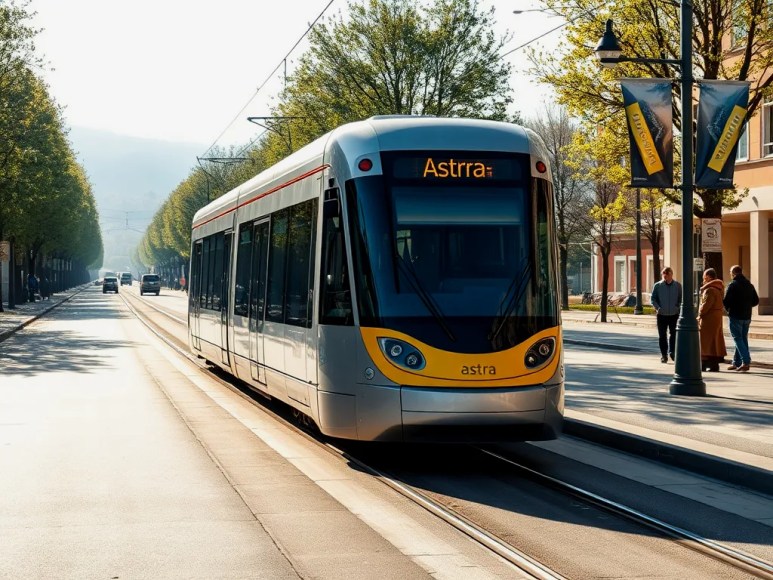
Astra signs supply contract for 20 low-floor trams
The Municipality of Ploiești formally contracted Astra Vagoane Călători for 20 new low-floor trams to replace an aging fleet. The first tram will arrive within six months after the contract’s start-of-work notice, and the remaining 19 vehicles will be delivered by month 17. The new trams are designed for 18-metre lengths and a minimum capacity of 100 passengers to serve routes 101 and 102, delivering step-free boarding that improves access for people with reduced mobility, parents with strollers and older passengers.
How the project is financed and what that means
The project’s roughly €50 million budget combines a €36 million loan from the European Investment Bank and a €9 million grant from the European Commission under the Public Sector Loan Facility for the Just Transition Mechanism. Ploiești will contribute about €5 million from local funds. The EIB and CINEA publish slightly different total-cost figures (approximately €51 million vs €50 million), reflecting typical variance in project-level estimates. This is the first Romanian city to use this specific Just Transition financing channel for tram procurement.
Expected energy, emissions and noise benefits
New vehicles are projected to use around 20% less energy than the existing fleet, which translates into an estimated annual reduction near 197 tonnes CO2-equivalent according to CINEA. Noise inside the cars should drop from roughly 74 dB to about 56 dB, improving passenger comfort. Operators also expect about an 8% decline in per-kilometer maintenance and operational costs once the fleet settles into regular service.
Depot upgrades and lifecycle savings
The contract includes refurbishment items for the existing depot: roof repairs, rail-connected structural elements and systems upgrades to support the new low-floor units. Ploiești’s municipal assessment projects lifetime savings in energy, electricity and maintenance of approximately €17 million, assuming a minimum 30-year service life for each tram and long-term warranty arrangements. Transport Călători Express (TCE), the local operator, anticipates fewer service interruptions and improved timetable reliability after modernization.
Delivery schedule, technical requirements and accessibility features
Delivery milestones are clear: initial delivery within six months and full fleet delivery by month 17. Technical specifications mandated a fully low-floor interior, space for wheelchairs, priority seating, and boarding heights compatible with platform levels to enable level access without ramps. The procurement also requires robust door systems, energy-efficient traction equipment and modular interiors to facilitate future upgrades.
Why this investment matters for Ploiești and regional transition goals
Ploiești sits in Prahova county, a region historically tied to carbon-intensive industries and therefore a target for EU Just Transition support. Replacing trams contributes directly to modal shift efforts by offering a quieter, more accessible and cheaper-to-operate public-transport alternative to private cars. The project aligns capital investment with local air-quality and mobility goals while demonstrating how targeted grants combined with concessional loans can accelerate fleet renewal in mid-sized European cities.
Performance monitoring and verification after commissioning
The project foresees post-delivery performance verification: energy use, in-service energy consumption per vehicle-kilometer, noise measurements and reliability statistics (mean time between failures, on-time performance). CINEA and the EIB typically expect beneficiaries to report these indicators annually during the financing period. That data will confirm whether the projected ~20% energy savings and the estimated emissions reductions materialise in operating conditions.
Practical implications for passengers and operators
Passengers will see immediate improvements: faster, level boarding that reduces dwell times and boarding friction, lower interior noise and more predictable service. For the operator, the new fleet reduces spare-parts diversity, simplifies maintenance routines and lowers energy consumption. These operational gains can be reinvested into service frequency or kept to reduce municipal subsidy requirements.
Key figures at a glance
Procurement: 20 low-floor trams from Astra Vagoane Călători
Budget: ~€50 million (EIB €36M loan + EU €9M grant + Municipality ~€5M)
Delivery: First unit within 6 months; all by month 17
Vehicle size & capacity: ~18 m length, ≥100 passengers
Projected benefits: ~20% lower energy use, ~197 t CO2e/year reduction, noise ~74 dB → ~56 dB, ~8% lower operating/maintenance cost per km
Depot works: roof and rail-linked structural upgrades, systems modernization
Next steps and what to watch
Monitor the contract’s start-of-work notice to confirm the first delivery date; review technical acceptance reports once trams arrive; and track early operational KPIs (energy consumption, reliability, noise) published by Transport Călători Express or municipal updates. These milestones will show whether projected savings and accessibility improvements are realized in everyday service.
Be the first to comment