
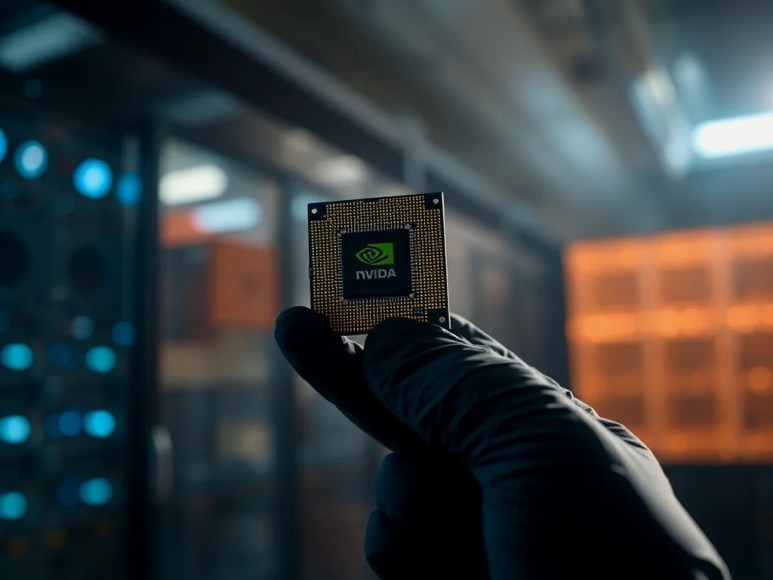
Nvidia stops H200 shipments to China amid new US export rules
Nvidia announced an immediate halt to H200 chip shipments to China. The company’s interim CEO, Colette Kress, confirmed the decision at the November 17, 2026 financial briefing. The halt reflects changes in US export licensing and enforcement that now restrict delivery of certain high-performance AI accelerators to China and to foreign data centers serving Chinese customers.
How the change affects direct sales and multinational data-center relationships
The policy shift impacts two channels: direct sales into mainland China and indirect supply via international cloud and colocation providers that host Chinese workloads. Previously licensed deliveries of Hopper-architecture products to Chinese buyers generated significant revenue; Nvidia declared $2.4 billion in quarter-to-date sales of licensed Hopper-based data-center products through the quarter ending October 25. Going forward, Nvidia’s guidance assumes zero revenue from sales of data-center AI chips into China for the affected period.
Quantifying the potential revenue hit and Jefferies’ estimate
Investment bank Jefferies modeled the export-control impact and estimated that Nvidia’s data-center revenue could fall by roughly $44–$62 billion over the next year if restrictions remain tight. This figure is an analyst projection, not an accounting loss already taken. The magnitude reflects both directly curtailed hardware sales and follow-on effects: reduced recurring cloud purchases, delayed system upgrades at hyperscalers, and slower lifecycle replacement of AI racks in China-serving environments.
Operational moves inside Nvidia after Jensen Huang’s departure
Following founder Jensen Huang’s departure on November 11, 2026, Colette Kress assumed the interim CEO role. The board also formed a governance committee focused on national-security compliance, export controls, and international trade risks. These steps centralize oversight of global supply policy and signal tighter internal approval gates for cross-border shipments and customer qualification processes.
Which customers and regions feel the spillover?
Countries hosting data centers that serve Chinese customers—such as Singapore, Malaysia, Thailand, and Indonesia—face secondary scrutiny. Operators in those jurisdictions may now need to implement enhanced customer due diligence, log access/use cases for advanced accelerators, and provide flow-down contractual clauses that restrict China-targeted workloads. Cloud providers that previously routed Chinese compute through regional hubs must reassess contractual commitments and may pause procurement of the highest-end accelerators until licensing clarity returns.
How Chinese domestic chip efforts will respond
China will accelerate investment in domestic AI accelerators and high-performance computing stacks. Expect three concrete responses: 1) increased funding and procurement for local silicon projects, 2) faster integration of commodity GPU alternatives and heterogenous accelerators in large model training pipelines, and 3) tighter co-design between Chinese AI firms and local foundries to close performance gaps. These moves reduce near-term dependence on foreign chips but will require multi-year build-out to match top-tier performance.
Short-term technical workarounds and their limits
Operators and researchers may try several technical and operational workarounds, yet each has limits:
1) Architecture-level optimization: rewrite model kernels and mixed-precision pipelines to run on lower-tier accelerators. This lowers throughput and increases training time, making some experiments infeasible.
2) Distributed training across more nodes: compensate for less powerful chips by scaling horizontally. This increases networking, power, and cooling costs and creates synchronization bottlenecks.
3) Hybrid cloud arrangements: split workloads between onshore and offshore environments to keep sensitive training local. This approach faces data sovereignty and latency constraints and may still violate export rules if foreign hardware indirectly accelerates China-serving workloads.
Practical steps for affected companies
Companies and data-center operators should take immediate, pragmatic actions:
1) Audit customer footprints: map which tenants run China-targeted workloads and which workloads transit regional hubs. Maintain evidence trails for compliance.
2) Review procurement pipelines: pause purchases of restricted accelerator classes until legal sign-off or obtain explicit export licenses when feasible.
3) Update contracts and SLAs: add clauses that prohibit the use of procured accelerators for China-targeted processing where contractually required to comply with export controls.
4) Budget for alternative capacity: forecast higher unit costs if switching to more numerous lower-tier accelerators or local substitutes, and model increased TCO (total cost of ownership) from scaled horizontal deployments.
Scenario planning: timelines and outcomes to prepare for
Prepare for three plausible scenarios and their operational implications:
Scenario A — Short-term pause (3–9 months): Regulators provide clarifications and some licenses are reissued. Impact: temporary revenue slowdown, delayed procurements, modest supply-chain rebalancing.
Scenario B — Medium-term restrictions (9–24 months): rules remain tight, accelerating Chinese investments in local silicon. Impact: sustained revenue deferral for global chip vendors; increased cloud costs and slower adoption curves in China.
Scenario C — Prolonged decoupling (>24 months): bifurcation solidifies into distinct technology stacks. Impact: long-term revenue loss, segmented developer ecosystems, and an expanded market for indigenous accelerators and interop tools.
What investors and analysts should watch next
Track these high-signal indicators:
1) License approvals and denials: frequency and scope of US licenses for China-facing shipments will indicate regulatory appetite for exceptions.
2) Nvidia guidance and supply-chain comments: updates on revenue assumptions, inventory builds, and regional sales mixes reveal material business impacts.
3) Chinese procurement programs: state-backed chip funding, procurement of domestic accelerators, and partnerships between AI companies and foundries show how quickly local alternatives scale.
Bottom line
Nvidia’s stoppage of H200 shipments to China marks a material shift in AI hardware flows. The change forces immediate compliance, procurement, and architectural responses across the industry. Companies that act quickly to map exposures, reconfigure workloads, and plan for multiple timelines will reduce disruption; Meanwhile, accelerated Chinese investment in local silicon will reshape competitive dynamics over the coming years.