
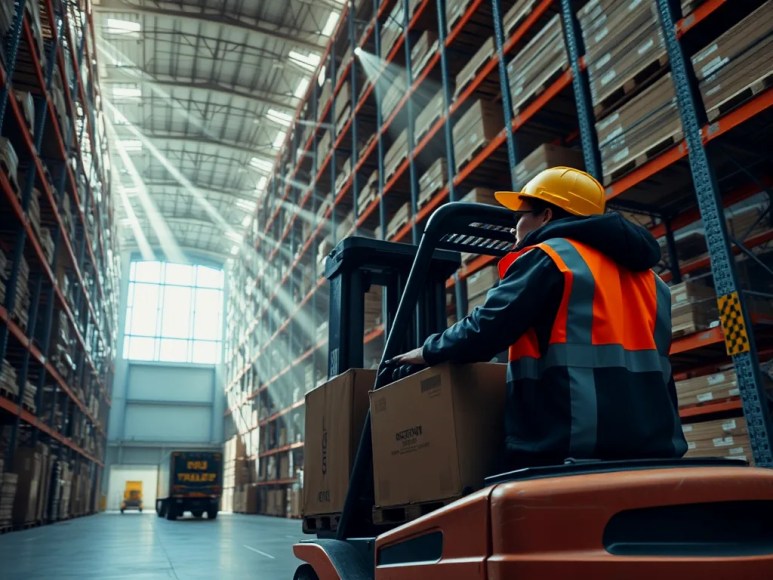
New employment peak in transportation and warehousing
The number of paid employees in Türkiye’s transportation and warehousing sector reached 1,405,178 in September 2026, exceeding the 1.4 million mark for the first time. According to TÜİK (Turkish Statistical Institute) data, the sector showed approximately 6.1% growth in one year with an additional 80,316 paid employees from 1,324,862 in September 2025. This increase confirms the significant employment role of land, sea, air, and rail transportation, as well as warehousing and distribution services, in the economy. In addition, the total number of paid employees in the industrial, construction, and trade-service sectors reached 16,448,397 during the same period.
E-commerce and distribution operations create new job opportunities
The continuous increase in e-commerce volume directly triggers recruitment due to the requirements for warehouse capacity management, order preparation, last-mile logistics, and reverse logistics. Example: a large e-commerce company expanding its warehouse staff by 30% during the season and doubling its last-mile driver network significantly boosts employment data in the short term. The data does not directly isolate the e-commerce impact; however, the share in the annual increase can be estimated by monitoring operational changes, shift numbers, and employee density per square meter of warehouse.
Rail transport is part of integrated logistics
Rail-connected logistics centers and port terminals enable the transfer of high-volume cargo between different modes of transport. There are increasing labor needs in freight train operation, wagon and locomotive maintenance, signaling, and terminal operations. When new infrastructure investments (e.g., logistics center connections) are completed, the demand for personnel in these areas will increase both in quality and quantity. Example steps: port-operator coordination, wagon maintenance planning, establishment of intermodal transfer lines; each step creates new professional requirements.
Digitalization is changing the need for qualified personnel
Smart warehouses, fleet tracking software, route optimization, and automated handling technologies are transforming logistics job descriptions. Data analysts, automation maintenance technicians, and supply chain software specialists are now prominent in recruitment. Practical example: a maintenance-analysis team established to reduce robotic conveyor failures in a warehouse automation system shortens downtime by 40% while requiring retraining of operational personnel. This transformation brings not only an increase in numbers but also a change in quality; companies should invest in training programs, internal transfers, and certifications.
The sustainability of employment growth is important
The level of over 1.4 million paid employees is a record; However, for sustainable growth, job security, productivity, vocational training, and competitive conditions must be considered together. Indicators to be monitored in the short, medium, and long term include: employee turnover rate, work accidents and reported occupational health incidents, productivity per square meter, and employment transition rate per training session. Businesses should simulate their personnel plans based on trade mobility and new facility investments using three scenarios (increase, stagnation, contraction).