
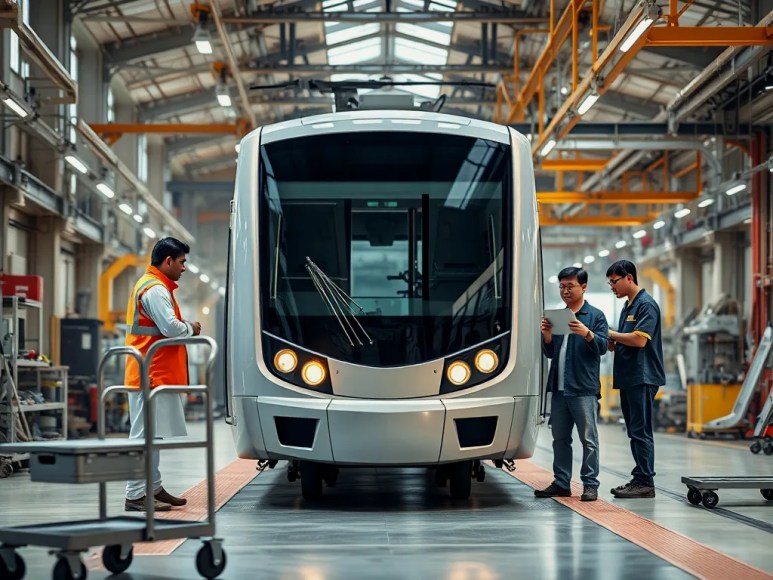
Jupiter Wagons signs framework agreement with Woojin to localize metro rolling stock
Jupiter Wagons Limited and South Korea’s Woojin Industrial Systems agreed to form a joint venture to bid together on metro contracts and manufacture rail systems in India. Jupiter will own 80% of the new company and lead site, plant and working-capital financing, while Woojin will contribute technology transfer, key components, and technical support. The partners aim to design, test, commission and maintain systems locally rather than importing full trainsets.
How the 80/20 joint venture will operate and fund the plant
The JV structure assigns operational leadership and capital responsibility to Jupiter Wagons, which will secure land and install manufacturing lines. Woojin will provide traction packages, train control and management systems (TCMS), automatic door assemblies and aluminum body fabrication know-how. The companies have not declared the plant location, amount of investment or an exact production schedule; however, the arrangement clearly separates financial risk (Jupiter) from intellectual and product inputs (Woojin).
What components and systems the JV will produce in India
The agreement covers complete metro cars plus critical subsystems: traction systems, TCMS, automatic doors, bogies and aluminum car bodies. A dedicated aluminum body fabrication facility is planned to enable higher local content for lightweight vehicles. The JV can also extend traction-system production to Vande Bharat-type EMUs, semi-high-speed and high-speed train programs if tenders demand localized traction packages.
Why technology transfer from Woojin matters for Indian manufacturing
Woojin brings proven metro and commuter vehicle experience: it has taken orders for over 2,200 metro and suburban cars since 2019 from Seoul Metro, KORAIL and Busan Transit, and its traction Technologies appear in KTX high-speed applications. Localizing that know-how helps reduce dependence on imports, shorten lead times for city procurement, and create a supply base able to provide lifecycle services — from commissioning to maintenance — for Indian transit authorities.
How this JV aligns with India’s Make in India localization rules
Indian metro typically requires minimum local content thresholds (metro cars: usually ≥75% local content; key subsystems: around 25%). By producing aluminum bodies, traction systems and TCMS domestically, the JV can meet or exceed these thresholds and strengthen tenders’ compliance. That capability also reduces currency-related cost risks and supports faster after-sales response through an India-based spares and service network.
Market context: India’s expanding metro network and opportunity size
India’s metro network expanded from five cities and 248 km in 2014 to roughly 26 cities and about 1,200 km by November 2026. Rapid urbanization and state-level rapid transit programs create multi-year demand for rolling stock. A conservative scenario—adding 400–600 km of network annually across cities—translates to sustained procurement pipelines for several thousand cars over the next decade, making local manufacturing capacity strategically valuable.
Competitive landscape: how the JV compares to other Indian manufacturers
Titagarh Rail Systems, a domestic rival, has already been ramping passenger-car production and plans aggressive scaling: 12 metro cars in FY2025, 63 in FY2026, roughly 200 in FY2027 and 275 in FY2028, targeting 500 cars/year by FY2030 with phased traction localization. The Jupiter–Woojin JV differentiates by pairing a wagon-maker experienced in freight and metallic assemblies with a global metro subsystem supplier, offering integrated traction-plus-body solutions rather than body-only or retrofit scopes.
Step-by-step: how the JV can operationalize localization and win tenders
1. Secure a strategically located industrial site with rail connectivity and utilities to cut logistics cost and cycle time.
2. Install modular production lines: aluminum extrusion and body assembly, bogie assembly, traction assembly and final fit-out.
3. Validate subsystems through test rigs and pilot trains to generate test certificates required by Indian railways and metros.
4. Build a local supply chain for castings, electronics, door mechanisms and interiors to reach Make in India thresholds.
5. Offer lifecycle support packages (spares, depot retrofits, predictive maintenance) priced into bids to improve total-cost-of-ownership for buyers.
Potential benefits and risks for stakeholders
Benefits include faster delivery for metro projects, improved local employment and skill transfer, strengthened after-sales networks, and reduced import bills. Risks include capital intensity for factory setup, supply-chain ramp-up time, certification delays, and competition from established OEMs and other expanding domestic players. Success will depend on tight project management, assured order flow from early contracts, and rapid localization of critical suppliers.
Examples and early indicators to watch
Watch for three early indicators of JV momentum: land and factory site announcements, first domestic prototype trains entering commissioning, and initial procurement wins for city metro tenders mentioning local traction supply. Collectively, these will signal that the JV moves from memorandum stage to commercial manufacturing and will affect supplier partnerships and regional procurement dynamics.