
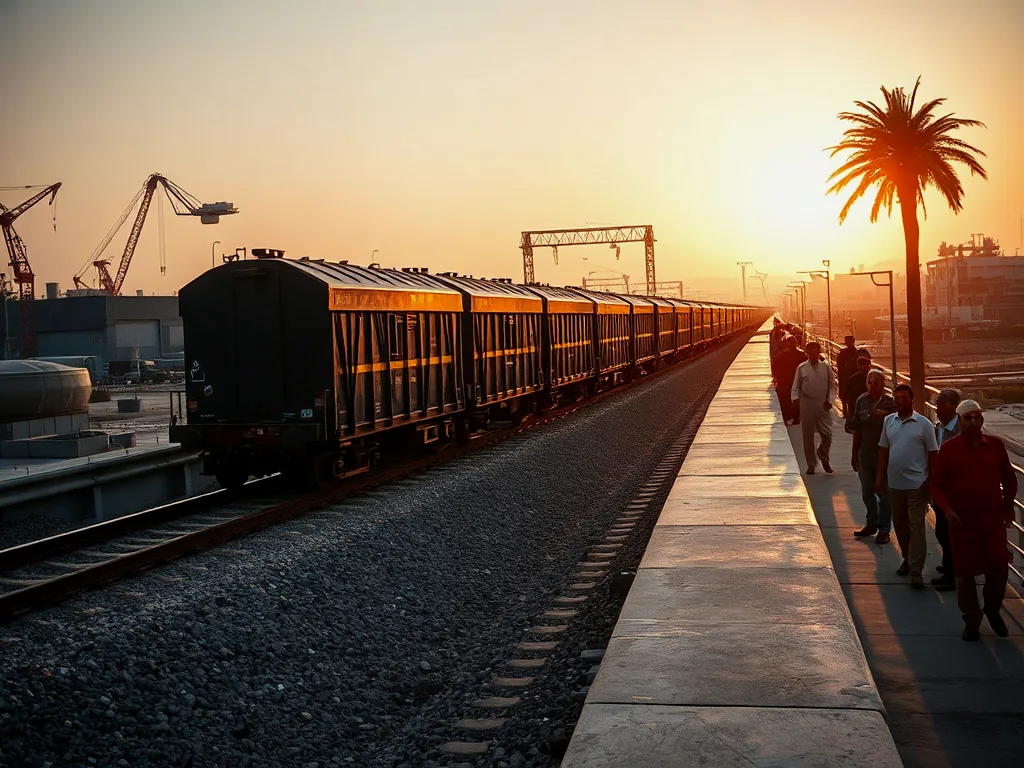
First freight train runs on the 52 km Karachi–Pipri rail corridor
On 28 November 2026 a freight train completed the inaugural run on the 52-kilometer rail corridor connecting Karachi Port and the Pipri cargo terminal. The Special Investment Facilitation Council (SIFC) confirmed the operation as the first tangible outcome of a public–private program led by DP World, Pakistan Railways and the National Logistics Corporation (NLC). This first movement demonstrates the corridor’s operational readiness for scheduled freight services and establishes a spine for intermodal transfers between sea and land.
How the corridor reduces road congestion and logistics cost
The corridor redirects container flows away from city roads by enabling direct transfers between port berths and the Pipri inland terminal. Quantitatively, replacing even a fraction of port-bound trucks with trains reduces urban axle loads and congestion: a single 20-wagon freight train can remove roughly 40–60 heavy trucks from Karachi streets on a single trip. Lower vehicle counts translate into measurable savings—reduced fuel consumption, less vehicle wear, faster dwell times—and therefore lower door-to-door logistics costs for importers and exporters.
Investment structure and the scope of the first phase
The initial phase is part of a planned $400 million foreign investment program announced when ground works began in January 2026. Phase one includes two primary deliverables: rehabilitation of the existing railway alignment between the port and Pipri, and construction of a multimodal logistics park at Pipri. Rehabilitation encompassed track renewal, bridge repairs, signaling upgrades and gauge-standard maintenance to permit heavier axle loads and higher average speeds. The Pipri logistics park will host container stacking, bonded warehousing, customs inspection bays and rapid transshipment facilities.
Operational design: schedules, capacity and performance targets
Operational plans call for timed shuttle services at predictable intervals to suit both import discharge patterns and inland hinterland demand. Initial capacity modeling projects daily throughput of several hundred TEUs, scalable by adding more shuttles and lengthening trains. Target performance metrics set in early operator agreements include average transit time under two hours between port apron and Pipri terminal, container dwell reduction at the port, and on-time departure rates above 90% once routine operations stabilize.
Regional connectivity and trade corridors amplified
Beyond local benefits, the corridor creates logistical continuity toward Pakistan’s interior and neighboring markets. Containers moved by rail from Karachi to Pipri can then join inland rail networks toward central Pakistan, and via transshipment connect to routes serving China and Central Asia. Integration with the China–Pakistan Economic Corridor (CPEC) and the Main Line-1 modernization strategy is explicit: the rehabilitated corridor leverages upgraded track geometry and signaling standards to ensure compatibility with future long-haul freight trains using ML-1 improvements.
Practical examples: a container’s journey and time savings
Example scenario: an import container discharged at Karachi is lifted directly onto a scheduled rail shuttle, arrives at Pipri in under two hours, clears customs through an onsite bonded yard and is onward-loaded onto a domestic freight service the same day. Compared to the road alternative—truck pick-up, city congestion, multiple checkpoints—this reduces handling stages and variable delay risk, improving predictability for supply chains handling consumer goods, industrial inputs and time-sensitive shipments.
Expected economic and environmental impacts
Economic impacts include lower unit transport costs that improve competitiveness for importers and exporters, increased throughput capacity at Karachi Port without immediate expansion, and new jobs in terminal operations and rail maintenance. Environmentally, modal shift to rail reduces per-container CO2 emissions and particulate pollution inside the city. Estimated emission savings will scale with modal share: replacing 30% of port-related truck trips with rail could cut emissions from port road transport by a similar proportion.
What remains to be announced and next steps
Public statements confirm the first run but leave several operational details pending: the regular timetable cadence, the exact composition and frequency of trains once commercial schedules begin, and confirmation that the first investment tranche is fully complete. Next steps for stakeholders include finalizing commercial service agreements, rolling out customs digitalization at Pipri to speed clearance, and expanding yard capacity in line with measured demand during the initial months of operation.