
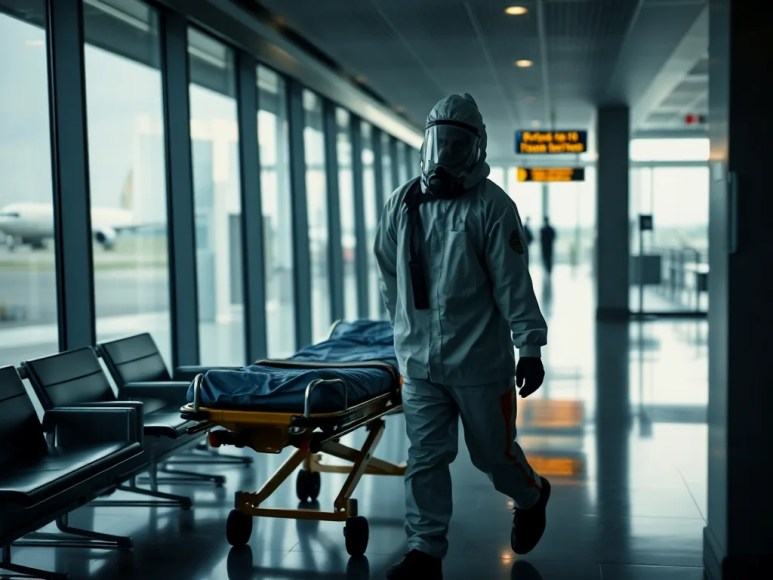
Overview of the drill and its objectives
Authorities staged a full-scale public health emergency exercise at Ankara Esenboğa Airport on 20 November 2026 to validate rapid-response procedures for a suspected contagious disease aboard an international flight. The scenario involved a passenger aircraft carrying 145 passengers and six crew, and tested detection, containment, triage, transfer and interagency communication under realistic conditions. Organizers focused on three operational goals: identify and isolate potential contagious cases quickly, protect responders and receiving hospitals, and verify command-and-control between airport and regional health authorities.
Scenario specifics and why they matter
Planners scripted a symptomatic index patient presenting fever, rash and confusion, and a 20-person tourist group in which 11 members reported diarrhea, abdominal pain and vomiting. The originating country in the scenario had an ongoing Ebola public health emergency, forcing teams to evaluate Ebola, bacterial meningitis and foodborne toxin (botulism) as concurrent candidates. Testing multiple high-consequence and common diagnoses in one drill forces responders to practice differential containment and diagnostic prioritization rather than assume a single cause.
How the airport isolation and zoning were executed
On pilot request the aircraft conducted an emergency landing and taxied to the predesignated quarantine apron (apron 3). Field teams established hot, warm and cold zones and set up a decontamination tent. AFAD personnel led environmental monitoring and contamination surveys on the aircraft and cargo areas while medical teams limited access and maintained negative-pressure principles at patient transfer points. This zoning minimized cross-contamination risk and preserved clean corridors for patient movement.
Triage and clinical decision-making used in the exercise
Medical teams performed on-board screening and rapid triage, separating passengers into categories: immediate critical, potentially infectious needing isolation, and low-risk contacts. The most severe simulated patient was transferred using a negative-pressure isolation stretcher to Pursaklar State Hospital. Other symptomatic passengers were assigned to Etlik City Hospital. Triaging decisions integrated observable signs, travel history, and proximity exposures to guide isolation level and destination hospital selection.
Interagency coordination and information flow
The Emergency Operations Center convened under the Esenboğa civil governor. The Airport Chief Medical Officer and the Ankara Provincial Health Directorate operated a simultaneous crisis cell to exchange situational updates. Participants included AFAD, UMKE, municipal services, the Ministry of Agriculture and Forestry, WHO observers and academic advisors. The drill rehearsed secure, real-time information sharing on case counts, laboratory needs, ambulance routing and bed capacity to prevent bottlenecks at receiving hospitals.
Decontamination, environmental safety, and responder protection
AFAD teams executed step-by-step decontamination of the aircraft and passenger areas: 1) establish exclusion perimeter, 2) conduct surface and air sampling, 3) remove and bag potentially contaminated waste, 4) apply disinfectant according to agent-risk assumptions, 5) ensure safe doffing and waste containment for PPE. UMKE enforced clinical safety procedures and monitored responder exposure with occupational-health checklists. These measures reduced secondary exposure risk and validated PPE protocols across agencies.
Clinical and laboratory pathways tested
The exercise simulated point-of-care testing and sample transport flows to evaluate laboratory turnaround and confirmatory pathways. Results in the scenario returned a negative Ebola test, while one case met criteria for bacterial meningitis and multiple cases aligned with a suspected conserved-food–related intoxication (botulism). The exercise therefore stressed parallel testing workflows: urgent CSF and culture processing for meningitis and toxin analysis coordination for suspected botulism, while maintaining biosafety for high-risk specimens.
Patient movement and hospital surge validation
Planned patient movement prioritized isolation capability and specialty care. The ill patient reached Pursaklar State Hospital with continuous critical monitoring during transfer; Other symptomatic passengers went to Etlik City Hospital. Hospitals executed surge protocols, opened dedicated bays and invoked Mor Code and Turquoise Code procedures for infectious and hazardous exposures. This validated ambulance routing, bed allocation and interfacility communication under surge conditions.
Lessons learned and operational improvements identified
Key practical takeaways emerged: 1) pre-assigned quarantine aprons and a clear aircraft routing map accelerate initial containment, 2) cross-training between AFAD and UMKE reduces handoff delays, 3) predefined laboratory channels for high-consequence agents decision speed-making, and 4) Real-time bed-tracking reduces ambulance diversions. recommended routine joint exercises using multi-hypothesis scenarios to ensure teams practice differential diagnosis and layered protective measures.
Implications for passenger safety and routine operations
Beyond crisis response, the drill highlighted routine operational impacts to minimize during real events: passenger communication templates, luggage handling protocols for exposed items, and passenger reunification procedures. Airports and airlines can prepare passenger information packets, safe-baggage handling SOPs and a reunification center plan to reduce confusion and preserve evidence for epidemiological investigations.
How this exercise informs future preparedness planning
Running complex, multi-cause drills like this one provides concrete data for updating public health emergency plans: adjust staffing models for prolonged events, standardize isolation equipment caches, and formalize laboratory priority lists. The exercise also underscored value in periodic external review (WHO and academic observers) to benchmark national practices against international standards and to incorporate new technologies—such as rapid multiplex panels and portable negative-pressure devices—into future response kits.