
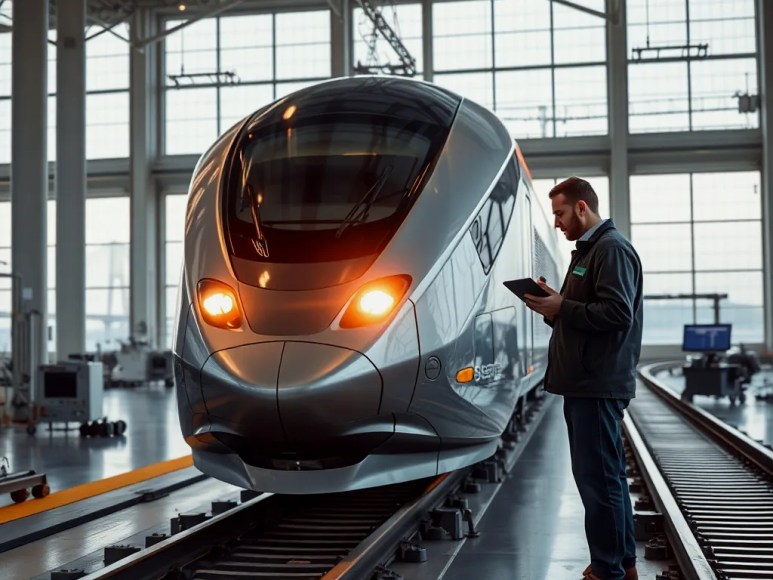
Turkey’s rail transformation stretches beyond laying tracks to building critical train technologies
Turkey is shifting from being mainly a rail consumer to becoming a rail technology developer. Recent national projects produced full electric train sets and high-speed prototypes that passed demanding dynamic tests. That progress reveals manufacturing scale but also highlights gaps in deep subsystems: traction motors, power electronics, train control software, braking systems and sensor suites. Measuring technological independence requires tracking who designs core components, where intellectual property sits, which subsystems rely on licensed production, and how maintenance supply chains operate.
How domestic train programs prove industrial capability — and where they still need to go
TÜRASAŞ’s national electric multiple units and high-speed train programs reached technical milestones in testing, including speeds above 225 km/h in trials. Those results demonstrate systems integration and production know-how. Convert that into lasting capability by establishing repeatable production lines, qualified suppliers for critical parts, certified test facilities and documented design-for-manufacture processes. Example: moving from a single prototype to serial production of 14 high-speed sets requires validated lifecycle procedures, spare-parts pools with agreed lead times, and rigorous failure-mode analyzes for every subsystem.
Which subsystems determine true rail technology sovereignty
Prioritize verticals that create the largest strategic dependency if imported: traction motors and inverters, main transformers, onboard control and signaling units (TCMS/CBTC), brake control and energy recovery systems, condition-monitoring sensors and cybersecurity for rolling stock. Domestic design capability in these areas reduces foreign vendor lock-in. A practical step-by-step path: 1) identify high-risk imported items, 2) fund joint development projects between OEMs and research labs, 3) create pilot production runs under quality oversight, 4) certify parts to international norms and 5) scale to volume with supplier development programs.
Engineering behind high-speed performance — practical considerations
High-speed reliability depends on holistic engineering, not a single component. Key areas to address concurrently: aerodynamics (reduce pressure pulses in tunnels and crosswinds), bogie design for stable wheel-rail interaction, redundant braking architecture for fail-safe deceleration, active vibration damping to preserve ride quality, and energy-optimized traction control to lower operational costs. For example, redesigning bogie suspension with tuned secondary springs and active dampers reduced wheel wear in analogous programs by measurable percentages, improving maintenance intervals and lifecycle cost.
Linking rail vehicle manufacturing to national industry and logistics
Rail vehicles amplify value only when integrated into supply chains and modal networks. Rail-enabled factories and port links slash unit transport cost for heavy or bulk goods compared with road haulage. To illustrate: a single block-train operating at regular frequency can replace dozens of long-haul trucks per week, yielding lower per-ton transport cost, less congestion and reduced pavement wear. Investments should therefore pair rolling-stock production with sidings, intermodal terminals and customs streamlining at border crossings to convert geographic position into export competitiveness.
Scaling: universities, SMEs and the supply chain ecosystem
Build an enduring industrial base by embedding long-term R&D programs in universities, establishing accredited test centers, and creating supplier development funds targeted at SMEs making precision casting skills, power electronics, sensors and software modules. Structured internships, collaborative PhD programs with industrial targets, and shared tooling grants accelerate capability. A concrete policy: offer multi-year procurement commitments to suppliers that meet defined capability milestones in exchange for co-investment in factory upgrades.
Export readiness: what domestic trains must prove to win international contracts
To export, rolling stock must demonstrate certified safety, lifecycle cost advantages, accessible spare parts, and post-sale service networks. Achieve this by securing EN/IEC certifications, publishing verified energy-consumption and downtime statistics from in-service fleets, and piloting maintenance hubs in partner countries. Export deals often hinge on local service guarantees; setting up regional parts warehouses and training local maintenance crews converts a sale into a sustainable revenue stream.
Regional development: rail connections that expand local economies
Rail investment should target more than intercity passenger speed records. Extending freight-capable lines to secondary industrial regions raises local firms’ market reach and lowers input costs. Design regional services around predictable timetables, modular wagons for mixed cargo types, and first/last-mile logistics solutions. Case in practice: converting an underutilized branch line into a weekly freight shuttle for agricultural exporters increases harvest-to-port throughput with modest incremental capital.
Policy and measurement: how to track progress beyond kilometers of track
Shift performance metrics from raw infrastructure length to technology ownership and industrial depth. Useful indicators: percentage of critical subsystems designed domestically, number of certified suppliers for traction and control systems, average lead time for spare parts sourced locally, export revenue from rolling-stock and components, and R&D headcount in rail-focused programs. Regular published dashboards tied to public procurement rules create accountability and attract private investment.
What success looks like — practical milestones for the next five years
Set concrete, staged targets: (1) certify at least three critical subsystems domestically (traction inverter, TCMS, brake controller), (2) achieve serial production capability with documented quality metrics, (3) establish two export maintenance hubs regionally, and (4) scale a supplier network of 50 SMEs meeting ISO/EN standards. Each milestone should include timelines, funding commitments and measurable acceptance criteria so progress becomes verifiable and actionable.
Turkey’s strategic gain lies not in the total kilometers of rail but in the share of technology and industrial competence that operates on those rails. When core components, software and service ecosystems are domestically owned and continuously improved, the rail sector becomes a durable engine of trade, manufacturing and innovation.