
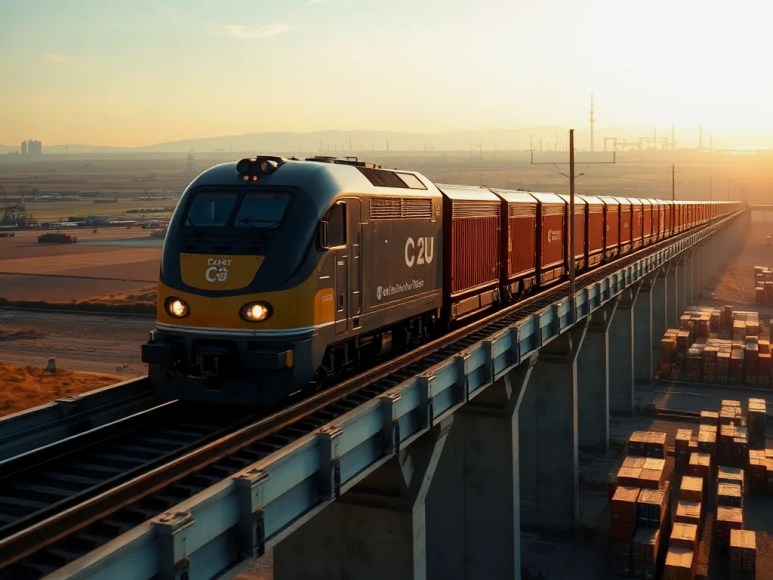
Yavuz Sultan Selim Bridge to host an 8.3 billion-dollar rail link
Turkey is constructing a 127 km, double-track, electrified, and signalled northern rail corridor that will pass over the Yavuz Sultan Selim Bridge. That Istanbul Northern Railway Crossing (INRAIL) section, running between Çayırova and Çatalca, sits at the center of a roughly $8.3 billion investment package documented in international finance papers. Major multilateral lenders have already committed portions of funding: the World Bank approved $2 billion in March 2026, while other contributors include the Asian Infrastructure Investment Bank and the OPEC Fund for International Development. Planners project the corridor will raise Bosphorus rail freight capacity from about 3 million tons per year today to a target of 50 million tons per year once the line and complementary works are complete.
Why the northern rail link matters for freight throughput
The existing Marmaray tunnel carries heavy passenger traffic and offers only limited windows for freight movements. Operational constraints currently allow roughly four freight trains per day through Marmaray, a bottleneck for growing China–Europe rail flows. By separating passenger and freight routes and adding a high-capacity, electrified northern passage, Turkey will reduce scheduling conflict, increase daily freight train slots, and shorten dwell times at Istanbul terminals. Example: a freight operator running 12 daily round trips through a dedicated northern corridor could move roughly 3–4 times the current Marmaray freight volume, depending on train length and axle load.
Halkalı–Kapıkule upgrades strengthens the Europe link
The Halkalı–Kapıkule project complements the northern crossing by improving the western gateway to Europe. The Çerkezköy–Kapıkule 153 km segment opened in October 2026, bringing the total line closer to its 229 km scope and a 2028 completion target for remaining sections. When finished, planners expect passenger travel time between Halkalı and Kapıkule to fall from four hours to about 90 minutes and annual freight capacity to rise from 1.5 million tons to an estimated 9.5 million tons. That capacity gain creates a paired-flow system: northern Bosphorus capacity handles intra-Anatolian and long-haul east–west freight, while Halkalı–Kapıkule enables rapid cross-border moves into the Bulgarian and wider European rail networks.
How Turkey aims for a 2,000+ km continuous cargo corridor by 2030–2031
Ministry targets on a continuous corridor exceeding 2,000 km between Turkey’s eastern and western borders with a 30 million tons annual throughput goal. Achieving 14-day transit times from China to London will require synchronized upgrades: faster line speeds, longer passing loops for 750–1,500 m freight trains, higher axle loads (eg, 22.5–25 t), and streamlined customs and border procedures. Step-by-step priorities include (1) completing physical rail links and intermodal terminals, (2) installing interoperable signaling and traction standards, (3) implementing bilateral and multilateral border-processing agreements, and (4) scaling rolling-stock fleets and crew training for cross-system operation. Real-world example: if border processing reduces average hold time from 12 hours to 3 hours per crossing and average line speed climbs from 40 km/h to 60 km/h, the same physical corridor could shave several days off transit and multiply annual throughput.
Operational and customs reforms needed to make 14-day China–London services reliable
Physical infrastructure alone won’t deliver a 14-day China–London rail product; Administrative harmonization must follow. Key reforms include standardized electronic consignment notes, pre-arrival scanning and customs clearance, trusted-trader lanes, and synchronized timetabling between national operators. A practical timetable coordination measure: agree fixed daily departure slots at major terminals, reserve passing loops at border junctions, and publish a corridor-wide realtime tracking feed so shippers can plan time-sensitive consignments with predictable cutoffs. Case study: corridors that implemented electronic pre-clearance cut border delays by 40–60% within two years of rollout.
Regional connectors—Zangezur and the Development Road—diversify routing options
Turkey also monitors alternative links that reduce dependence on a single east–west axis. The Zangezur corridor—contingent on Azerbaijan–Armenia political settlement—could open a route that connects Türkiye to Central Asia while bypassing some Black Sea chokepoints. Meanwhile, the Iraq-focused “Development Road” concept aims to link Iraq’s Grand Faw Port to Europe via Turkish nodes, combining rail and road segments to provide additional maritime–land intermodal alternatives. These routes broaden options for modal planners and shippers, but each faces separate diplomatic, financing, and construction timelines.
Hicaz corridor ideas extend connections into the Middle East
Reviving or reimagining segments of the historic Hejaz Railway offers potential long-range benefits for Turkey’s Middle East access. Modern proposals envision corridors that traverse Syria and Jordan toward Saudi links, potentially enabling trade flows from the Levant into Gulf ports and onward to Asia. Such projects would require multilateral security guarantees and investment in resilient freight terminals; however, they could create competitive new routes for energy and containerized cargo moving between Gulf ports and European markets.
Risks, financing realities, and expected economic impact
Projected macro gains—such as the World Bank’s scenario of a 4.1% GDP uplift and $47 billion contribution—represent modeled outcomes, not guaranteed returns. Main execution risks include financing gaps, permitting delays, tunnelling and geotechnical challenges under the Bosphorus, and geopolitical shocks that disrupt cross-border flows. Funding strategies combine multilateral loans, export-credit agency packages, and public–private partnerships for terminals and operations. Example mix financing: 30–40% concessional multilateral loans, 30% ECA-backed export finance for rolling stock and signaling, and 30–40% project-finance equity for terminal concessions.
What shippers and logistics operators should prepare for now
Operators should evaluate route diversification, investors in interoperable wagons and telematics, and establish customs partnerships across borders. Practical steps: run pilot trains on upgraded segments to tune timetables, sign reciprocal operating agreements with neighboring national operators, and deploy container tracking and temperature-control telematics for express supply chains. By preparing rolling-stock assets (eg, 1,200–1,500 m trains with 22.5 t axle capability) and digitalized documentation, forwarders can capture early-mover advantages when capacity comes online.
Bottom line: infrastructure, operations, and diplomacy must align
Turkey’s near-$10 billion program can shift major volumes from sea to rail only if engineering works, operational reforms, and regional agreements progress together. The northern Bosphorus crossing and Halkalı–Kapıkule upgrades will materially increase physical capacity; administrative simplification and alternative corridor regionals will determine how much of that capacity turns into predictable, competitive rail services between Asia and Europe.