
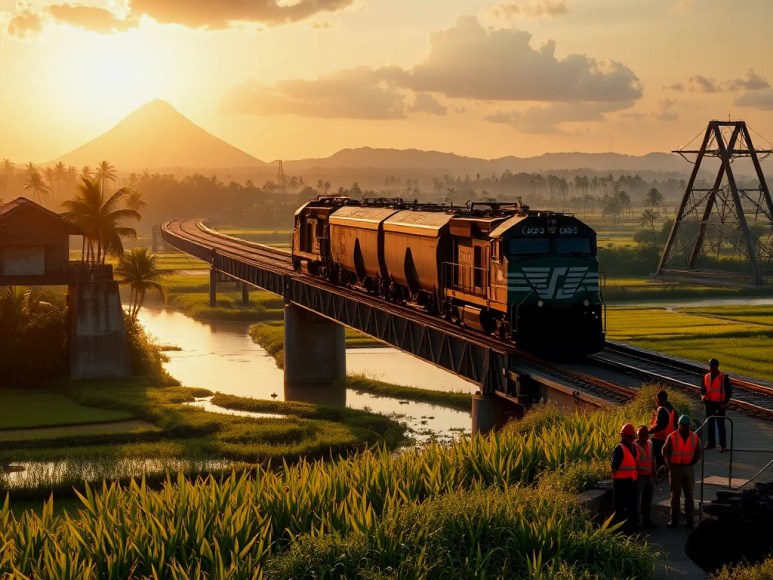
Framework agreement signed for a 162 km double-track freight railway
China Railway Engineering Corporation (CREC) and PT Nusa Investama Utama (NIU) signed a framework agreement to build a 162-kilometer freight railway in East Kalimantan, Indonesia. The signing took place on 25 November 2026 in Jakarta and was attended by Indonesian Transport Minister Dudy Purwagandhi. The agreement establishes roles for preliminary engineering, feasibility studies, and a pathway to detailed design and construction procurement. Early work will focus on route definition, environmental and social baseline studies, and coordination with mining concession holders to align railheads and loading facilities.
Operational target: 100 million tons per year, scalable to 200 million
The line is planned as a double track from the outset to enable high-frequency, bi-directional flows. Initial operational modeling targets 100 million tonnes per year of coal freight; Staged upgrades and signaling modernization can raise capacity towards 200 million tonnes per year. Capacity planning includes axle-load specifications, train length scenarios (eg, 1.5–2.5 km unit trains), and pit-to-port cycle times to determine required rolling stock and siding geometry. Example: with 2 km trains carrying 10,000 tonnes each and an average turnaround of 8 hours, the corridor could move roughly 60–70 million tonnes annually per direction; doubling track and optimizing terminal throughput makes 100+ million feasible.
How the railway integrates into a future Trans-Kalimantan network
The project is positioned as the first link of a larger Trans-Kalimantan freight backbone. Planning steps to ensure network integration include mapping interchange points with planned north–south corridors, reserving right-of-way for future extensions toward Central and South Kalimantan, and designing junctions that allow continuous long-haul operation without transshipment. Practical integration tasks: establish common signaling standards, agree axle-load and gauge tolerances, and create a phased timetable for physical extensions tied to cargo demand triggers.
Environmental, social, and spatial planning requirements
Comprehensive feasibility work must cover biodiversity assessments, hydrological modeling, and community impact plans. Key mitigations: align alignment to avoid critical habitats, design drainage to prevent sedimentation of rivers, and construct noise and dust barriers near settlements. Social measures include workforce training programs, resettlement frameworks where unavoidable, and locally prioritized procurement clauses. A robust Environmental and Social Management Plan (ESMP) with monitoring indicators and public grievance mechanisms will be required before financial close.
Technology transfer, employment, and local content strategies
The agreement foresees technology transfer elements and local employment targets. Practical measures: joint training centers for track construction, signaling, and rolling stock maintenance; phased localization of component manufacturing (sleepers, turnout parts, signaling cabinets); and apprenticeship quotas for East Kalimantan workers. Contracting strategies can link milestone payments to local content percentages and documented skill-transfer outcomes to accelerate capacity building.
Unresolved commercial and technical details
Several critical items remain for negotiation before construction begins: the final alignment and station/terminal locations, total capital cost and financing structure (EPC loans, export-credit agency support, public-private partnership elements), concession length, tariffs and access charges, and an agreed construction and commissioning timetable. Lenders will require detailed traffic forecasts, risk allocation matrices, and sovereign or project-level guarantees before committing funds.
Key operational considerations and examples
To achieve targeted throughput with reliability, operators must specify axle loads (eg, 25–32.5 tons), signaling (CBTC or ETCS-level equivalents for heavy freight), and maintenance regimes. Example operational design: a two-shift maintenance pattern with predictive tamping and ultrasonic rail inspection can maximize availability to 98–99%. Terminal design must avoid bottlenecks—parallel discharge berths, rotary car dumpers or bottom-dump unloading with conveyor integration, and staged stockyards sized for 7–14 days of buffer stock.
Next steps and realistic timeline
Immediate next steps are commissioning detailed feasibility and environmental studies, defining financier-ready project documentation, and finalizing public approvals. Realistic timeline example: 12–18 months for feasibility and ESIA, 6–12 months to secure finance and final permits, and 36–48 months for construction depending on ground conditions and procurement speed—total delivery from agreement to first ton could span 4–6 years under an accelerated program.