
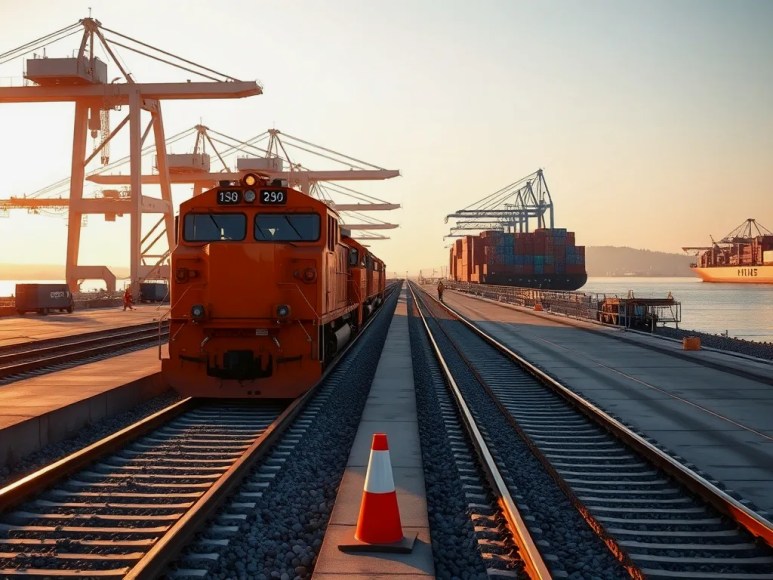
The federal and Ontario governments will fund a new multimodal port and rail transshipment hub in Sault Ste. Marie with a combined C$250 million to unlock northern supply chains and shift cargo from truck to rail and ship.
Project scope and site transformation
Crews will convert roughly 98 hectares of waterfront industrial land along the St. Marys River into an integrated logistics campus. The plan includes two deep-water berths sized for bulk and breakbulk carriers, a purpose-built rail interchange yard for unit and block trains, and upgraded road links that connect industrial corridors to Highway 17 and regional highways. HOPA Ports will lead phased construction, beginning with environmental and technical studies and advancing to heavy civil works and marine construction.
How the multimodal flows will operate
Operators will receive inbound unit trains from northern mining, forestry and agricultural zones at the rail yard. Cranes, conveyor systems and ro-ro ramps will move ore, logs, grain and packaged cargo from rail wagons to vessels or short-haul trucks. The co-location of rail, road and marine facilities shortens transfer times: a properly sequenced train-to-ship transfer can take under 12 hours for bulk loads, versus multiple days when transiting distant ports or relying on long-haul trucking. The design emphasizes staged storage buffers, covered handling for weather-sensitive commodities and segregated circuits for hazardous and non-hazardous loads.
Funding breakdown and municipal contributions
Federal support will come via the Trade Diversification Corridors Fund, providing up to C$125 million. Ontario offers C$125 million as repayable financing. The City of Sault Ste. Marie has signaled conditional support up to C$15 million, separate from the provincial and federal allocation. Together these layers reduce upfront capital risk for the port authority while aligning public objectives—job creation, modal shift and corridor resilience—with private sector operators who will ultimately finance equipment and terminal operating systems.
Construction timeline and key milestones to 2031
HOPA Ports plans to complete environmental assessments, Indigenous partnership agreements, and detailed designs by 2027. Site remediation and preparatory earthworks would follow in 2028. Major marine, rail and road construction phases are scheduled to run from 2029 through 2030, with operational commissioning and phased openings in 2031. This staged approach allows early cargo handling capacity to come online as later berths and rail loops complete, enabling revenue generation during build-out and reducing financing pressure.
Projected cargo volumes, metrics and employment impact
Transport Canada projects the facility could handle more than 3.5 million metric tonnes annually. by 2031 under certain throughput scenarios. Ontario’s models forecast an increase from present regional throughput of roughly 627,400 tonnes to approximately 3 million tonnes in steady-state operation. HOPA Ports’ own scenario planning estimates annual marine volumes above 2.4 million tonnes using slightly different commodity and routing assumptions. The variance reflects differences in assumed commodity mix, transshipment rates and hinterland capture.
Direct employment estimates tied to terminal operations and construction reach 2,150 jobs, with an additional 2,600 indirect jobs from supplier and logistics chains in Transport Canada’s projection. Ontario’s indirect estimate sits near 2,120 jobs. HOPA Ports calculates an annual economic contribution near C$933 million under its mid-case projection. Treat these numbers as modeled outcomes that depend on commodity markets, rail connections and export demand.
Strategic value for Northern Ontario exporters
The hub creates an alternative corridor for miners, foresters and agricultural producers to reach Great Lakes and ocean markets. Currently, limited multi-user port capacity between Thunder Bay and southern Ontario constrains routing options; Sault Ste. Marie fills this geographic gap. By shortening modal trips and providing dedicated rail-to-ship facilities, producers can reduce per-tonne logistics costs and lower turnaround time for rolling stock and vessels. That improved velocity also opens up opportunities for time-sensitive bulk shipments and seasonal surges.
Rail linkages, network effects and unanswered details
Key rail connections will tie into existing Huron Central Railway lines toward Sudbury and beyond, and interchange points with Class I carriers will determine national reach. The exact routing, capacity of connecting track, and frequency of scheduled block trains remain subject to commercial agreements and infrastructure upgrades. Planners must clarify the expected volumes per train (eg, 10,000–12,000 tons per 100-car train for bulk commodities), siding capacity for staging and contingency routing during winter months when Great Lakes navigation windows narrow.
Operational examples and step-by-step transfer process
Example: an iron ore shipment from a Northern mine
1. Mine operator assembles a unit train at origin and dispatches to Sault Ste. Maria.
2. Train arrives at the terminal’s rail yard, enters a dedicated unloading loop and discharges via rotary car dumper or bottom-unloading wagons into covered conveyors.
3. Conveyors feed a shiploader, with dust suppression and screening as required to meet environmental controls.
4. Vessel berths, receives cargo, secures hatch covers and departs within a predefined berth window.
This end-to-end sequence preserves rail asset utilization, reduces double-handling and limits exposure to winter road conditions.
Environmental, Indigenous and community integration
Environmental assessments will examine aquatic habitat impacts, sediment disturbance from berth construction and stormwater management for impervious surfaces. The project includes commitments to Indigenous consultation and partnership frameworks; These agreements will likely cover employment targets, business participation and cultural heritage protections. Community integration plans envisage noise mitigation, traffic management, and shoreline public access where feasible, balancing industrial use with local amenity retention.
Risks, sensitivities and contingency considerations
Principal risks include commodity price swings that reduce export volumes, delayed rail upgrades at interchange points, and Great Lakes navigation seasonality that compresses sailing windows. Cost escalation in marine civil works and supply chain disruptions for specialized equipment (cranes, shiploaders) pose schedule risk. Mitigation measures include phased commissioning, flexible cargo handling systems that switch between bulk and breakbulk, and contractual arrangements with rail partners to guarantee minimum service levels.
What this means for shippers and regional planners
Shippers gain an additional outbound route with potential cost and time benefits; regional planners receive a tangible asset to attract value-added processing and logistics businesses. Municipalities and port operators should align zoning, workforce development and rail corridor investments now to capture the earliest operating volumes and sustain long-term competitiveness.