
Discovery context and specimen history
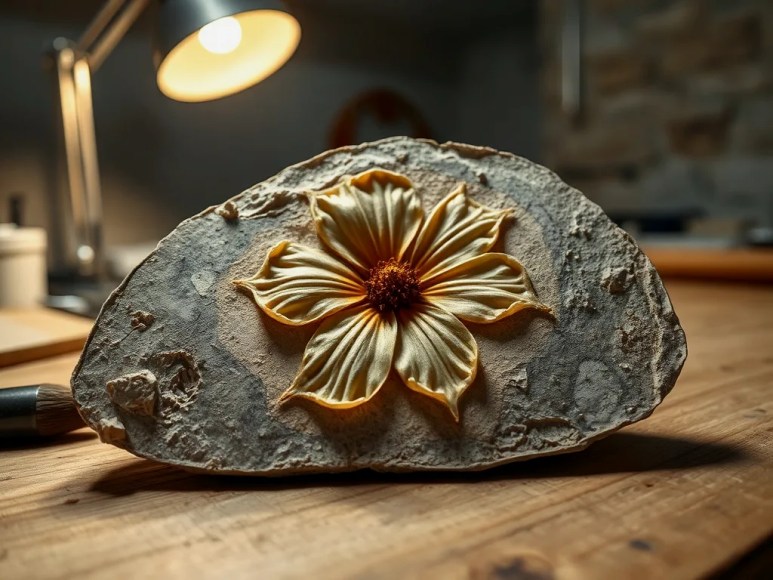
Researchers at the Kew Research Institute and the Smithsonian reexamined a small stone collected in Kansas 130 years ago and uncovered a fully embedded flower using high‑resolution micro‑CT scanning. Paleobotanist Steven Manchester performed the micro‑CT scan and produced a three‑dimensional reconstruction that revealed a complete flower roughly 1.5 mm tall and 1.2 mm across, concealed within the matrix and invisible on the specimen’s exterior.
Morphology: what the fossil shows
Virtual sections and 3D segmentation show a flower built from three sepals, three petals, six stamens and three carpels—an architecture strongly indicator of monocots The relative proportions and organ placement align with small flowers found in modern palms, certain orchid‑like lineages and early representatives of the lily/banana group. Micro‑CT permitted measurement of dimensions and internal relationships without damaging the sole specimen.
Scientific importance: filling gaps in the fossil record
Reliable Cretaceous flowers interpreted as monocots remain rare. Tomlinsoniella pedicellata provides the earliest unambiguous evidence of a 3+3 perianth and 3/6 reproductive organ pattern in a flower dated to ~100 million years ago. That morphological snapshot supplies calibration points for divergence estimates and lets researchers test hypotheses about which floral traits are ancestral in major monocot clades.
Palmlike affinities and alternative evolutionary scenarios
Many characters in the fossil—overall floral plan, organ counts and proportions—parallel those of palm flowers (Arecaceae). However, assigning the specimen to modern palm lineages remains tentative because only one specimen is known, fine micromorphological details are obscured by preservation, and convergence among monocots is common. Reasonable alternatives include placement in an extinct palm‑relative lineage or an independent monocot branch that evolved a palmlike floral architecture convergently.
Taxonomy and the name
The authors named the taxon Tomlinsoniella pedicellata in honor of botanist Barry Tomlinson. The specific epithet highlights the pedicellate nature of the flower preserved in the stone. The published description includes diagnostic morphological characters and measurements to allow future comparisons and potential taxonomic reassessment should more material appear.
Why micro‑CT worked: method and workflow
Micro‑CT reveals internal structure without sampling or destroying the specimen. The workflow in this study followed three main steps:
1. Preparation: stabilize and mount the stone, select X‑ray voltage and exposure to maximize contrast between mineral matrix and organic‑derived tissues.
2. Scanning: acquire axial slices at high resolution, then reconstruct the slice stack into a volumetric dataset.
3. Virtual dissection and segmentation: use image‑processing software to isolate perianth parts, stamens and carpels, measure dimensions and generate renderings and orthogonal virtual sections for publication.
This non-destructive chain of procedures allowed the team to extract detailed morphological data from a tiny, embedded flower and to preserve the physical specimen intact for future study.
Key scientific contributions and consequences
The fossil advances several research areas:
– Early monocot floral architecture: direct morphological evidence shows that a 3/3 perianth and 3/6 reproductive scheme existed in the mid-Cretaceous.
– Calibration for molecular clocks: an identifiable, dateable flower refines minimum age constraints for monocot divergences and helps reconcile molecular estimates with paleobotanical data.
– Morphological conservatism and innovation: similarity to living forms implies long‑term stability for certain floral traits, while differences point to early experimentation within monocots.
Comparative data and measurements
The following measurements summarize the fossil and its nearest morphological comparisons:
Tomlinsoniella pedicellata: flower height ~1.5 mm, diameter ~1.2 mm; perianth 3 sepals / 3 petals; 6 stamens; 3 carpels.
Comparative notes: these dimensions overlap with minute flowers in some extended palm taxa and with small flowers from orchid‑type and lily/banana groups. The organ counts match canonical monocot floral symmetry and provide a clear character set for phylogenetic coding.
Follow‑up research directions and recommended steps
Researchers should pursue several targeted efforts to strengthen interpretation:
1. Search for additional specimens: rescan adjacent slabs, reexamine historical collections from the same locality and use micro‑CT prospecting on other matrix fragments.
2. Micromorphology and chemistry: apply scanning electron microscopy and elemental mapping to detect preserved cuticle or microstructural traces that micro‑CT cannot resolve.
3. Integrative phylogenetics: incorporate the fossil’s discrete morphological characters into combined morphological‑molecular analyzes and test alternative placements under constrained topologies.
4. Taphonomic experiments: assess how decay and mineral replacement would alter floral parts at submillimeter scales to validate interpretations of organ identity.
Open questions the fossil raises
Tomlinsoniella pedicellata clarifies some points and leaves others unresolved: was this specimen a member of the palm crown group, a stem relative, or an independent monocot lineage? How widespread were similarly small, palmlike flowers in the Cretaceous, and what ecological roles did they perform? Systematic searches of museum collections with micro‑CT and targeted field sampling will help answer these questions.
Conclusion
Tomlinsoniella pedicellata represents a rare, securely interpreted Cretaceous monocot flower that micro‑CT revealed inside an old museum specimen. The combination of explicit organ counts, measurements and three-dimensional context makes it a valuable calibration point and a stimulus for renewed micro-CT surveys of historical fossil collections. Follow‑up microscopy, chemical analysis and expanded sampling offer a clear path to test its relationship to palms and to refine our understanding of early monocot evolution.