
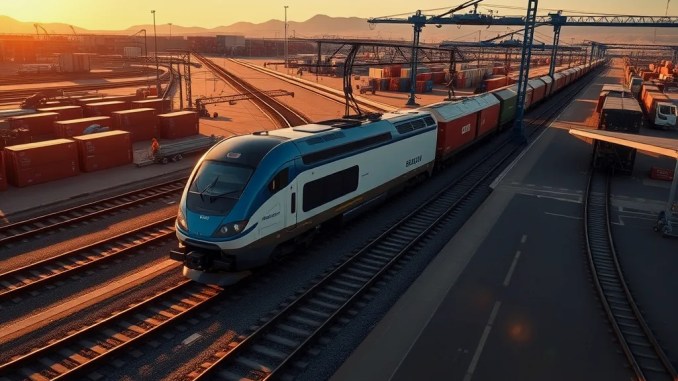
Overview of the Júndiz Concession and Ambitious Volume Targets
The Júndiz terminal concession awarded by Adif mobilizes a public–private joint venture led by Medlog (40%) alongside Bilbao and Pasaia port authorities and regional partners to scale rail–sea intermodal flows The consortium will operate the 55,000 m² terminal under an initial six-year contract with potential extensions up to 20 years.
The operator plans a staged ramp-up: 4,723 intermodal transport units (ITUs) handled in 2025, a target of 15,000 ITUs in year one of operation, 45,000 in year two, and a steady state of 60,000 ITUs per year from year three onward. Those milestones yield roughly 300,000 ITUs in the first six years if achieved, reflecting a multi-fold increase from initial throughput.
What counts as an ITU and why it matters
ITU definition and operational consequence: ITUs include ISO containers, swap bodies, semi-trailers and rolling platforms. Because these units transfer between road, rail and sea without unpacking cargo, they enable faster modal shifts, lower handling damage and improved turnaround times. For Júndiz, focusing on ITUs directly targets modal integration, shortens hinterland connections to Bilbao and Pasaia ports, and raises the terminal’s competitiveness for long‑distance rail freight on the Atlantic Corridor.
Ownership structure and strategic interests
Share distribution: Medlog 40%, Bilbao Port Authority 25%, CTV 15%, Vitoria‑Gasteiz Intermodal Transport Center 15%, Álava Chamber of Commerce 15% (note: percentages sum because some partners share equal stakes), Pasaia Port Authority and Servicios Intermodales Bilbaoport (Sibport) each hold 2.5%. This composition melds port operators, logistics specialists and regional public institutions.
The mix balances commercial know‑how (Medlog), port access and hinterland reach (Bilbao, Pasaia), and regional development priorities (Álava entities). That alignment should accelerate coordinated rail–port services and incentivize investments that tie terminal performance to port calling patterns.
Site layout, current infrastructure and immediate capacity
The concession covers approximately 55,000 m² with 36,000 m² of concrete operational yard. The site includes three electrified loading tracks totaling roughly 7,000 m² of continuous rail surface, 10,515 m² of internal roads, a 455 m² administrative/service building, a 530 m² heavy vehicle parking area and a 360 m² light vehicle parking area.
Operationally, two of the existing loading lines measure 600 m (mixed‑use) and the third accepts 460 m trains. The terminal already supports multi‑gauge operation via a third rail, enabling both standard and Iberian gauge rolling stock. These features let the facility handle cross-border and domestic flows without transshipment gauge breaks at origin or destination.
Upgrade path: mobile cranes, portal cranes and staged investment
Adif’s near-term concept uses mobile container cranes to reach an initial capacity of about 50,000 ITUs per year. The joint venture’s target of 60,000 ITUs by year three surpasses that estimate and anticipates further mechanization.
Introducing portal (rail‑mounted) cranes would transform throughput: design estimates place annual capacity at up to 170,000 ITUs and average daily train handling rising to seven trains per day. The project plans to add four new mixed-use tracks for 740 m trains, permitting longer block trains that lower per-unit rail costs and enhance operational rhythm.
Investment occurs in four phases with a total estimated budget near €95 million. Adif has already invested more than €37 million in the first phase, while subsequent phases tie capacity upgrades to operator commitments and contractual clauses governing extensions.
Contractual milestones and extension triggers
The contract’s initial six‑year term begins on signature. Extension mechanics embed performance thresholds: to obtain the first three‑year extension the operator must handle at least 125,000 ITUs within the first five years. Later extensions hinge on demonstrated capital expenditure and capacity increases performed by the operator.
Setting throughput‑based extensions aligns incentives: the operator gains term security only after proving market traction and investing in infrastructure that raises long‑term capacity.
How the terminal supports the Atlantic Corridor and hinterland integration
Geographically, Júndiz sits on the Trans‑European Transport Network and anchors the Vitoria–San Sebastián–Bayonne–Bordeaux cross‑border axis. Improved terminal performance directly shortens transit times between northern Iberian production/consumption centers and Atlantic gateway ports, making rail competitive against long-haul road movements.
Examples: (1) Exporters in Álava can consolidate containerized and swap‑body shipments into longer block trains to Bilbao or Pasaia, reducing drayage. (2) Importers benefit from scheduled rail links that connect port calls to Júndiz with predictable weekly rotations, reducing inventory buffers and logistics costs.
Quantitative scenario: ramp‑up and capacity sensitivity
Conservative scenario (mobile cranes only): annual throughput stabilizes at ~50,000 ITUs. Growth scenario (portal cranes + 740 m tracks): capacity expands toward 170,000 ITUs per year. Revenue sensitivity depends on uplift in modal share: if Júndiz captures an additional 1% national rail freight market share for containerized cargo, it would translate into tens of thousands of ITUs annually and justify portal crane investments within a multi‑year payback horizon.
Operational considerations and bottleneck mitigation
Key operational levers: synchronized port–terminal train timetables, availability of seamless gauge‑compatible rolling stock, Investment in fixed portal cranes to reduce lift cycle times, and on-site last-mile drayage coordination. Bottlenecks to monitor: pathing constraints on feeder lines, yard congestion during peak vessel discharge windows, and workforce shift patterns linked to intermodal train arrivals.
What stakeholders should track next
Short term: contract signature date, operator ramp-up reports, and the timetable for crane acquisitions. Medium term: first‑year throughput versus the 15,000 ITU target, evidence of new weekly rail services to Bilbao/Pasaia, and capital expenditure milestones tied to extensions. Long term: modal share shifts in the Atlantic Corridor and measurable reductions in road drayage kilometers for Álava‑origin cargo.
Practical example of route economics after upgrades
Assume a manufacturer in Álava moves 1,000 TEU per year to the UK via Bilbao. With current road drayage and port handling costs, average door‑to‑door cost is X. After Júndiz installs portal cranes and secures reliable daily block trains, rail leg unit cost can fall by 15–25%, lowering total logistics cost and delivery lead time variability. That delta makes rail attractive for medium‑distance flows and can shift contractual routing decisions in favor of rail‑linked ports.
Conclusions — expected impact if targets are met
If the joint venture meets staged targets and executes crane and track upgrades, Júndiz will substantially increase rail‑served intermodal volumes in northern Iberia, strengthen port–hinterland linkages, and position Álava as a logistics node on the Atlantic Corridor. Success depends on coordinated investments, reliable train paths, and commercial activation of shippers and carriers to fill the increased capacity.






Be the first to comment