
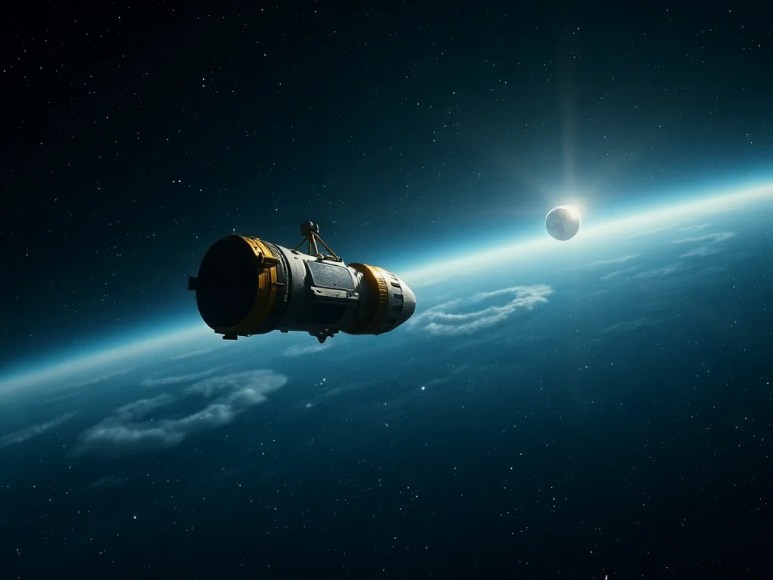
NASA announcement and why the timing matters
NASA announced that Voyager 1 reached a distance of one light-day from Earth on 18 November 2026 at 05:16 Eastern Time. A light-day is the distance light travels in 24 hours—about 25.9 billion kilometers—so radio signals exchanged with Voyager 1 take roughly 24 hours to arrive one-way. Because commands require acknowledgement, a full command-and-response cycle typically takes about 48 hours. Deep Space Network (DSN) scheduling and the spacecraft’s limited power mean engineers plan operations around long, predictable delays rather than real-time interaction.
Voyager 1’s mission arc: launch, planetary encounters, and interstellar entry
Launched on 5 September 1977, Voyager 1 completed high-resolution flybys of Jupiter in 1979 and Saturn in 1980, returning imaging and in-situ measurements that redefined understanding of giant-planet systems. After decades cruising outward, Voyager 1 crossed the heliopause in August 2012 and entered interstellar space. Since 1998 it has remained the human-made object at the greatest distance from Earth. That trajectory and longevity make it a continuous, in-situ probe of the interstellar medium unlike any other instrument.
How distance turns into communication delay and how the process works
Radio waves travel at light speed, so the one-light-day separation directly produces a ~24-hour one-way latency. Communication proceeds as follows: engineers on Earth schedule DSN antenna time, transmit commands in S- or X-band when the antenna is pointed and locked, Voyager’s receivers demodulate the weak carrier, onboard systems apply error-correction and store telemetry, and the spacecraft transmits a return signal. The DSN then captures that faint return with large dishes and phased-array techniques, passes raw data to JPL for processing, and engineers extract science and health metrics. Because signal-to-noise ratios are extremely low, mission teams use long integration times, redundant coding, and prioritized telemetry stacks to maximize useful return from each contact window.
Operational workflow at JPL: step-by-step from signal capture to decision
JPL’s operations follow a disciplined sequence:
1. Schedule and antenna targeting: DSN assigns an antenna pass, points, and prepares receiver parameters.
2. Signal capture: Antenna arrays acquire Voyager’s carrier and begin long integrations to isolate the packet stream.
3. Data processing: Raw samples are filtered, despread, and decoded; forward-error-correction and interleaving techniques recover packets lost to noise.
4. Telemetry analysis: Automated tools and engineers parse spacecraft health, power budgets, instrument states, and science packets.
5. Command planning: Based on telemetry, teams create a prioritized command sequence that fits power, thermal, and communication constraints.
6. Command upload and verification: Commands are uplinked during a future DSN pass; Subsequent telemetry confirms execution, often taking a full round-trip delay.
This loop repeats across hours or days. Because of the delay, JPL emphasizes robust preparation, conservative commands, and fail-safes that allow the spacecraft to remain safe autonomously between contacts.
Scientific value: what Voyager 1 still measures and why it matters
Voyager 1 continues to deliver direct measurements of the interstellar plasma density, magnetic field vectors, and cosmic-ray fluxes. These datasets inform models of the heliopause’s shape and variability, the propagation of charged particles from the galaxy into the solar system, and the microphysics of collisionless plasmas. For example, changes in plasma density and magnetic field orientation recorded since 2012 help researchers test theories of heliospheric boundary instabilities and the presence of small-scale structure such as waves or discontinuities in the local interstellar medium.
Power management and instrument prioritization under declining RTG output
Voyager 1 runs on radioisotope thermoelectric generators (RTGs) whose electrical output decays predictably with time. Mission planners maintain a dynamic instrument priority list that maximizes science return while preserving essential communications and thermal control. Typical tactics include: shutting down lower-priority instruments, reducing instrument duty cycles, grouping telemetry into higher-efficiency packets, and scheduling longer but less frequent contact windows. These measures preserve the spacecraft’s ability to send critical housekeeping and key scientific measurements for as long as possible.
What to expect next: practical timelines and likely developments
At current velocity and trajectory, Voyager 1 will continue sampling interstellar space for years, but the rate of returned telemetry will slowly decrease as RTG power and onboard aging limit operations. Near-term expectations include periodic releases of calibrated plasma and magnetic-field datasets, trend analyzes of cosmic-ray populations, and occasional health-status updates. Engineers will continue compressing and prioritizing telemetry to squeeze more value from each DSN pass; researchers will mine long-baseline trends to test heliospheric and interstellar models.
Common questions answered succinctly
Why is Voyager 1 important? It provides the only direct, long-duration in-situ measurements from beyond the heliosphere, essential for testing models of our Sun’s interaction with the galaxy.
Why do communications take so long? Signals travel at light speed; at one light-day separation, one-way transmissions take ~24 hours, so command-response cycles require ~48 hours.
How long will Voyager keep working? Longevity depends on RTG decay and component aging. Teams will prioritize instruments and telemetry to extend scientifically useful operations for as many years as hardware allows.
Representative communication timeline and distances
The table below summarizes typical events and delays:
Date (2026) — Event — Distance (km) — One-way delay
18 November — Announcement of one light-day milestone — 25,900,000,000 km — 24 hours
19 November — Expected first reception of the announced signal at Earth — ~25,900,000,000 km — 24 hours
Practical tips for following Voyager 1 updates and data releases
To track Voyager 1, subscribe to official NASA/JPL feeds for data releases and DSN scheduling. Researchers use public archives (eg, NASA’s Planetary Data System) to retrieve calibrated science products. When examining raw telemetry, look first at housekeeping channels (RTG voltages, temperatures, transmitter power) to assess data reliability, then consult instrument packet summaries for science content.
Bottom line: why this milestone matters now
Reaching a one light-day distance is both symbolic and operational: it highlights the extreme communication latencies mission teams manage and underscores the continued scientific return from a probe launched nearly half a century ago. Each DSN pass now yields high-value, carefully prioritized data that extends humanity’s direct sampling of the interstellar environment.