
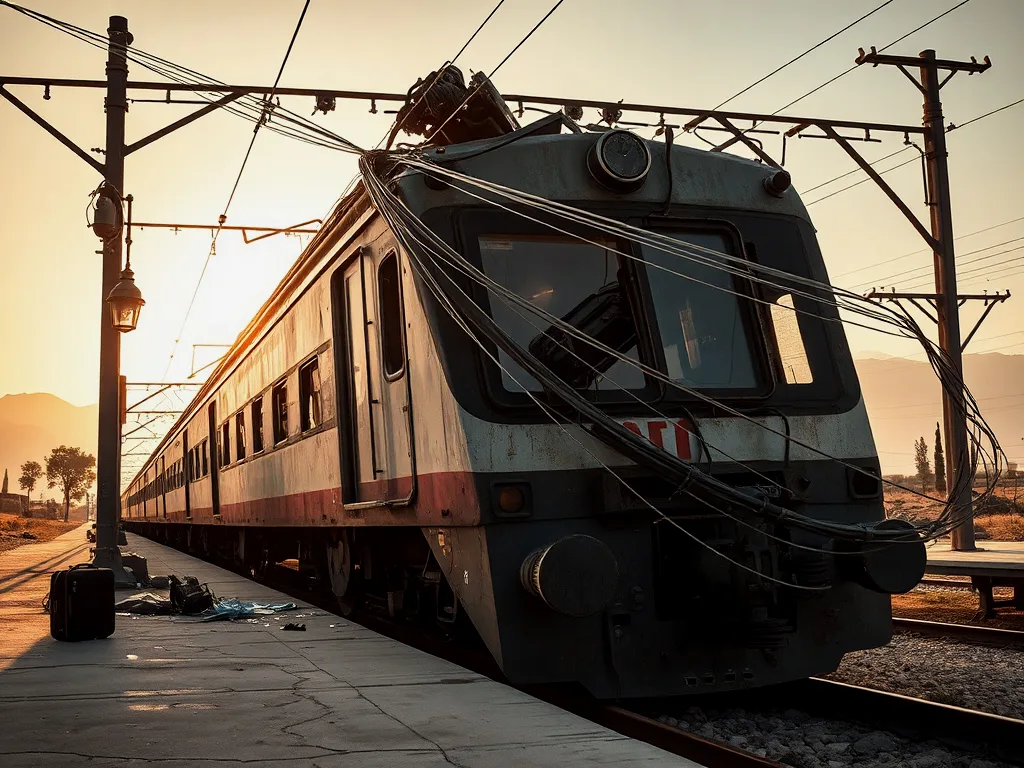
At Dakshineswar Railway Station in West Bengal, a live 11,000-volt overhead power line fell onto a stationary local passenger train, producing intense sparks and filling the platform with dense smoke. Railway staff quickly cut power to the overhead lines and began securing the scene; passengers evacuated without reported injuries. Below is a clear, action-oriented account that explains what happened, why it matters, what to do if you witness a similar incident, and how rail operators and passengers can reduce risk going forward.
What happened and how the contact created sparks and smoke
When a high-voltage overhead line makes direct contact with a train’s metallic roof or pantograph, the current takes the train’s metal body as a conductive path. That contact produces arcing—bright, hot electrical discharges—that can vaporize nearby material and ignite insulation or dust, producing visible sparks and smoke. In this incident the fallen 11 kV line touched the train’s exterior, generating large, sustained arcs that filled the station with smoke and forced immediate emergency action.
Immediate response taken by railway staff and emergency teams
Railway controllers cut the affected feeder supply to isolate the energized section within minutes, which is the standard first step to prevent further arcing and to allow rescue teams to approach safely. Platform crews moved passengers to designated safe zones, and track engineers inspected the train for residual charge and structural damage before allowing any reboarding. Clearing overhead assets, confirming line de-energisation with voltage detectors, and grounding exposed conductors followed as procedural tasks.
Why there were no reported injuries — technical factors that can reduce harm
Several technical factors may explain the absence of casualties: trains are long, continuous metal bodies that can distribute fault current across their surface (a phenomenon known as equipotentialisation), and if passengers remain inside and avoid touching external metal parts, they were less likely to experience current flow through the body Rapid isolation of the supply also limited exposure time. However, these factors do not guarantee safety in every incident—contact paths, arcing distances, and secondary fires can still cause harm.
Passenger actions to stay safe during an overhead line incident
Follow these immediate, practical steps if you encounter a fallen or sparking overhead wire at a station or on a train:
1) Do not approach the wire. Maintain distance: at least several meters from visible sparks or downed lines. Electricity can arc across gaps.
2) Stay inside unless instructed to evacuate. Exiting through doors may expose you to energized structures; wait for official instructions unless there is an imminent fire or smoke entering the coach.
3) Avoid touching handrails, metal doors, or the train exterior. These surfaces can become live if the fault current flows through the carriage body.
4) Move to high ground if on open track and a line is down. If you must leave, step away using short, shuffling steps with feet together to reduce the chance of creating a voltage difference between feet (step potential).
5) Call emergency services and report clear location details. Provide station name, train number, carriage position and descriptions (visible sparks, smoke, downed wire).
Operational impact: service disruption and inspection steps
Operators suspended services through the affected section while electricians confirmed isolation and cleared debris. Typical inspection steps included:
1) Phasing checks: Verify the overhead conductor is dead using calibrated voltage detectors and confirm protection relays operated as designed.
2) Visual and mechanical inspection: Look for burn damage on the catenary, droppers, and insulators, and assess pantograph condition and roof damage on the train.
3) Temporary repairs and rerouting: Fit short-term jumpers where safe, or institute bus replacement services until permanent repairs restore full running capability. Each step aims to restore safe operations without risking crews or passengers.
Preventive measures rail operators should implement
Reducing recurrence requires both engineering upgrades and procedural changes. Effective measures include:
– Regular overhead-line maintenance and real-time monitoring: Use predictive analytics on conductor sag, insulator degradation, and vegetation encroachment to schedule targeted repairs before failures occur.
– Improved support and rapid-isolation systems: Segment feeders with faster-acting breakers and ground-fault detection to reduce arc duration and energy release.
– Station design and passenger guidance: Clear, prominent signage reminding people to avoid overhead equipment and routine staff drills for line-failure scenarios.
Data and examples: frequency and typical causes of overhead contact incidents
Globally, most overhead-contact incidents arise from three root causes: infrastructure failure (corroded clamps, disconnected conductors), external interference (fallen trees, vehicle collisions with masts), and maintenance errors. In comparable metropolitan systems, overhead-line failures that cause passenger-facing incidents are rare relative to total train-km but clustered around extreme weather, deferred maintenance zones, and areas with heavy vegetation. Hard numbers vary by network—systems that publish reliability metrics report overhead-related service interruptions at a rate typically under 1–3 per 10,000 train-km in well-maintained systems, but the rate rises sharply during storms.
How authorities should communicate after such incidents
Clear, timely communication matters more than reassurance alone. Recommended messaging sequence for rail authorities:
1) Immediate alert: Confirm whether power is isolated and whether passengers are safe.
2) Status updates: Provide expected inspection duration, alternatives for onward travel, and realistic re-opening windows.
3) Technical summary after investigation: Share root-cause findings and planned remedial steps to restore confidence and reduce repeat incidents.
Takeaway — practical lessons for passengers and operators
Passengers should treat fallen lines and visible arcing as immediate hazards: keep distance, wait for trained staff, and avoid creating contact paths by touching metal. Operators must prioritize rapid isolation capability, predictive maintenance, and routine public-facing drills. When these actions combine, they reduce injury risk, shorten disruption time and improve system resilience.
Note: This account synthesizes typical electrical and railway safety practice and applies those principles to the Dakshineswar incident reported on-site; local investigators will publish formal findings after technical inspection.