
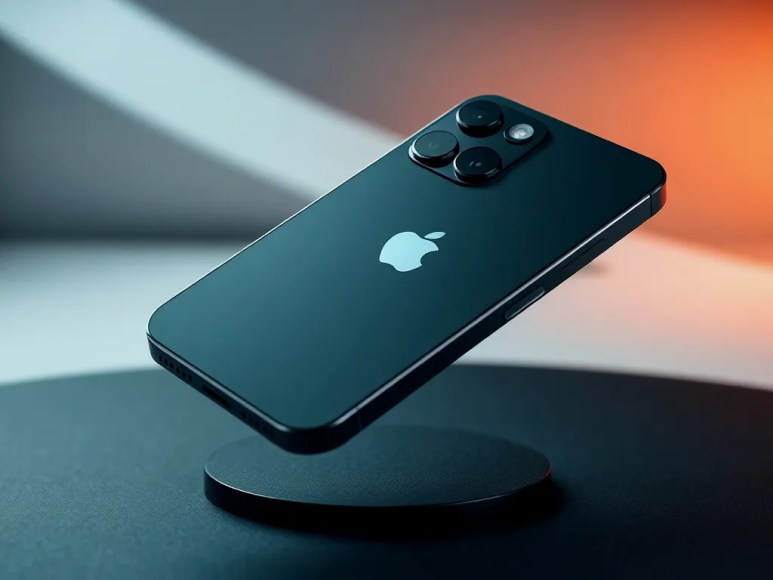
Curved Displays Return and Change How You Use Your iPhone
Apple redesigns the flagship with a pronounced curved-edge OLED that expands usable screen area and reduces visible bezels. The curvature creates a seamless appearance and enables edge swipe gestures that shorten common interactions—swipe-to-search, quick controls, and contextual toolbars become faster with finger arcs instead of long stretches. Engineers offset the fragility of curved glass by using advanced lamination, structural adhesives along the metal frame, and micro-reinforced corner bonding; These measures preserve impact resilience without adding bulk. In practice, you’ll see fewer accidental palm touches after calibration updates, but third-party cases must adapt to preserve the tactile benefits of the curve.
LOFIC Sensor Replaces Traditional FaceID Modules
LOFIC (Light-field Optical Focusing Integration & Capture) merges light-field capture and computational focusing in a single stacked sensor. Rather than stacking a separate ToF or VCSEL module for depth, LOFIC captures multi-angle light rays and computes depth maps directly, producing densityr, multi-plane depth data. For end users this means faster and more reliable biometric unlocking in varied conditions, improved subject separation in portraits, and the ability to refocus or re-bokeh after capture. Because LOFIC centralizes depth acquisition, Apple can reduce the on-screen sensor cutouts and maintain a uniform curved display without compromising secure face authentication.
How LOFIC Improves Real Photos and Video Workflows
LOFIC delivers practical gains across workflows. In low light it combines micro-exposures from slightly different light-field perspectives to reconstruct texture and reduce noise without oversmoothing. For portraiture, the sensor generates a multi-plane depth stack, enabling selective sharpening or blur on individual depth layers during editing. Video captures include per-frame depth metadata, which editors can use to track subject distance and apply grade-accurate rack focus or depth-aware noise reduction. In production terms, filmmakers receive 10-bit color video with aligned depth channels, simplifying compositing and object isolation.
Hardware and Software Camera Upgrades: What Changes and Why They Matter
Apple pairs larger sensor areas, improved pixel binning, and refined OIS algorithms with an ISP pipeline tuned to LOFIC’s output. Larger sensors capture more photons and improve dynamic range; pixel binning trades resolution for per-pixel sensitivity in night modes. OIS algorithms exploit gyroscope and LOFIC-derived depth cues to better separate camera shake from subject motion, producing sharper handheld long-exposure frames. On the software side, the A21 Pro routes depth-aware neural chains to the NPU, enabling instant HDR merges, semantic segmentation for subject isolation, and adaptive denoising that preserves fine detail. The combined effect: cleaner night photos, faster HDR processing, and depth-accurate bokeh that resists edge artifacts common to naive segmentation models.
A21 Pro: Architecture and Measurable Gains
The A21 Pro integrates high-frequency performance cores, energy-efficient background cores, a high-throughput GPU, and an expanded NPU array specialized for imaging tasks. Benchmarks should show multi-threaded app launches and game frame rates climb 20–40% versus the previous generation while neural workloads—real-time semantic segmentation, multi-frame alignment, and color transforms—execute several times faster. Power gating and dynamic voltage scaling extend battery life under mixed use; When imaging tasks push the NPU, the chip confines heavy workloads to the dedicated neural fabric, avoiding full CPU wakeups and reducing thermals. In day-to-day use, photographers will notice faster export times, editors will preview complex effects with less lag, and routine tasks remain snappy with minimal power impact.
People Also Ask: Concise Answers Users Search For
Will the curved screen break more easily? Proper engineering—advanced bonding, edge reinforcement, and optimized glass chemistry—reduces breakage risk compared with naive curved designs, though no curved glass is inherently invulnerable.
Does LOFIC mean FaceID disappears? LOFIC replaces the standalone FaceID hardware but retains secure biometric authentication by producing robust depth maps that the authentication stack uses for liveness and identity verification.
How much better is low-light photography? Expect a measurable improvement: larger sensor area plus LOFIC-guided multi-frame fusion improves signal-to-noise ratios, yielding clearer textures and better highlight retention versus previous models.
Will the A21 Pro heat more under camera loads? A21 Pro confines imaging workloads to the NPU and specialized ISP stages, which lowers average heat compared with running the main CPU and GPU at sustained peak; thermal design still matters for prolonged 4K/8K recording.
Do third-party apps benefit immediately? Apps that call system image APIs receive richer depth metadata automatically; developers unlocking full LOFIC potential will need to update for depth-aware editing, focus pulls, and compositing workflows.
Production Risks and How Apple Can Mitigate Them
Combining a curved display and LOFIC sensor increases production complexity across alignment tolerances, thermal dissipation, and touch-sensor calibration. Key mitigation steps include tighter supplier tolerances for display lamination, multi-point factory calibration of depth-to-display coordinate transforms, and expanded burn-in and thermal cycle testing to prevent long-term drift. Software mitigation includes continuous OTA calibration adjustments and developer toolkits that expose standardized depth formats to third parties, preventing fragmentation and inconsistent experiences.
When to Expect It and Who Benefits Most
Market timing alignments with a milestone anniversary launch; shipping windows typically follow shortly after. Everyday users gain a sleeker screen and faster, more capable cameras. Content creators and mobile filmmakers get the bigger wins: per-frame depth captures, 10-bit multi-channel video, and processor-accelerated export pipelines shrink turnaround times and increase creative control in post-production.
Examples and Practical Scenarios
Photographer scenario: a wedding shooter captures a low-light indoor ceremony. LOFIC provides layered depth and cleaner multi-frame fusion so portraits retain dress texture and ambient candle highlights while editors can adjust background blur post-shoot without reshooting. Videographer scenario: a solo documentary filmmaker records interviews on a gimbal; per-frame depth and A21 Pro’s NPU enable real-time background separation for live compositing and faster color-grade previews on set.
Search-Friendly Summary and Related Queries
Curved OLEDs increase usable screen area and enable edge gestures. LOFIC consolidates depth capture, replacing discrete face modules and improving portraits, low-light shots, and video post-production. A21 Pro accelerates imaging and neural tasks while improving efficiency. Related searches that this article targets include: “iPhone 20 LOFIC sensor explained,” “A21 Pro imaging performance,” “curved iPhone durability,” “depth metadata video workflow,” and “iPhone 20 Pro low light camera test.”