
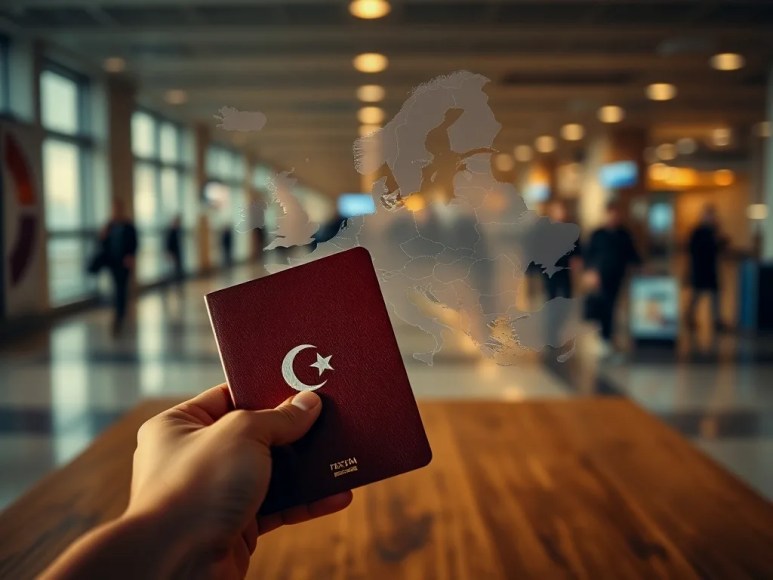
Current Turkish passport standing and what a Schengen waiver would change
Turkey’s passport currently ranks lower than many peers, limiting direct entry to numerous countries and imposing time-consuming visa procedures. Using previously reported Passport Reports figures, Turkey is shown at 74th with a mobility score of 106. If all 29 Schengen-area countries removed short-stay visa requirements for Turkish passport holders under identical entry conditions, that mobility score could rise to about 135, a nearly 27.4% increase. That improvement reflects a jump from 69 direct visa‑free destinations to roughly 98, with visa-required destinations dropping from 92 to 63.
Exactly how the score and access numbers were recalculated
Start with the baseline published values: 69 visa‑free, 30 visa‑on‑arrival, 7 e‑travel authorizations, and 92 visa‑required out of 198 total destinations. Add full visa exemption for 29 Schengen destinations to the visa‑free column (assuming ETIAS is not treated as an e‑travel authorization). Recompute:
New visa‑free: 69 + 29 = 98. New visa‑required: 92 − 29 = 63. Mobility score increases proportionally from 106 to ~135. The calculation assumes other countries’ policies don’t change and ETIAS is either absent or counted consistently; if ETIAS applies as an e‑permission, classification shifts and the effective benefit is different.
Which 29 countries would shift access and why classification matters
The 29 nations broadly consist of the 25 EU members in Schengen plus 4 non‑EU Schengen states: Germany, France, Italy, Spain, Netherlands, Belgium, Austria, Sweden, Denmark, Finland, Portugal, Greece, Poland, Czechia, Slovakia, Hungary, Slovenia, Croatia, Bulgaria (note: Bulgaria is an EU member but not in Schengen at all times—classifications vary), Romania, Estonia, Latvia, Lithuania, Luxembourg, Malta, Croatia, Hungary, Iceland, Norway, Switzerland and Liechtenstein. Removing short‑stay visas in those countries immediately increases practical access, but how the access is recorded (visa‑free vs e‑travel authorization like ETIAS) changes the measured mobility and traveler obligations.
ETIAS: why electronic authorizations alter the benefit
ETIAS requires non‑visa travelers to apply for pre‑travel authorization. If Turkey gains Schengen exemption but remains subject to ETIAS, travel becomes faster than full visa processes but still requires an online approval—currently priced at €20 for most foreigners. That means the perceived convenience and the statistical classification (visa‑free vs e‑permit) would diverge: travelers experience reduced friction but still face a mandatory prescreening step, and indexes that count only visa‑free entries will register a smaller uplift.
Real-world traveler implications: visas, wait times, and weekend trips
Removing the Schengen short‑stay visa obligation eliminates consular appointment delays, reduces document packaging, and shortens planning horizons. Practical examples:
– A family planning a Friday–Monday city break currently must secure appointments and gather bank letters and employment proofs weeks in advance. Waiver would let them book with days’ notice.
– An entrepreneur attending a two‑day trade meeting avoids multiple document translations and can respond to ticket opportunities within business days.
– A student attending a three‑day conference can travel with an ETIAS-style online permit or, if fully visa‑free, no permit at all.
Transport and tourism sectors: measurable demand and capacity effects
Airlines and tour operators typically observe demand elasticity: lower travel friction increases short‑notice ticket sales and weekend package booking. Predictable effects include higher load factors on short‑haul flights, increased off‑peak tourism, and stronger demand for regional rail services linking border cities. Caveat: ticket prices, currency fluctuations, and macroeconomic conditions mediate absolute passenger growth, so expect incremental demand rather than automatic mass travel surges.
Exporters, SMEs, and trade shows: step‑by‑step advantage
Step 1: Shorter lead time for trade show participation—no consular backlog means quicker confirmation and lower cancellation risk.
Step 2: Faster on-site aftersales, enabling same‑week troubleshooting or urgent part delivery coordination.
Step 3: Reduced administrative costs per trip (visa fees, courier charges, documents), improving ROI on short B2B visits. These steps cumulatively favor small exporters who previously found visa procedures disproportionate to the visit value.
Academic mobility and research collaboration impacts
Short stays for conferences, workshops, and supervisory meetings would become easier, increasing spontaneous academic mobility. Example outcomes: higher attendance at last‑minute symposia, smoother short internships or lab visits, and improved opportunities for rapid cross‑border research troubleshooting. Long‑term study, scholarships, or paid research positions remain governed by national long‑stay immigration rules and are unaffected by short‑stay visa waivers.
What won’t change: work rights, residency, and global visa reciprocity
Schengen short‑stay exemption does not grant the right to work, apply for residency, or automatically prompt third countries (eg, USA, UK, Canada, Australia, New Zealand, China) to change visa rules. Those nations set policy independently. A Schengen waiver increases European access but not global visa‑free reach; any reordering of global passport rankings depends on multiple bilateral policy shifts.
Policy hurdles left: the six outstanding criteria and realistic timing
The EU’s roadmap previously listed 72 benchmarks; official sources reported 66 completed and six outstanding. The remaining criteria span judicial cooperation, anti-terrorism measures, or administrative reforms (specific items vary across official updates). Until those six are conclusively addressed in verifiable fashion, no firm implementation date can be set. Monitoring official EU and Turkey communications is essential for accurate timing.
How to prepare now: practical actions for travelers and businesses
– Travelers: keep passports valid well beyond travel windows, enroll in travel insurance that covers changing regulations, and monitor ETIAS or Schengen announcements.
– SMEs and exporters: map critical short‑stay travel needs to calendar months, prepare modular travel budgets that assume lower administrative costs, and renegotiate flexible ticket options.
– Universities and research centers: design short‑term mobility programs that can scale quickly once entry rules change, and retain contingency plans for long‑stay visa processes.
Search snippet‑ready answers to likely user questions
Will Schengen waiver make travel visa‑free for Turks? If implemented as a full waiver, yes for short stays; if applied with ETIAS, travelers need an online permit but avoid consular visas.
How many extra countries would Turks visit visa‑free? Roughly 29 more (the full Schengen set), moving visa‑free access from about 69 to 98 destinations in the conditional calculation.
Does it change work or residency rights? No — short‑stay waivers do not allow paid employment or residency; those require separate national permits.
Concluding practical perspective
A Schengen short‑stay visa abolition for Turkish passport holders would offer a measurable, immediate boost in travel freedom, business agility, tourism demand, and academic exchange. The size of the benefit depends on whether access is classified as full visa‑free or as an ETIAS‑style electronic authorization, plus the timing and completion of remaining political and legal conditions. Travelers and organizations should prepare operationally for faster cross-border movement while watching official channels for the final legal framework and implementation details.