
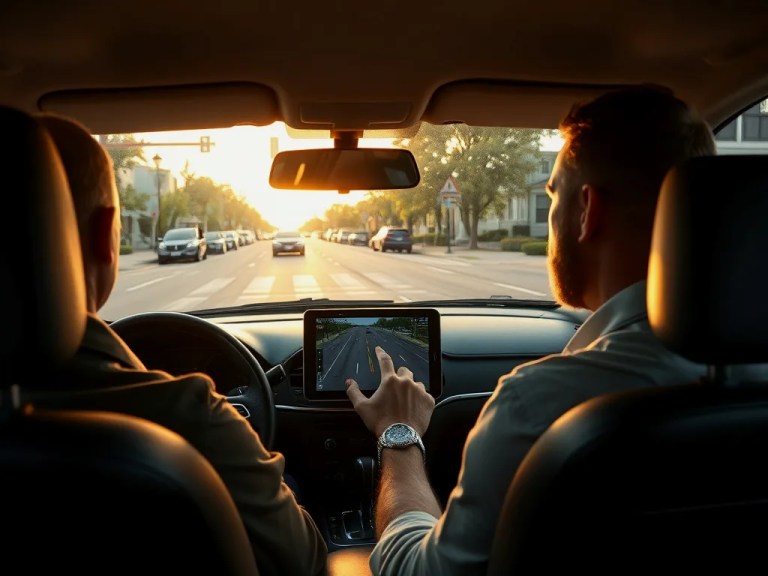
Why researchers choose GTA for real-world traffic studies
Researchers deploy GTA because it delivers dense urban scenarios, varied weather, and realistic vehicle dynamics at low cost. They modify the game to create repeatable traffic patterns, control spawn points, and script hazardous events that would be dangerous or illegal on real roads. These controlled variants let teams run many iterations quickly, measure human reactions, and collect labeled sensor-like data (camera views, object positions, velocities) for algorithm training.
How bicycle-safety devices are validated using GTA
An applied research team mounts vibration actuators on handlebars and tactile vests on riders, then places volunteers on a physical bicycle in front of synchronized game displays showing forward and rear perspectives. The lab records response time, steering choices, and gaze while the virtual traffic performs sudden lane changes, fast-passing trucks, and dooring events.
Step-by-step test workflow:
1. Scenario design: Script congested corridors, curbside obstructions, and left-turn conflicts that match local crash typologies.
2. Instrumentation: Integrate inertial sensors on the bike, haptic controllers on rider gear, and eye-tracking cameras; log vehicle state from the game engine.
3. Execution: Randomize cues and device-on/device-off trials to avoid learning effects and measure baseline etc. assisted performance.
4. Analysis: Compare reaction times, evasive maneuvers, and near-miss frequency using paired statistical tests; iterate ergonomics and vibration patterns to maximize detection without causing distraction.
How autonomous vehicle teams generate and label training data in GTA
Teams automate large-scale data capture inside the game to expose perception and planning networks to rare but crucial events: multi-agent collisions, jaywalking at night, and slippery roads. They extract synchronized RGB sequences, depth proxies, semantic segmentations, and object bounding boxes, then apply curated labeling pipelines.
Example pipeline:
Data generation: Spawn thousands of episodes with randomized traffic density, pedestrian behavior, and lighting. Use headless clients for scale.
Auto-labeling: Pull object IDs and positions from the engine, then project to image space for precise labels; augment with synthetic noise to mimic real sensor errors.
Model training and validation: Train perception stacks with a hybrid of real and synthetic data; validate on holdout GTA scenarios and a small set of instrumented real-world drives to measure sim-to-real gap.
How researchers design and test ethical dilemmas in simulation
GTA allows teams to craft replicable moral trade-offs, such as choosing between hitting a two-person motorcycle or swerving onto a sidewalk occupied by an elderly pedestrian. Researchers study algorithmic choices and human judgments in parallel to quantify preferences and identify societal acceptance boundaries.
Methods used:
Multi-policy comparison: Implement utilitarian, rule-based, and priority-first policies; run thousands of trials to compute outcome distributions (fatalities, injuries).
Human benchmarking: Present video clips to human subjects and record their choices, then measure alignment between human decisions and algorithm outputs.
Transparency experiments: Test whether exposing algorithm rationale (weights, predicted outcomes) changes human acceptance of an autonomous choice.
How transferable are GTA-trained models to the real world?
GTA-derived models shorten development cycles but face a measurable sim-to-real gap. Causes include perfect engine physics, lack of real sensor noise, and unrealistic driver heterogeneity. Teams close that gap with domain adaptation and progressive testing.
Effective transfer techniques:
1. Domain randomization: Vary textures, lighting, and physics parameters so models learn robust features rather than engine-specific cues.
2. Sensor noise modeling: Inject lens artifacts, motion blur, and dropout to mimic cameras and LIDAR imperfections.
3. Hybrid validation: Move from simulation to controlled test tracks, then to supervised urban pilots with safety drivers and constrained envelopes.
Ethical and legal boundaries when using commercial games like GTA
Research teams navigate intellectual property and human-subject regulations. They obtain platform permissions when required, secure institutional review board (IRB) approvals for human participants, and redact or responsibly disclose vulnerabilities found during testing.
Practical safeguards:
Seek licensing guidance: Contact rights holders early, document mod usage, and prefer vendor-approved APIs where available.
Follow human-subject rules: Use informed consent, present realistic risk disclosures, and store participant data securely.
Concrete study results and lessons learned
Selected outcomes from published and replicable projects show measurable improvements but also limitations:
Handlebar/vest haptics: Early prototypes reduced median reaction time by 150–250 ms in controlled trials, but long-term habituation and comfort remain design hurdles.
Perception models: GTA pretraining improved sample efficiency for rare-event detection; However, accuracy dropped 10–30% when ported to unmodified camera feeds without adaptation.
Ethics simulations: Policy selection changed projected casualty distributions by roughly 15–25% across testbeds; community preference surveys favored policies that minimized fatalities but penalized non-consensual risk redistribution.
How researchers improve realism to increase impact
Teams invest in higher-fidelity sensor stacks, human-driver behavior models, and multi-agent interactions. They validate fidelity by measuring metric drift: how perception confidence and control stability change when moving from sim to field.
Validation checklist:
1. Cross-check trajectories: Compare simulated vehicle trajectories against instrumented fleet logs for representative maneuvers.
2. Human-in-the-loop calibration: Run experiments with experienced drivers to spot unnatural agent behavior and refine traffic models.
3. Long-tail scenario curation: Prioritize rare but high-consequence events—eg, sudden road debris, animal crossings—when building test suites.
Policy and planning recommendations for cities and labs
Municipalities and research centers can adopt simulation-in-the-loop workflows to de-risk infrastructure changes. Use GTA or licensed simulators to pretest bike lanes, signal timings, and curb management strategies before committing capital-intensive changes.
Recommended governance steps:
Form multi-stakeholder protocols: Create agreements among universities, vendors, and transport agencies covering data sharing, IP, and safety criteria.
Mandate staged validation: Require simulation pass/fail criteria followed by closed-course and limited public pilots for any autonomy certification.
Practical tips for teams starting GTA-based experiments
Start small, document reproducibly, and plan for adaptation work:
• Prototype scenarios that match local crash statistics.
• Log engine-level ground truth together with rendered frames.
• Invest early in noise and domain-randomization techniques.
• Engage IRBs and legal counsel before running human trials.
What to expect from next-generation games like GTA VI
Next-generation titles promise richer physics, more complex agent AI, and finer environmental details. Researchers will gain more diverse datasets and closer approximations of urban complexity, but must still address IP constraints and sim-to-real validation. The potential lies in accelerating iterative design for safety devices and in producing ethically varied scenario libraries for robust policy evaluation.