
Summary of the Incident and Key Findings
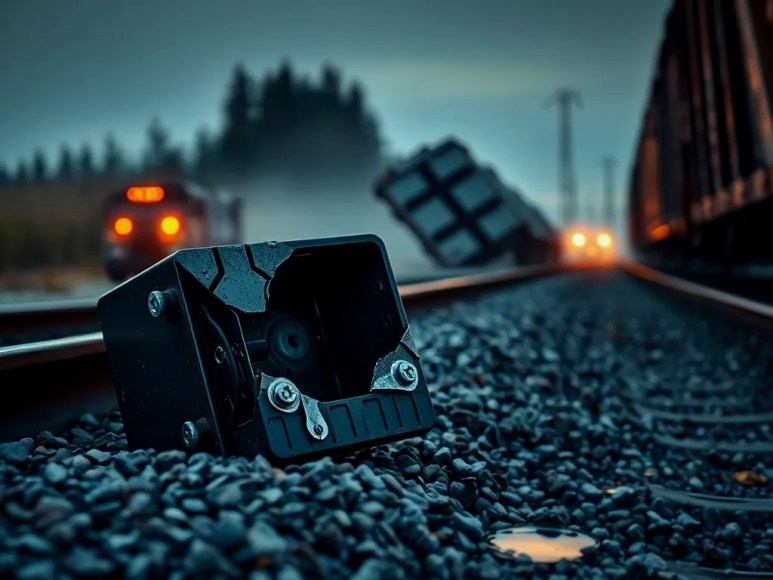
On 4 February 2025 a CN freight train experienced a wheel failure that triggered a derailment near Emo, Ontario. Investigators determined a 1992-manufactured wheel on CSXT 250514 developed an internal fatigue crack that progressed to a catastrophic rim fracture. High-resolution images captured the crack one day earlier at a wayside detector, but the detector’s software did not flag the anomaly because it was configured to measure flange and rim dimensions, wheel profile, and wear—not to detect cracks.
How the crack was first detected and why no alarm occurred
On 3 February 2025 the train passed a CN wheel-profile detector in Stanberry, Wisconsin. The detector’s camera system recorded a clear image of a crack extending from the rim into the wheel body on the R3 wheel of car CSXT 250514. The detector processed geometric and profile metrics and produced no maintenance alarm because its algorithms did not include crack recognition. The missed alarm reveals a capability gap: wayside systems that rely solely on dimensional analysis can record visual evidence of defects without generating actionable alerts.
Sequence of derailment and physical consequences
The CN manifest freight B78191-02 contained 104 fertilizer cars and three locomotives, with a gross train mass near 14,179 tonnes. At mile 108.1 outside Emo, the wheel’s rim was fractured. The broken wheel damaged track components and by mile 109.5 the failure escalated at a switch, causing 14 freight cars to derail. Ten cars rolled onto their sides and approximately 1,689 tons of fertilizer spilled. The Transportation Safety Board (TSB) reported no injuries and no hazardous materials release from the spilled fertilizer.
Metallurgical evidence linking the fracture to manufacturing defects
Laboratory metallurgical analysis identified inclusions and oxide stringers consistent with substandard steel cleanliness in the Griffin Wheel Company wheel produced in 1992. Analysts examined six steel specimens; five exceeded the clean steel thresholds later mandated by the Association of American Railroads (AAR). The wheel underwent ultrasonic inspections after re-profiling in 2008, but received no subsequent ultrasonic tests for 17 years. Investigators concluded internal defects acted as initiation sites for fatigue cracks that propagated under service loads until the rim failed.
Why wheels made before 2003 pose elevated risk
AAR tightened steel cleanliness and manufacturing controls in 2003. Wheels made before those requirements can contain nonmetallic inclusions and oxide clusters that increase the probability of stress-initiated cracks. From 2003–2025 TSB reviewed 15 derailments caused by rim breaks; eight involved pre‑2003 wheels. The report highlights that rail fleets still contain an unknown number of older wheels and that railways lack a systematic plan to remove them from service, leaving a persistent fleet risk.
Wayside detection, imaging, and AI: what worked and what did not
Traditional wheel-profile detectors perform reliable dimensional checks but do not always detect surface or subsurface cracks. High-resolution imaging systems captured the crack in this case but without crack-specific analysis they produce passive evidence instead of a preventive maintenance action. Operators in North America now test or deploy integrated systems combining:
1) High-resolution optical imaging that records wheel surfaces in multiple angles and lighting conditions.
2) Automated image analysis and machine learning trained to identify crack patterns, spalling, and unusual surface texture.
3) Periodic ultrasonic inspections to find subsurface anomalies that images cannot reveal.
When these technologies interoperate — sharing timestamps, car identifiers, and axle positions — they increase early-detection probability and reduce false negatives. The Emo case demonstrates that presence of cameras alone is insufficient; operators must implement analytics that convert images into timely maintenance alerts.
Operational and maintenance controls to reduce rim-break risk
Railways can reduce rim-break risk with a layered approach:
• Inventory management: tag and track wheel manufacturing dates and material spec on each car and set retirement thresholds for pre-2003 items.
• Inspection cadence: add ultrasonic scans after re-profiling and schedule recurring ultrasonic inspections at intervals based on service exposure and defect-history data.
• Wayside modernization: upgrade wayside detectors with crack‑detection image analytics and cross‑verify suspicious findings with immediate targeted ultrasonic inspection.
• Data fusion and alerting: integrate profile, image, and ultrasonic data into a central system that issues graded alerts and schedules prompt shop pulls for cars flagged as high risk.
Practical example: implementing a rapid response workflow
Step-by-step workflow rail operators can adopt:
1. Real-time detection: wayside imaging plus AI flags a suspected crack and records axle ID/ GPS location.
2. Immediate action: system generates a high-priority maintenance ticket and notifies operations to hold the car at the next crew change point.
3. Confirmatory test: perform ultrasonic or portable phased-array inspection at the yard or siding within 24–48 hours.
4. Remedial action: remove wheelset for shop repair or scrap based on confirmatory results; If confirmed severely, remove car from service immediately.
5. Root-cause feed: log defect details into fleet management to trigger sample testing of same-production wheels across the fleet.
Policy and fleet-wide implications
The investigation suggests regulators and industry should consider targeted policies: mandatory tracking of wheel manufacturing epoch, minimum ultrasonic re‑inspection intervals after reprofiling, and certified image-analytics standards for wayside detectors. Creating a defined retirement pathway for pre-2003 wheels reduces systemic exposure. Regulators can also require interoperability standards so that different manufacturers’ detectors and AI modules exchange defect flags reliably.
Lessons learned and recommended next steps
The Emo derailment shows three clear lessons: first, manufacturing defects can remain latent for decades; second, wayside imaging without crack analytics creates missed opportunities; Third, coordinated inspection and data-fusion workflows materially reduce risk. Recommended next steps for operators: complete a fleet wide inventory of wheel dates and steel cleanliness records; pilot integrated wayside imaging + AI + ultrasonic confirmation programs on high‑density routes; and develop service‑removal plans for identified at‑risk wheels.
Concluding note on preventing similar accidents
Derailments originating from wheel rim fractures present predictable failure modes if fleets retain older wheels and if detection systems do not analyze visual data for cracks. Combining improved manufacturing traceability, regular ultrasonic checks, and automated image-based crack detection creates a practical defense-in-depth strategy. Implementing those measures, with clear operational response steps, will reduce the chance that future visual evidence of a crack goes unacted upon and that a localized wheel failure escalates into a multi-car derailment.