
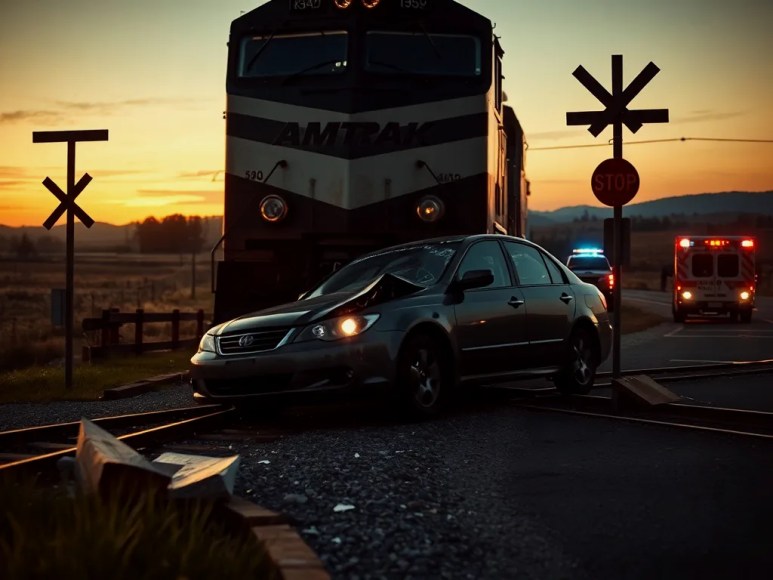
Accident at Grade Crossing
On November 22, 2026, a four‑car Amtrak train struck a stationary automobile at the grade crossing near E Street and South Vulcan Avenue in Encinitas, California. Emergency responders arrived quickly: firefighters and paramedics treated two people who were in the car. Approximately 190 passengers were aboard the train; no injuries were reported among them. Local agencies—San Diego County Sheriff’s Office and the North County Transit District (NCTD)—opened an immediate investigation into the circumstances that left the vehicle halted on the tracks while crossing gates were down.
What Happened and Why the Vehicle Was on the Tracks
Initial accounts indicate the automobile came to rest on the rail corridor while the crossing protection—gates and warning lights—was active. Possible contributing scenarios investigators will examine include mechanical failure, driver misjudgment, traffic queuing, or a medical event. Investigation steps to resolve causation include timing analysis of gate activation etc. vehicle position, onboard camera and signal data review, and witness interviews. A precise determination will depend on recovered data from the train’s event recorder and any surveillance or bystander video.
Immediate Operational Impacts: COASTER and Pacific Surfliner Service
After the collision, COASTER commuter operations between Oceanside Transit Center and Solana Beach were suspended temporarily. Replacement BREEZE buses covered select routes while track inspections, debris removal, and accident documentation proceeded. Amtrak’s Pacific Surfliner service along the LOSSAN (Los Angeles–San Diego–San Luis Obispo) corridor also experienced delays and cancellations; LOSSAN is a high‑frequency passenger corridor handling roughly 50 weekday passenger trains and four freight trains per the city planning data cited in January 2026 documents.
How Transit Agencies Manage Post‑Collision Response
Standard response protocols unfolded: secure the scene, attend to casualties, protect evidence, and restore safe rail operations. Track inspectors conducted rail and signal integrity checks before authorizing movement. NCTD coordinated with Caltrans, local law enforcement, and Amtrak operations control to reroute or substitute transit services. These coordinated actions reduce prolonged service disruptions and address passenger welfare and community safety.
Safety Upgrades Planned for the Crossing
Encinitas’ Quiet Zone and Rail Corridor projects highlight planned infrastructure upgrades at the E Street grade crossing. Proposed measures include additional barrier arms, enhanced warning lights, improved traffic signal interlocks, and dedicated pedestrian channeling to lower conflict points. The municipality’s January 2026 timeline aimed to complete FRA and CPUC approvals and design work by the end of 2026; Construction scheduling remained undetermined. Implementing multi‑layer countermeasures—engineering, enforcement, and education—reduces the likelihood of similar incidents.
What Investigators Will Look For: Step‑by‑Step Evidence Collection
Investigators typically progress through a defined checklist: 1) secure and document scene with photographs and measurements; 2) download train event data recorder (speed, horn use, brake commands); 3) extract signal system logs and crossing gate timing; 4) obtain vehicle telematics or cellphone data where available; 5) interview operator, passengers, witnesses, and first responders; 6) inspect vehicle mechanical condition and roadway geometry; 7) evaluate visibility, lighting, and signage; 8) Compile findings into a causal analysis and safety recommendations. Each step produces discrete evidence that narrows the probable cause and supports mitigation actions.
Data, Examples, and Comparable Incidents
Grade crossing collisions routinely involve a small subset of crossings with complex traffic patterns or constrained roadway geometry. For example, studies show collisions decline significantly when four‑quadrant gates or median barriers prevent vehicles from driving around lowered gates. In California, targeted investments at high‑risk crossings have reduced incidents by measurable percentages where engineering treatments were fully implemented. Applying those lessons to E Street—such as installing four‑quadrant gates and priority intersection signaling—can change driver behavior and reduce entrapment risk.
Service Recovery and Rider Guidance
Transit agencies followed post‑accident recovery protocols: complete safety inspections, certify track integrity, and gradually resume scheduled services. Riders affected by cancellations typically received notifications via agency websites, real‑time apps, and station staff, and were offered alternative BREEZE bus service where available. Passengers should check official NCTD and Amtrak channels for the latest status, refunds, and rebooking instructions following corridor disruptions.
What Residents and Drivers Should Know Now
Residents near the corridor and drivers using the E Street crossing can expect intensified safety work and possible localized lane and traffic control during upgrades. Recommended precautions while projects proceed include obeying crossing signals at all times, avoiding the temptation to circumvent gates, allowing extra travel time, and reporting any near‑misses or malfunctioning equipment to local transit authorities to ensure timely maintenance and correction.
Next Steps and Timeline for Final Findings
Investigative agencies will continue evidence collection and analysis; Preliminary findings often emerge within days to weeks, while final reports can take months depending on data complexity. The city’s planned design approvals target late‑2026 completion; Construction scheduling will depend on funding, permitting, and contractor availability. The final investigative report will determine blame, propose remedial actions, and inform whether regulatory or enforcement changes are needed to prevent recurrence.
Note: The cover image associated with this article was generated using artificial intelligence and is a representative illustration; it does not show the actual accident scene.